Sunday, 21 February 2021

Blue or green?


At first glance, seeing this photo might make you a little excited at the prospect of a 351S model being available. The blue shade looks about right and, even though it's not in great condition, you may be tempted to investigate if this were shown in a sale catalogue or auction listing.


Then take a look at this one. I would find it difficult to resist buying this one as it looks very much like it could be the scarce shade of green found for a short time in the early Agricultural Gift Sets with an all-yellow platform trailer.


The extraordinary thing is that they are all the same model! It is a very ordinary deep green 438! I have not doctored the photos. Apart from being reduced in dimensions, they are straight from my camera, taken in daylight, although admittedly February daylight and I had a light on in the room on the ceiling above them.

This really does demonstrate how careful we must be or, at least, how we must be prepared for disappointment! The difference is quite remarkable and the model sitting on the desk in front of me as I write looks quite normal and obviously deep green.

Maybe it is just my eyes, the effect of other items nearby or just my brain wanting to see something that it is looking for! Perhaps you see no particular problem and don't really understand why I am writing this. But if you are in any way like me then I am afraid that we will each need to ask sellers for some alternative photos, ideally taken next to some other model but, as that's a lot to ask for something that is probably going for about £10, we shall simply continue to take chances and hope!

This was actually one of two models I bought a few days ago after staring at the screen for ages. I even downloaded the seller's photo of the models and ran it through some editing software to try and determine what the 'natural' colours might have been. That indicated that they were even more definitely blue! Indeed, I had to reassure myself that they weren't rather dirty examples of the Pony Club edition!

The pair did only cost £10. And that included postage. I didn't expect much. I didn't get much. Just two deep green 438 Land Rovers. One as above that is complete and, being all original, might get me my money back. The other I have made into something else - just for fun!


Saturday, 6 February 2021

Creamy stars and window frames. 500 or 357?

I have wondered how to distinguish between a 500 US Army Land Rover and a 357 Land Rover Weapons Carrier for a long time and had almost given up. My research into the 351S models, however, may have provided an answer at last. 


There are three models to collect, the November 1963 issue, all of which are believed to have gone to the States and numbered 500 in no-pictorial boxes and two 357 models from January 1965. The 357 may have either a lemon or red interior.


There are also distinct paints used on the 357 - a light khaki with a matt finish and a deeper shade with a satin, or much more shiny finish. It is always difficult to be sure about the canopies actually issued as they all get swapped around over the years but I believe they all had a similar mid-shade of khaki canopy and not the deep green type which appears to have been transferred rather more recently from a 438 issue with that colour.


The difference would appear to be in the perspex unit used for the windows. On the more recent 357 models it is a smooth unit and so there will be a sort of indent at the rear window.


On the 500, the window unit has a raised section which fits into the space for the rear window making a flush surface at the rear of the cab.

This can also produce a sort of 'frame' in the perspex when viewed from some angles.

The stars also seem to be a much creamier colour, all my 357 models having decidedly white stars.


Until yesterday, I had never taken off the canopies on the two original boxed models that I have had for many years and so had not noticed this difference.

Now, I cannot say that this is a definitive conclusion to the matter. It is possible, perhaps, that this particular type of window unit was being used for early 357 models too. However, models that I have of other Land Rovers, where I can be pretty sure of a purchase date prior to 1965, have the plain unit / indented rear window. The only Land Rover produced at around the same time as the 357 Weapons Carrier would be the 477 Breakdown Truck. Should all these prove to have the later style unit then that would further strengthen the case, as would, indeed, the 417S modes with a type 2 jib, although, with the longer span of production, I guess there may be examples of the 417S with the type 2 jib but early unit. That I shall investigate further but, for now, I am content to use this to distinguish the two.

This is important because if you thought the 351S was rare with its mere 25000 sales then the 500 will be considerably scarcer with just 17000 said to have been sold and most, if not all, of them exported. So if you have a matt, light khaki finish, lemon seats and a frame in the perspex rear window with cream rather than white stars on the bonnet and doors then you're most likely to have a 500.


Thursday, 4 February 2021

A sweeter flavour gold for the James Bond Aston Martin


February is looking good with another valuable arrival this month. This is a late edition of the iconic James Bond Aston Martin in a non-metallic finish which is termed toffee gold in various publications. It is certainly quite different to the metallic finish, which itself comes in a few shades, but there are two further features that distinguish this one. Firstly, it has a brighter red interior and, secondly, the underside of the ejector roof has a matt, plastic-looking finish.


The bullet shield on these versions is also often a dark, almost black metal in contrast to the normal lighter metal colour.


This particular example seems to be in first class condition all round with all the features working and very minimal signs of wear, just a small chip and scuff mark on the roof and a feint rubbing mark on the top of the windscreen, visible only from some angles.

These seldom appear on the market. In an original box they're worth about £750. I'll try and find an original box but in the meantime it will be available with a first class reproduction box which also contains all the correct goodies at £300. There is another currently advertised at this price but with 'economy' postage of £13! It also has a suspicious problem with the ejector seat. 

As this gold colour is comparatively easy to find, you do need to beware of people who rebuild these. Some specialists do a super job but they will be highly unlikely to have the correct interior or roof so watch out for toffee coloured examples with the same colour on the roof underside and the original darker red interior.


These two illustrations are from a QDT blog on this issue.

Wednesday, 3 February 2021

351S RAF Land Rover discoveries


The 351S RAF Land Rover with suspension and interior is a rare model. Of all the Corgi Toy issues from this era, I have found this one the most difficult to find anywhere and at any price. It just doesn't appear. You'll see 'Pop Art' Minis and the yellow 406S Land Rover and other scarce items quite regularly but this one just never seems to be in anyone's box of toys to be sold. The books tell us that 25000 of these were sold. That's not a lot by Corgi standards. The not particularly common RAC Land Rover issued at the same time is said to have sold 207000. It is still a lot more than the Rocket Age Gift Set 6 (10,000) and even the Golden Guinea Gift Set 20 (23000), each of which are definitely easier to find, the latter particularly so.

The books tell us that this was issued in December 1962 but also withdrawn in 1962 so I can only assume that either a huge crate of these went somewhere never to return at the start of production or that the data we've been given is wrong. Suffice it to say that a original example of a 351S in almost any condition is a valuable item now.

I have accumulated four examples and finally believe that I have at least one, possibly two originals. I shall look at each one in turn but I'll start with comparing the colours of those I have.


Often you will find that a seller's camera produces quite different shades to what you will see yourself in daylight. I have even had trouble distinguishing the deep green 438, also issued in December 1962, from a possible dark blue colour and have even bought a few hoping they might be RAF blue only to discover they were a rather non-RAF deep green!

As you'll see above, my first acquisition, the model on the left was a blue colour closer to the RAC blue than RAF blue. The two centre ones look the right colour but then so does the one on the right. So colour, especially if you only have one to look at, doesn't help as much as you might hope.

I will now look at each in turn.

First, here is the one of the right in the photo above and I can say straightaway that it is a repainted model. It has been done very well, though, with quite a reasonable job of some aged-looking rivets that are possibly correct front and back.


Although I was unaware of this at the time, however, the rear window is a different casting, with quite a distinct angle to the vertical parts of the frame and the window itself is inset, the window unit being flat perspex only.


It is a nice-looking reproduction, however, although not adding silver to the radiator or bumper is a surprising omission by what would seem to be an accomplished person. The previous 351 model only had a roundel on the front so I think adding one to the rear may also have been a mistake here. The roundels on all of the others that I have, by the way, are mine and not great but I thought they should be there.


The second is, I think, the genuine article.


The rivets look original and real and the paint colour is good and consistent under the wheel arches. In particular, the rear window sits flush with the outside of the cab and the frame lacks the angle of the previous example. This would seem to imply that, for the 351S, a window unit that had a raised profile to fit the rear window space was used. I have just checked some other Land Rovers and found that I have a 416S with the same flush fitting as well as one 438 model. That is a new discovery for me and I will have to return to this subject in a future article!


I think it is fair to conclude, though, that a genuine 351S will have to have this flush window and that might help you in your deliberations. This particular example lacks a piece of the hook and has obvious playwear but it is sound and I am pleased to have it.


Here is another that I think is original (apart from my roundel!). It has pretty solid rivets which I don't think anyone could have replaced like that and, if they had, I am pretty sure they would have added the hook that is missing!


The colour under the wheel arches and beneath the front bumper is consistent too. The rear window is also flush. I was a little put off by the silver splashes under the font bumper but I am content that this one is good.


Like the other original, this one has had a hard life and lost a lot of paint but it's real and worth a fortune.


The last one to illustrate here is, in fact, the first one I acquired some years ago.


I had nothing to compare it with the and, although the colour did seem a bit 'blue' I was hopeful that it would be an original. Underneath, the rivets looked very original and secure and certainly did not seem to have been tampered with in any away. The colour was consistent too under the wheel arches and near the front bumper.

I was concerned, however, by the splash of paint on the base itself which was a worrying sign that some owner might have been in the habit of adding paint and more so by the extra silver paint that seems to have been marked near the bumper.


The tyres, of course, I knew were incorrect but they do suit the model and I was not too bothered about someone having changed them and so I have left them in place. The rear window on this one was completely missing, though! That was odd. I suppose it is possible to break and then remove the bits but not that easy to make a clean job of it. This means I cannot test whether it meets the new 'flush' requirements but the frame is in keeping with an original 351S style.


So I don't know what to make of this one. the colour is quite different but it really does not appear to have been taken apart and repainted. It will, I guess, remain a mystery! The most likely explanation is that it is a production sample. I had had a few of these for other models and they often do have splashes of paint here or there.

I shall probably put the two originals on sale but the price will be high, I'm afraid. Maybe if I find a few more I be more generous but if you want one now I feel they have to be at least £400 and I will have to hang on to the mystery one as I can't sell it with confidence as one or the the other. The reproduction is worth about £50, consistent with what I have found collectors have been happy to pay for the 322 International Rally Rover 2000 models that I've made with the correct wheels (but the normal 322 body).

I shall write more about the 'flush window' later. Maybe that will finally provide a way to distinguish 500 from 357?!

Tuesday, 2 February 2021

Warning: this purchase may contain hidden costs!


This is the bill for over €50 that a customer had to pay in Belgium before he could have a Rover 2000 Monte Carlo delivered.

The car had cost him about €95 with €15 postage, €110 or thereabouts in total. This additional fee, therefore, represents almost 50% of that price and, understandably, he is at a loss to understand why it is so high.

It would appear that there are two elements to the charge; duty, similar to UK VAT of €26.86 and what are described as formalities of €24. Neither if these figures makes a great deal of sense to me. I shall have to assume that formalities are something along the lines of a standard service charge but that is excessive, surely? I have had to pay such charges on items I have imported in the past but that element has always been comparatively modest, a matter of a few pounds.

The VAT rate in Belgium is 21%. So €26.86 would be 21% of €127.90.

The total price of the Rover model was £98 including postage which implies an exchange rate being used of £1 = €0.77. The rate is low at the moment but not that low! On the 28 January it was £1 = €0.88 so that element of the charge made also seems high.

Clearly there is not a lot anyone can do now and this does work both ways insofar as UK buyers will be paying quite a lot extra to receive goods from EU sellers but I have suggested that my customer query the bill anyway. I feel that I shall have to warn new customers who buy items for delivery not only to Belgium but other EU countries too. I would like to be able to estimate their additional charges so that they know what they're letting themselves in for but I doubt that I will be able to estimate the fee and, indeed, if every firm is going to charge the same sort of rate as the Belgians then I simply won't have many EU customers.

This is of some considerable concern as a good 30% of my sales go to EU countries. Additional costs of around 50% - and this illustration is quite a typical sale, value-wise - are simply not acceptable and I am unable to reduce my prices sufficiently to offset those amounts. I might consider sharing the VAT element with customers for a period but not if my gesture is going to be dwarfed by their administration costs.

I would be interested to know of others' experiences, both in sending items or receiving them and to be able to have some clarification, if that is possible, of what to expect in other countries.


Monday, 1 February 2021

Corgi Toys @ 60 : Ford Zephyr, a Jeep and Lamp Standards

February 1961 brings two new models to the shop windows. Each is a re-working of an existing model, though, but sufficiently different to be interesting still,

The first is the Jeep FC-150, first issued in 1959 and now bearing a hydraulic tower which can be raised so that the workman included in the box can access the light unit in a lamp standard, also included in the box. Sold as Gift Set 14 this stayed in the catalogue until 1964, replaced by a metallic green edition in 1965 but without the man and the lamp standard is also dropped as it gets a new catalogue number 478.

This model can be found with all three variations of wheel type - smooth, shaped fixed and free-spinning - the last being quite rare and, possibly one of the very few models where free-spinning wheels were fitted without suspension or interior. The Gift Set 14 edition is always red.


The other release was the Ford Zephyr in its estate mode. 1960 had seen the Police version, this is the one you might have seen in a neighbour's drive. It is always two-tone, pale blue and a deep blue, with an interior and suspension and has the same range of wheels as the Jeep, smooth, shaped fixed and the free-spinning wheels fitted to the last models produced. This model had a longer run than the Jeep (without suspension) and so the three types of wheel are fairly evenly spread.

You'll find it with both a lemon and red interiors.


Saturday, 2 January 2021

Corgi Toys @ 60: Another Mini, an Ambulance and a Cage on wheels


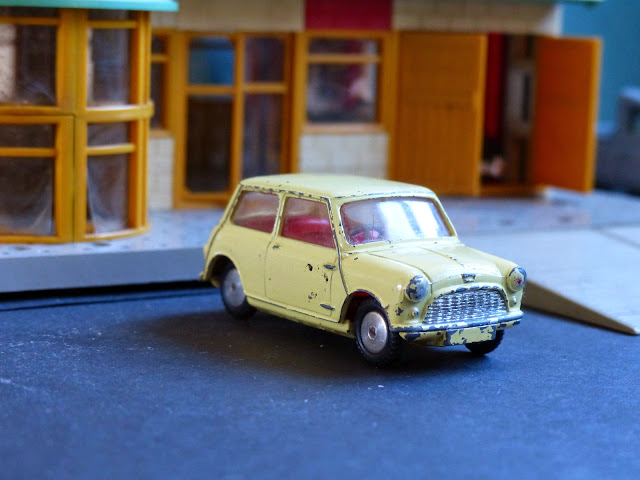
January 1961 sees the arrival of the second Mini, the Austin Seven, or Se7en as the box displays. Identical to the Morris from the previous year but with the Austin style of grille and an Austin badge on the bonnet, this came in red or primrose yellow and will have had smooth, fixed wheels at the outset.


Later there will be several changes to the casting, the the body and the base changing quite substantially. The interiors, as for the Morris will be red or yellow plastic. I have encountered several primrose editions that appear to have been issued without any suspension wires being fitted but the suspension seems to be sound on all the red ones.


Also issued this month was the last of the Bedford CA vans, here in khaki as the Military Ambulance edition which will have first has smooth fixed wheels and quite shortly after issue getting the shaped wheels as above. This is, of course, the Mk II single screen edition, although there is also a MkII version of the 412 St John's Ambulance too. That doesn't appear to be feaured in issue lists to dealers, it just sort of comes out at some time in 1960.


Finally, the start of 1961 sees the issue of individually boxed Animal Cages, the second Chipperfields Circus model, following the Circus Crane Truck issued a few months earlier. You really did need to have that truck, though, as nothing else was particularly well-suited to pull these trucks along and so soon you'll see a Gift set with the two sold together.

With the cage were two animals to fit inside. The first editions had two lions and two polar bears included with transfers for each. Early editions had fixed smooth wheels and metal sliding doors at each end and a divider in the middle. Later these became plastic and fixed shaped wheels would be fitted quite soon after issue too.