Showing posts with label Rover 2000. Show all posts

Tuesday, 8 July 2025

Sometimes you get a pleasant surprise

 Whilst I am only too fully aware of the number of models sold on Ebay which are far from what they seem and have descriptions which, even those written by AI, veer markedly from the truth, I do sometimes strike lucky. I bought those illustrated below plus a couple of other Corgis for £30. They did look a bit dirty and the photos provided weren't very well-focussed but I was happy to pay a lot more for just one of them - what looked like a lovely example of a #322 Rover 2000 Monte Carlo, one of my favourite models.


It has two or three small marks to the paintwork but none in obvious places and is totally original. No one has attempted to repaint the roof and it has the correct original decals with that slightly unusual font which most dealers supplying replacements get wrong. And the rear window isn't cracked where the Trans-o-lite system joins. Amazing! Prior to starting the catalogue and my Corgi business I had always kept my own Rover model on a shelf or on my desk at an office for many many years. It was one of the first models that I searched for in 2013 because my own model had disappeared. I did need one now for a Gift Set 38 I am building to take advantage of a reasonable reproduction box that has come my way but I tend to buy these when they're at reasonable prices anyway. It must be something about the colour and I do love jewelled headlamps and, of course, the super Trans-o-lite double headlamps.


In the group was this little #328 Monte Carlo Hillman Imp. Now I did expect this to arrive with something wrong, most probably broken suspension which these Imps so often suffer from. However, apart from some flat spots on the tyres, which were rock hard and have now been replaced, and some wear to the decals on the sides, this is a super little example. It is also the version with a yellow interior whereas most I've had have been white.


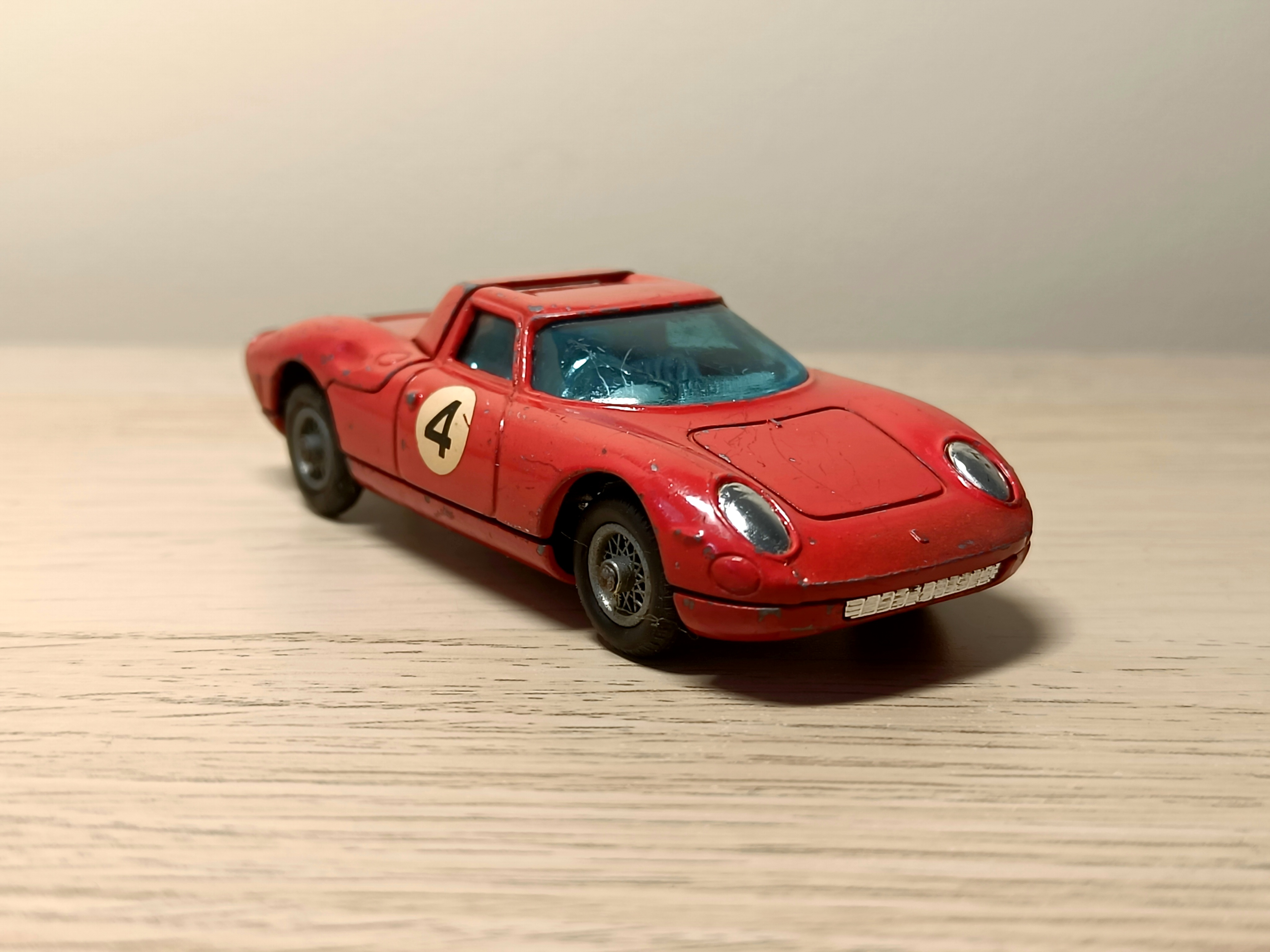
The #314 that was in the group is not a model I like very much and they all do seem to be very cheap and plentiful so the £5 I effectively paid for this one isn't quite so much of a bargain and I probably won't sell it for ages and even then at only £10 if I'm lucky. It's clean, though, and just missing the Ferrari transfer and a RN4 on one side. Unlike the other two I have at the moment, this one does have both exhausts! They seem to break very easily, being thin pieces of chrome-plated plastic and a little vulnerable at the rear. I know of only two variations for this model and that is in the lines on the base. Early models have two simple parallel lines. Later models have an angled section at the rear end of each line. This was around for such a long time that there may well be other differences that emerged with time but I have yet to know about any. I do notice different RN transfers - colour and style of numeral but wonder that these may just be poor reproductions.


Another model I have managed to avoid having for many years is this #151A, the second outing for the rather bland-looking Lotus Mark 11. The first edition from 1958 was a little interesting in that there are some scarce colours like red and silver to discover but for this one it's just smooth or shaped wheels and RN3 or 7. This one does have a driver although I am not sure it's the correct character as he appears to be much too high above the screen. Having said that, the Simon Templar father-figure in the #215S Thunderbird would suffer at any speed as he sits several inches above the top of the screen in that car too.

I am quite happy to have this, though, as it is very clean, all original and a colleague in Australia sent me a sample reproduction box in return for my assistance with design and dimensions for it. His work is excellent, rather better than some we may be more familiar with and I can now sell this model with his box, which has been lying around for a couple of years at least. 

I am also most relieved that the tyres are OK on this one. I have no idea how anyone can change them!

I shall not bother to bore you with photos of the other two models, for which £5 was probably about the right price to pay if I am going to get any profit at all from them. One was a #309 Aston Martin Competition, a late model with the small, closed vent. The paintwork was not good, though, showing a lot of playwear so it could be something someone might wish to restore. The only other fault is a small scratch on the front screen so I really don't want to break it apart as the decals, suspension, wheels are all sound and, despite being well worn, it is still all original. So someone might like it for a few pounds.

The other was a #155 Lotus-Climax Racing Car. It looked great, with a driver and suspension is intact and the paintwork very good. Unfortunately, though, it has lost the twin chrome exhausts. It does look an easy repair and one that ought to be worth doing as the end product will be a lot better than some restoration repaint. There's no need to break it so perhaps that'll appeal for a few pounds too.

This article was just about some of the every day models we see come and go and to share how sometimes you can do well on Ebay. The site is much-criticised and some people seem to want to avoid Ebay like the plague but I don't have a lot of trouble there. The costs of selling are high but it is the only site which I feel reaches a large enough audience of people who are interested in what I have to sell. I would much rather everyone buys from my own store, where I do get to keep a lot more of the proceeds and, accordingly, list products at lower prices, but it's simply not anything like as well-publicised.

You do have to be careful - and I feel sorry for whoever bought a fawn-coloured 'Pre-production sample' of a #241 Ghia L6.4 this week for £166. I did write to the seller when I first saw it to say that he would be disappointing a buyer as there were several signs that this was most definitely not a pre-production sample but merely something someone had repainted and screwed back together. The seller maintained that the screw was the same type as another that had been illustrated, possibly in the Great Book of Corgi, of a factory sample of a Ghia Mangusta 5000 De Tomaso and even included that illustration in his listing. The two screws were quite obviously different and, whilst I doubt Corgi had any 'standard screws' for holding models together anyway, I am sure that a pre-production sample, which would be from 1962/3 would not be identical to a 1968/9 one for the later Ghia!

I have had many genuine colour trials and factory samples and they have rarely been screwed together. The base is either riveted as per a normal issue or where the model is very much something being worked on and a very early sample, the base is held on by elastic bands. Screws may have been used sometimes and I am sure some people will have genuine examples but that badly-painted brown Ghia was not good. Unfortunately, now that it has achieved that price once this will be used by someone to justify another high price next time it appears on the market and, much as we may criticise Ebay sellers, there are plenty of similarly inaccurate descriptions at all the major auction houses where I suspect this will finish up one day at £400.

But that is all another story. For now I just wished to share you some of the nice surprises that can be found on Ebay.

Saturday, 1 March 2025

Corgi Toys @ 60: Nine new releases for March 1965!

 I don't think there will have been many children getting all the new issues which March 1965 brought to their local toy shop. There were no less than seven new models and two gift sets this month 60 years ago.

One was the almost iconic Corgi gift set - the Monte Carlo Gift Set of three 1965 rally models.


Record indicate that just 72000 of these were sold, not many for those times, and these sets are extremely expensive now, with prices reaching £1500 or more for a set in its original box. The box may be one of the most expensive pieces of folded cardboard around as the cars can be found individually for around £120 each in unmarked condition so the box adds a massive £1200!

It's an attractive set and features the 321 Mini Cooper which was released in February plus the new Citroën and Rover which were simultaneously released individually his month too.


The Citroën DS19 is catalogue number 323 and is the 210S model with four small jewels as fog lamps and the Monte Carlo decals. Individually it was issued in its own illustrated box. A classic problem with this model has been the aerial which can become brittle and is not easily replaced.


The Rover 2000 is the 252 model with Monte Carlo decals and two jewels added to the grille. The individual models were first issued in a 252 model box with a 'Special Release' label over one end. Later issues had their own illustrated boxes.

Another Mini appears this month in the shape of the Austin Mini Countryman.


I would have dated this rather later than 1965 but it did, indeed, come out this month 60 years ago. This is a substantially revised casting, previously seen as the Minivan and Police Van, now with woodwork and windows and a chrome-plated roof rack and two surf boards. In the box is a young chap in swimming trunks in a position where he neds to be holding the surfboard to avoid looking a bit strange.

It's a nice model and will eventually get cast wheels to replace the first issue's shaped wheels. There is also a little known and seemingly very scarce variation where there is no fuel filler on the rear left wing.


I believe this is a very early edition but have no further information about this.

A commercial vehicle gets revised this month in the shape of the quite ancient Jeep FC-150. First issued in April 1959, the Jeep now gets an interior and suspension as well as a plastic canopy.

There are three initial releases, two in blue and one in a sort of green-beige colour, often referred to as avocado. The blue can be found quite easily with either red or lemon interiors but the avocado version seems to be mostly red, with lemon being a scarce variation.


Later this model will get cast wheels and it stays in the catalogue for many years through to 1972.

The Saint's Volvo P1800 is issued this month too. This is a straightforward adaptation of the July 1962 228 model with the addition of a character at the wheel and a 'Saint' emblem on the bonnet.


Later editions get a red or blue label which covers the whole of the bonnet and has the Saint emblem in white. The red is usually found with cast wheels. The blue label edition is quite scarce. The same body and character will stay in the catalogue until 1972 too, the red label edition getting Whizzwheels and a different interior in 1970 as #201.

The 'Simon Templar' character appears to be the same as the driver inserted in the 215S Ford Thunderbird.

Next we have some models brining us some refreshments. First is a Karrier Van, looking rather old-fashioned now, but with an interior and suspension and a nice 'trans-o-lite' feature that lights up the 'Snack Bar' sign at the front.

You'll find two versions of this - the usual one is Joe's Diner but there's a nice Belgian variation advertising patates frites.


After your snack you might have fancied an ice cream and the next model is the Ford Thames Ice Cream Van in Wall's livery.


You get a model of the ice cream seller and a young lad on a pavement with a 'hopscotch' design. This was a short-lived issue, however, being replaced after just a few months in October by a 'musical' version. The characters and display scene go and instead you get an ugly handle at the back which plays a tune when turned.

Finally for this month, the second issue of the Fordson Tractor is paired with a Beast Carrier in Gift Set 33.
This is the first appearance of the Beast Carrier trailer, which will not be available individually in a box until later in 1965. It comes with four calves on a card straw design in the trailer and a green plastic mesh stretched across the top. There is also a driver on the tractor in this set.

This is quite a scarce set because it gets the new Ford 5000 tractor at the end of 1966 and is renamed Gift Set 1. The Beast Carrier itself is another very long-running model, staying in the catalogue until 1972.


Thursday, 27 February 2025

Simple memories


I just glanced at my desk today and realised how lovely ordinary, not quite perfect, played-with every day Corgi Toys can be. I had been cleaning a few recent arrivals. None would satisfy the purist collector who requires a model to be flawless and, ideally, still in its original box and packing with a membership leaflet too, of course. For me, though, these arrivals are a pleasure to see. I don't know why but perhaps seeing models with signs of wear sparks something in my memory and takes me back to sometime in 1964 when a 12-year-old me would have had these lying around on a layout his dad had helped  build.

In the house where I lived at that time there was what we called a box room. It was about 6 feet square and half the room was occupied by a bedstead. That was almost never used as a bed, however, and instead of a mattress there was a piece of hardboard that fitted across the whole of the bedstead. Onto that I had used strips of masking tape to create road markings, Bayko buildings provided some buildings where I could park some cars and Floral Garden items made everything quite attractive with their trees, walls, fences and paving cards, of which I had a large quantity as they were so useful in making road edges.

The nice thing about this layout was that I didn't have to tidy the cars away every evening. So they survived pretty well with only minor chips from time to time. I did keep quite a few boxes but all the models I liked would usually be out on the layout somewhere.

I remember now how much easier it was to drive the models around where they had free-spinning wheels. My Morris Mini-Minor had these but the Austin Seven had fixed wheels and was much less fun. Now I think about it, the only other models I had with fixed wheels were a Renault Floride and an Austin A40. I had bought the Austin A40 because my dad had one. His was all red and was the 'Countryman' type with an opening window and boot at the back. I didn't know about the Mechanical models and I guess I was too late for these anyway when I started buying Corgis for myself so I had bought the two-tone blue 216 model and used some Massey-Ferguson red paint to try and get closer to my dad's car in appearance. (He worked for an agricultural machinery depot so we always had paint in machinery colours!)

So the Citroën in the picture here would not have been on my layout and I completely missed all the original 1950s issues. My friend Andi in Germany had spotted the Citroën at a very reasonable price and I was lucky to win that one. Both the green / black and yellow / red editions are hard to find in good condition nowadays, the yellow one showing little marks much more obviously than the green. The Citroëns make quite a little collection on their own as you need to find two versions of each - early editions with 'differential' bulges and the later smooth base variety. Then there are the blue-tinted windows and plain windows, probably for each type too. That makes 8 models you need to collect! And you thought that was a simple model in just a couple of colours!

There may even be some variations in the base that someone can tell me about. I seem to recall spotting something (other than the differential or a hole where the revised smooth casting has malfunctioned) but can't recall what now. It may have been that some bases are silver and others grey but I cannot be sure about that.

Somewhat simpler indeed is the E Type Jaguar. As a child I only knew about the red one. I liked this car a lot, much better than the later 335 issue which was annoyingly too big and just didn't look right sat next to the 307. The metallic grey is lovely, though, and I would definitely have been to the shop and bought one had I known at the time. I always found the red plastic top a bit odd and felt it should be black and, of course, you can now buy black replacements which look great. As it was, the top usually was left to one side and I played without it. You could sort of 'get in' with your fingers and drive around that way.

That reminds me of one of my favourites for playing with - the Austin Mini Van. I had two of these and you really could whizz these little cars around like mad, 'driving' them from inside the rear section. You could put things in the back too, although I always wished there had been windows on the rear doors. I think I put some perspex on mine which improved their appearance a bit. I was always impressed that Corgi had put jewels on this lowly van! They made it a bit special.

Back to the E Type, you will find some variations in the intensity of the metallic grey finish, some being quite distinctly black as opposed to grey in my view. The plum red always seems to be pretty much plum red, however. Otherwise I did read some time ago about there being bases with one rivet as opposed to two but I have to say I have not yet managed to find any of the former.

The car most well focussed by my camera is the delightful Chevrolet Sting Ray, here in that gorgeous metallic cerise colour and plain shaped wheels. I know it also looks lovely with the wire wheels but somehow this one always catches my eye and I find them very hard to resist when they come up for sale. Mine as a child was in this lovely shade but I had the wire wheels. The Buick Riviera was the first model to be issued with wire wheels from the start but I have a feeling the Chevrolet may have been the first car we could buy with them if they were fitted before June 1964.

This particular example that I have acquired has lights that look really nice and in line with the front and top edge. Most get loose and never sit quite right. They can also look a bit awkward when open and viewed from the front but this one actually looks fine. I may well hang on to this one in my own collection. Having twin jewelled headlamps was a bit special too. We had had four jewels on the Jaguar Mk X earlier but here we had two full-size side by side. Nice. I did like those jewels and I am very surprised that the Corgi Model Club has been using quite dull plastic instead.

Elsewhere in the picture you'll catch a glimpse of the lovely Rover 2000, the original model in metallic slate-blue. I have written before about this model and the small casting differences in the badge and grille. The colour always seems to be consistent, though, so, apart from the maroon edition and the very scarce cast wheel maroon model, there are not too many to collect of this one. The 'Trans-o-lite' dual headlamps are great and I had no end of enjoyment at night with a torch making beams from the front.

Because the Volkswagen 'Toblerone' Van had completely passed me by I was not aware of these lights until I got the Rover. I must have had some catalogues at the time but I really don't think I spent a lot of time studying them as I simply didn't know about several models. The 253 Mercedes 220SE was a surprise to me when I re-started my collection. I'd always thought there was a blue edition of the 230 model! Something else which I would definitely had bought had I realised it was available was the Oldsmobile Toronado in its first outing as 264 in super metallic blue and almost pure white interior. It didn't do much but looked wonderful and is another I find hard to resist now.

On the subject of Oldsmobiles the last models in the picture are a pair of 235s, one in the more familiar metallic slate-blue (very similar to the Rover colour) and the solid sky blue colour. I didn't have these as a child but would have been very happy had someone bought one for me. They're very simple - and you only need the two for a complete collection - and they're nice to drive around. One of the problems with the Jaguar Mk X and Ford Consul Classic was that their bonnets often opened when you hit the brakes! The Jaguar was hard work driving around corners too. I had one in a terrible shade of pale green which I was never particularly happy with (although I would be very glad to have one in that rarer shade now!) and, as soon as I found the new metallic cerise shade in my local shop, I bought a replacement for the chipped model I had on the layout. Again, I had no idea just how many different finishes that model was produced in. It's probably just as well as my earnings from helping out at a local farm and a bit of lawn-mowing probably wouldn't have been enough. By 1966 it would be records that I spent my money on too, or tapes on which to record tracks from the radio. 

So forgive me for my simple memories from some very ordinary models rather than writing about some exciting new discovery or variation. In a couple of days it'll be March and I'll have nine issues to tell you about so that'll keep me busy tomorrow!


Thursday, 4 July 2024

Late model differences


A 413 Mobile Butchers Shop came this week and prompted me to write about the small but important differences that you may find in models issued at the very end of their production period. The Karrier is a great example as it must have looked so dated on the shelves in 1964 and to discover that there was actually one of these old things with suspension was quite a surprise a year or so ago when I first found one. I now see that there is a reference to 413S in some Corgi documents although the boxes still read 413. This is certainly a rarity.


Another scarce one is this 210S Citroën DS19. It seems that Corgi decided to continue to produce these after having adjusted the casting for the 1965 Monte Carlo version to provide holes for the four small jewelled fog lamps. Instead of fitting jewels, though, we get some bright metal blobs instead. I have seen these fetch £150 or more at auctions but they do seem to appear regularly and maybe are not as scarce as I had originally thought. I now have four in stock although this latest addition is by far the best. Interestingly, only these models with the fog lamps have free-spinning wheels.


Free-spinning wheels are the difference on this late edition 223 Chevrolet Impala. It was a popular model, the very first Impala issued, in fact. and stayed in production for a long time before being sliced in half for the MkII version. Shortly before that some models got free-spinning wheels fitted but these are not at all as common as you might expect.


Corgi started fitting the shaped wheel in place of the smooth wheel in 1961 and some of the later editions of the 207 Standard Vanguard had them fitted. They also made another change that people may not have noticed, however, and that was in how the red paint now only covered the roof, not the pillars. Although shaped fixed wheels are less common on many models from this period (205, 209, 213, 214, 215 and 216 can be found, and 210 is common) only the 207 had this additional change.


Whilst late Buick Rivieras with cast wheels in metallic blue are quite common, and you find a few gold versions too, the pale blue Buick with cast wheels is very rare.


Wheels, again, are the thing to look for on the innocent and ancient-looking Jeep FC-150. This long-running model first appeared with fixed smooth wheels and the vast majority that you'll come across will have fixed wheels of one type or the other. Very few do exist, though, with free-spinning wheels and are worth picking up when you do see them as it is not something that sellers will realise is rare at all.


The penultimate one for now is the maroon Rover 2000 with cast wheels. Together with the equally rare gold Hillman Imp with cast wheels, it was produced for a Car Transporter Gift Set 41/48 which also featured the more common grey Ford Cortina Estate, Morris Mini Minor and Mini-Coopers all with cast wheels. Incidentally, a blue Cortina with cast wheels is also a desirable model.


Here is the Hillman Imp, which I had omitted from the article when first published.

There are, of course, many more models I could write about in a similar vein. I may return to this topic in another post. If you have any particularly interesting and rare late variations do let me know.

Friday, 10 May 2024

Corgi Model Club: 275 Rover 2000TC


This is the latest issue from the Corgi Model Club and their first Golden Jacks issue.


They have chosen the common metallic green edition with a tan interior, the one that most of us would remember, although I have a suspicion that we'll be seeing a white version next year.


The first thing I noticed when it arrived was how shiny and bright the wheels are. I really don't remember mine ever being that clean and bright but that may just be my memory. Now, of course, the cast material used on the originals has invariably turned dull and grey. Maybe collectors will be swapping these new wheels for their old ones!


The second thing you'll quickly notice is the continued use of plastic instead of glass for the 'jewelled' headlamps. Yes, they look neat and the colour's pretty accurate but they're no substitute for the original type and I can't imagine the cost would be dramatically more.


The spare wheel holder on the boot lid is excellent, with a satisfying click when you close it. I shall not be opening and closing mine often, though, as I expect it will be as vulnerable as the original to crack and break after a lot of use. That's entirely understandable, by the way, and not a criticism of the new issue.


Here you can compare the two. I only have one with the red interior but it is still, in all other respects, a fair comparison. At the front we have mentioned the headlamps. Otherwise it is very good, maybe with slightly fatter side lights and the new model has a better defined TC logo/


Other than the obviously brighter wheel material, there is no discernible difference in the side view.


At the rear too, everything looks great, even the design of the spare wheel cover device.


The paintwork on the new issue is more 'grainy' than the original and has a somewhat brighter green appearance.


I haven't checked but this may be the first re-issue with the later tyre design. This has been replicated really well and will be another useful spare that this model provides!


Saturday, 13 April 2024

Rover 2000 variations

Well, I seem to learn something every day! I have just noticed, after more years of collecting Corgi Toys than many people have been alive, that there are two types of window in the Rover 2000. So far, I have only seen the two varieties on the steel blue 252 model but I expect we'll discover it on the maroon edition and, perhaps, the Monte Carlo 322 model. I shall now have to check all my models and hope the photos I have taken of others over the years are good enough to show me the difference.


The difference is in the window unit which has a line included to indicate where there would have been separate panes in the real model. The Austin A40 had this to indicate what was then described as a quarter light at the front. I remember that there are two types of 230 Mercedes 220SE Coupé too but this is the first time I've noticed it on the Rover 2000.

Then I looked at the two Rovers more closely and discovered two badge styles and slightly different front grilles too!


The top is the 252 model without window unit lines and has a different shape of badge to the second model as well as slight difference in how the grille lines have been dealt with. I also took a look at a 322 model and find another variation here with a much less well-defined badge. (you can also see a surprisingly poor alignment of the additional jewelled lights! I remember being very annoyed with myself when I made a similar error when drilling holes in a 252 to make a reproduction 322 International Rally model but maybe I should not have worried as this happens on the genuine models after all!)

So, as well as window lines we also now need to look at the badges! I had not expected to need two steel blue 252s in my catalogue. I was prepared for a colour difference as some do seem to be blue-silver and others more silver-blue but so far I have been unable to have two different shades side by side so I may be imagining that.

So far, all my 322 models and the maroon 252s with cast wheels have had the lines in the window units. I have not checked the badges but will update this another day on that topic.

Sunday, 1 October 2023

Corgi Toys @ 60: Rover 2000

 It's October 1963 and you need to rush down to your local toy shop to buy the wonderful Rover 2000.


This was the first saloon car to get Trans-o-lite headlamps, and we got twin headlamps too! This system had been used in the VW Toblerone van and Commer Pick-up where an opening on the roof did not look odd and the tubes could be easily hidden. With the Rover, Corgi incorporated the input as a section of the rear screen.


The lights were great and, for many who did not get the van or pick-up truck, this was the first model where they experimented in the dark with a torch and flashed the lights quite realistically.


The rear screen was somewhat weakened by the need for a rectangular element to be fitted and now you'll find many models with small cracks around the area where the light enters.

The Rovers in a 252 box were mostly a metallic steel blue colour with a red interior but there was also a maroon edition with a white interior. This was issued quite a lot later and first seen in the December 1966 Car Transporter Gift Set 48/41.


A very scarce maroon edition also exists with cast wheels, produced for late issues of the Gift Sets.


A gold-plated 252 model was made in very limited numbers, some, but not all, being attached to the lid of a cigarette box and distributed to selected Rover customers and senior executives. 


Sunday, 27 June 2021

Time to go: a few surplus items from my own collection

For some reason there are quite a lot of models that have accumulated in drawers or boxes but never made it into my store as they have mostly been part of my own collection over the years. In a big 'administrative tidying-up operation' I shall try to ensure that everything gets featured and here are the first few that I have found.


A late edition of the 218 Aston Martin with free spinning wheels and closed vent.


An unusual variation of the Plymouth Sports Suburban - with a cream colour base instead of grey.


A late edition of the 222 Renault Floride with free spinning wheels in metallic blue and red interior.


A factory error that has put a 227 Morris Mini-Cooper base on a 225 Austin seven body!


Nothing unusual about this one - just a very, very nice example of the delightful early 252 Rover 2000 in light silver-blue.

These are all now available in my store if anyone is interested.