Showing posts with label spoked. Show all posts

Thursday, 5 March 2020

The mysterious Aston Martin Competition model


Look through the 1965 Corgi Toy Catalogue and on page 12 you'll see the 309 Aston Martin Competition model with spoked wheels


This was an update on the 1963 catalogue in which the illustration showed normal shaped wheels. The little red book that was issued with The Great Book of Corgi (1st Edition) also lists this quite specifically with an issue date of December 1964.

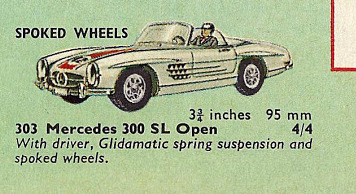
The same catalogue and leaflet also show the 303S and 304S Mercedes 300SL models getting the same treatment. For a long time I had assumed that this referred to the issue of the Mercedes cars with cast wheels with a louvre pattern of the same type found on other models. I had seena  few of those. Then I discovered genuine original examples of the Mercedes with 'spoked' (wire) wheels and had to accept that they did exist, eventually owning both.

The Aston Martin, however, remains, in my opinion, one of the scarcest models of all if, indeed, it does actually exist. The date for sales ending is shown as 1965 so a December 1964 release would imply low numbers anyway. We know that the Mercedes are few and far between. I have encountered three so far in about 7 years and that includes many views of Vectis and QDT auction lists. I have neither seen nor heard of the Aston Martin and that intrigues me.

Fitting wire wheels (as I call them) makes so much sense and I have always though that they would look fabulous on the model. Eventually I found a late issue 309 (with the closed vent) that was in reasonably good condition and available at a reasonable price too and have used this to make a copy of that elusive holy grail of a model. 

The wheels are from a Ferrari Berlinetta of similar vintage and the axles are as fitted to the original Aston Martin model. Removing the shaped wheel was quite hard work and required a bit of patience to file down the ends of the axles without damaging the paintwork but otherwise replacement was a pretty simple job.

This will now take a prominent position in a cabinet at home until either a real one does actually appear at a price I can afford, (or persuade myself that I can afford!) or until someone pays the very silly price that I shall ask for this one. Hopefully the promotion of it will encourage more people to have a look through my catalogue and stock and buy something or, often equally valuable, bring me some useful background information or technical knowledge.


Friday, 15 February 2019

Mercedes-Benz 300SL in gold with wire wheels


In a photo of big, blue plastic container full of old toys at an auction house somewhere in Brighton I spotted a Mercedes 300SL. On its side. It was the only one on its side and had it not been there and in that position I would not have realised that here was an example of the very rare 303S with wire wheels. The next problem was bidding enough to win it. There were ten or so decent-looking Corgis in the box and maybe twenty other models that I didn't recognise and a bag of catalogues or leaflets.

I was lucky. No-one else seems to have noticed it or considered it of much value. It was, fortunately too, one of those quite general auctions and these were the only vintage model cars appearing so it doesn't appear to have attracted the interest of dealers or wealthy Corgi collectors.

This is, indeed, quite a find. You may remember that some years ago I had wondered aloud whether these actually existed. The entry in the Corgi Catalogue of 1965 I had thought, at one point, referred to the model they brought out with cast spoke-effect wheels. Then I spotted a 304S at a dealer and began to search in earnest. I failed to find anything and finished up making my own!

This particular model is not just a rare one with those wheels, though, but also produced in the gold mirror finish which is quite different to the silver edition. This makes it even scarcer and I really do not expect to see another any time soon. The silver 304S sold for around £400. This one, I feel, should be worth a lot more. It is not in perfect condition but the windscreen is sound and there are only tiny marks to the bodywork. The slightly messy stripe tends to spoil its appearance but I am not going to attempt to clean that. Reflections and shadows really do not do justice to the appearance of this model. The driver is original and the old suspension system works.


I still have my doubts about the 309 Aston Martin Competition ever being issued with wire wheels. There was a nice normal edition in the box and I am tempted to change its wheels but, as an early type with an open vent on the bonnet, it wouldn't be right. I'll just have to keep looking.

I shall also get a box for the Mercedes if I can find one at a modest price. 


Monday, 27 February 2017

The Mystery of The Wheels


The 1961 Corgi Toys Catalogue was the first to illustrate the Bentley Continental. This year was the start of all the exciting 'features' that were being incorporated in many new models. Corgi threw everything at the Bentley - as the catalogue text says: steering, jewelled head lights, ruby rear lights, opening boot, spare wheel, chrome plated radiator and bumpers, special hubs...

Special hubs? The illustration doesn't show anything different - they look like the flat wheels common at the time.


As we know the car appeared with all those lovely features except for the special hubs. It was the star of the show anyway so I, for one, didn't pay any more attention to the difference at the time. It had the shaped hubs but then so too did plenty of other models so I don't think this was the first time they'd been seen, nor would it have been the first with free spinning wheels. Or was it? Could it be that the first occasion when free spinning wheels were made available was, indeed, on the Bentley in April 1961?

We know that examples of most other models released before that could be found with shaped hubs but most were still fixed. Only a few, like the Aston Martin, Morris Mini Minor and Austin Seven would get free spinning wheels but they might well have been rather later than April 1961. We know that Corgi were playing with the idea of making the wheels spin independently at about this time as some 303S and 304S Mercedes re-issues with suspension had the old style flat wheels spinning freely so it is possible that this may have been what they meant when the catalogue was drafted.

Alternatively, there may have been a plan to create a wheel that more closely resembled the classy hubs of the real thing, perhaps with bright chrome. I have no idea. All we know for sure is that the Bentley was the only model ever produced with pale grey tyres!

There was another mystery in the 1963 catalogue, also repeated in The Great Book of Corgi: spoked wheels for the Mercedes 303s, 304S and Aston Martin 309.


The catalogue has quite clear pictures of what look like the spoked wheels used for the Buick Riviera, Chevrolet Sting Ray and others fitted to these models.


It would have been a popular move and one that made a great deal of sense as the spoked wheels were really nicely made and suited models so well. Existing wheels could have been used so there need have been no special new tooling or change in the production process other than adding a box of the spoked wheels to the selections for these lines.

What seems to have happened is that a cast wheel, with a spoke effect design (to be used across the range in years to come), was fitted to later editions of the two Mercedes models. These were discontinued soon afterwards so they're not at all common. The 218 yellow or red Aston Martins had had a crude spoke effect cast wheel only ever found on that model and it was also fixed the the axle and not at all attractive. That was discontinued in 1962, though, and mercifully we never saw those wheels again.

I have never seen any 309 Aston Martin, however, with anything other than free spinning, shaped wheels. I am surprised that they didn't fit the same cast, spoke effect wheels as they used for the Mercedes, especially as they presumably were planning these at the same time. If there ever were any Aston Martins with those cast wheels or spoked wheels then they must be seriously rare. It is not particularly difficult for someone with the right tools to switch the wheels so I am inclined to be a bit suspicious of any I did encounter anyway. But if someone would like to have a go I would love to see one!

Update 9/3/17:
I have just seen this on Ebay.


Interestingly, the seller has not shown the base which always makes me wonder, especially as this is a dealer who should know to include that. He's asking £250 which, if it's genuine, seems very reasonable. Unfortunately, I can't afford that. He has another in better condition but with the cast, spoke effect wheels, at £350. Something wrong there. It ought to be the other way round. Anyway, it looks like the Mercedes may exist.


Wednesday, 17 February 2016

Corgi wheels

A collector in The Netherlands wrote to me with a question about the different types of wheels this week. He made the point that terms like 'spun wheels' or 'flat hubs' don't translate easily in Dutch. To be honest, I am not so sure they translate well in English anyway and I get quite annoyed at one trader who insists on adding  WITH SPUN HUBS!! after almost every title on Ebay.

So I thought there might be quite a few people out there who would like a guide as to the different types of wheel and it has been interesting to research this.

So let's start at the beginning. The very first type of wheel looked like this.


It was nearly flat and the same on both sides. I call these 'flat hubs'. This is the normal size on cars.


Some cars, like the Mini, would have had a smaller version.

Both these were fixed to the axle which made racing around corners a bit difficult and they didn't roll as well or as smoothly because the axle would have to revolve too.

Next came what I call a 'shaped' hub or wheel.


These had this slightly more realistic, perhaps, style with a more distinct rim for the tyre.


Again, there would be two sizes on cars and they were still fixed to the axle. Only one side would be 'shaped' like this so, occasionally, you will find vehicles that have some wheels showing the flat side and others the shaped side!


Still fixed to the axle, some Aston Martin DB4 models were released with a 'spoke effect' wheel. This was a bit rough, in my view, and didn't really look very good.


Finally, someone realised that the wheels needed to be able to spin freely on the axles, both for turning and for better running and, with the demise of the Mechanical editions, there was no need for a fixed axle anyway.


One of the first examples was this Mercedes 300SL which still had the 'flat' hubs but now they could spin freely with the axle having a turned end that was slightly broader to prevent the wheel falling off.


This is not a common style, though, and you won't find many vehicles with it. There would be the same two sizes for most cars and vans - the Triumph Herald, shown here with the smaller type. This one also features a polished end to the turned axle. I call these 'flat, free spinning' wheels.


By far the most common wheel is, of course, this one, which I call simply 'free spinning wheels' (or even 'normal wheels'! These wheels have a 'flat' side and a 'shaped' side. Unless there was an error at the factory, the shaped side will be the one showing. The illustration is a Bentley Continental which also had steering, requiring quite complicated engineering compared to the early days.


This 'shaped' and 'free spinning' wheel will appear in two sizes amongst cars and vans, an example of the smaller size here on a Ford Consul Cortina Estate. 


Next came the delightful type I call 'spoked wheels'. These are the best and just look excellent on every model they were fitted to. Corgi catalogues had the Aston Martin DB4 Competition edition and Mercedes 300SL coupés illustrated with spoked wheels and they would have been great but I have never seen any. They lasted for quite a while and were free spinning on the usual axles.

They were only made in the 'normal' size. So no Minis would have had them.


Competition cars needed something a little special and got these 8 spoke cast wheels. This example is on a Porsche 6. Some Mustangs had these too, as did the Customised Chevrolet Sting Ray.


A smaller version with slightly better defined spokes as used on several racing cars like this Lotus Climax.


A slightly fatter version appears on the Monkeemobile. Tyres for that must be difficult to find. I call all these just '8 spoke cast wheels'

The 8 spoke cast wheel and wire wheel types wouldn't suit every car, though, so Corgi came along with a new design which was to become the new 'normal' wheel. I call it simply 'cast wheel' but as it has a spoke design some refer to it as a spoked wheel too.


Here it is on a late Land Rover. It is a smart design and suited almost every vehicle well. Even a Land Rover but quite wrong when you think about it! Late edition Buick Rivieras had these wheels as did Ford Mustangs (the normal version as well as the Competition model) as well as many others.


You will find a smaller 'cast wheel' with the same spoke design on most Minis too. Some are quite scarce but all the BMC Mini Cooper S 'Manifique' had them. You'll see them on many others too, like the later Sunbeam Imps, late Bubble cars and, oddly, the Lancia Fulvia.

Looking for another new 'feature', Corgi now come up with what they called 'Golden Jacks'. Some models are produced with a very clever system that allowed us to put the car on a stand like a real car jack and remove wheels. Brilliant. Although the novelty did wear off after a while. the only real fun was fitting wheels from one model to another. There were just a few produced, as illustrated here:


Mini Marcos GT850


Rover 2000TC


Hillman Hunter


Rolls Royce Silver Shadow


Oldsmobile Toronado and Chevrolet Camaro SS350


Chevrolet Corvette Stingray

Golden Jacks were all well and good but the device that allowed them to be removed didn't really let them run that quickly so, at a time when everyone wanted to go faster and competitors were making models that whizzed along better, Corgi came out with 'Whizzwheels'.


The first type was what is now called 'Red Dot' Whizzwheels. These were only fitted to cars made in late 1969 to early 1970 and looked quite smart. they certainly spun quickly, with much less resistance from the tiny circumference axle.

A few models that had been featured in the 1969 catalogue as 'Available Later' with Golden Jacks actually came out with Whizzwheels. The underside of the Pontiac Firebird, Lamborghini and Ferrari still have the outline of where the devices may have been. Some that had been released with Golden Jacks like the Corvette and Camaro reappeared with Whizzwheels. The Oldsmobile and Hillman didn't, though.

Eventually, however, troubled times led to further significant reduction in engineering requirements and a new version of the Whizzwheel started to appear on almost every model.


This strange and unrealistic plastic affair was the start of some pretty poor times. It may have gone fast but the models were mostly a sad reduction from what had gone before. I think there was just the one size but the tyre part may be enlarged on some models. I am not sure about that, I need to check again. Another version, however, also came out and was probably the more common:


This may have been intended as something a bit more realistic with its four 'spokes' and 'wheel nuts' but it really didn't work. I can recall an MGB with a similar design in the real world but that's all! It did have different sizes, though, the normal one like the Ford Capri 3 Litre above and a smaller size.


Here's the smaller one on a DAF City Car. The 'wheel nuts' became rather poorly defined.

These wheels, possibly again with a slightly fatter tyre on models like the Bentley, remained across the range on almost everything for a while.

Someone must have realised that they were simply not good enough, however cheap they may have been and however short of cash the company might have been.


Welcome the new 'standard' Whizzwheel, a quite decent looking (from a distance at any rate!) 8 spoke affair that's you'll find on a very wide range of vehicles including the Datsun 240Z here.


A variation with five spokes can be found on the awful Ford Mustang 'Organ Grinder'.

Further improvements came after this as I guess they sourced some better moulding techniques and much more individually tailored wheels started to appear.


A Ford Mustang Mach 1 with a quite nicely detailed design that could have made Whizzwheels quite nice had they done this rather earlier.


A very attractive and accurate Citroen SM wheel can be found on late editions of this model. Earlier ones had the same as the Datsun above.


Late editions of the GP Beach Buggy also had quite attractively finished wheels, quite sought after in comparison to the dreadfully dull first type that most will have had.


Possibly the very last 1:43 Corgi model car made in Britain was this VW 1300 Driving School car. It has gold wheels of the older 8 spoke cast wheel which looks almost identical to a type of much earlier, occasionally appearing on a Ford Mustang and some racing cars. This isn't a Whizzwheel but a nice ' gold 8 spoke cast' wheel to finish this listing.

No doubt there will be some variations I have missed. I will revise this article as and when I discover more. In the meantime, I hope it proves helpful to someone out there.

Here is a link to the album of these images.