Showing posts with label wire wheels. Show all posts

Monday, 28 February 2022

The Toyota 2000GT and how it might have been


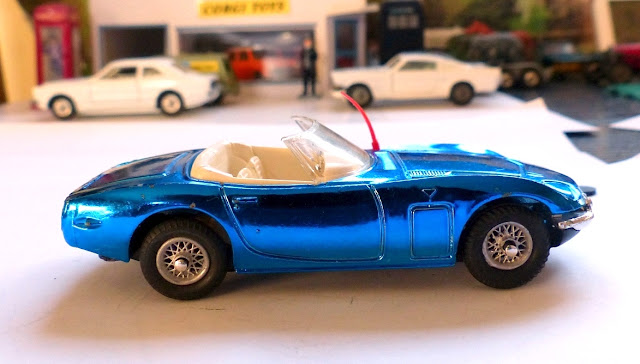
This is not a model issued by Corgi but I wish it had been. It's a 375 Toyota 2000GT which was issued with annoying 'pepper-pot' Whizzwheels in May 1970. The earlier 336 Bond-related issue had wire wheels and looked great so I thought I would see what this edition would look like with the same wire wheels.

This really is gorgeous. That paint finish is also quite exceptional. You can find it in a shiny purple too but that's scarcer and a lot more expensive.

It is not necessary to ruin the car either. Whizzwheels are easy to remove - just pull them off - and fit the wire wheels, although you will need to insert a sort of wheel bearing device to reduce the diameter of the hole to match the thinner axle. 


Thursday, 5 March 2020

The mysterious Aston Martin Competition model


Look through the 1965 Corgi Toy Catalogue and on page 12 you'll see the 309 Aston Martin Competition model with spoked wheels


This was an update on the 1963 catalogue in which the illustration showed normal shaped wheels. The little red book that was issued with The Great Book of Corgi (1st Edition) also lists this quite specifically with an issue date of December 1964.

The same catalogue and leaflet also show the 303S and 304S Mercedes 300SL models getting the same treatment. For a long time I had assumed that this referred to the issue of the Mercedes cars with cast wheels with a louvre pattern of the same type found on other models. I had seena  few of those. Then I discovered genuine original examples of the Mercedes with 'spoked' (wire) wheels and had to accept that they did exist, eventually owning both.

The Aston Martin, however, remains, in my opinion, one of the scarcest models of all if, indeed, it does actually exist. The date for sales ending is shown as 1965 so a December 1964 release would imply low numbers anyway. We know that the Mercedes are few and far between. I have encountered three so far in about 7 years and that includes many views of Vectis and QDT auction lists. I have neither seen nor heard of the Aston Martin and that intrigues me.

Fitting wire wheels (as I call them) makes so much sense and I have always though that they would look fabulous on the model. Eventually I found a late issue 309 (with the closed vent) that was in reasonably good condition and available at a reasonable price too and have used this to make a copy of that elusive holy grail of a model. 

The wheels are from a Ferrari Berlinetta of similar vintage and the axles are as fitted to the original Aston Martin model. Removing the shaped wheel was quite hard work and required a bit of patience to file down the ends of the axles without damaging the paintwork but otherwise replacement was a pretty simple job.

This will now take a prominent position in a cabinet at home until either a real one does actually appear at a price I can afford, (or persuade myself that I can afford!) or until someone pays the very silly price that I shall ask for this one. Hopefully the promotion of it will encourage more people to have a look through my catalogue and stock and buy something or, often equally valuable, bring me some useful background information or technical knowledge.


Friday, 15 February 2019

Mercedes-Benz 300SL in gold with wire wheels


In a photo of big, blue plastic container full of old toys at an auction house somewhere in Brighton I spotted a Mercedes 300SL. On its side. It was the only one on its side and had it not been there and in that position I would not have realised that here was an example of the very rare 303S with wire wheels. The next problem was bidding enough to win it. There were ten or so decent-looking Corgis in the box and maybe twenty other models that I didn't recognise and a bag of catalogues or leaflets.

I was lucky. No-one else seems to have noticed it or considered it of much value. It was, fortunately too, one of those quite general auctions and these were the only vintage model cars appearing so it doesn't appear to have attracted the interest of dealers or wealthy Corgi collectors.

This is, indeed, quite a find. You may remember that some years ago I had wondered aloud whether these actually existed. The entry in the Corgi Catalogue of 1965 I had thought, at one point, referred to the model they brought out with cast spoke-effect wheels. Then I spotted a 304S at a dealer and began to search in earnest. I failed to find anything and finished up making my own!

This particular model is not just a rare one with those wheels, though, but also produced in the gold mirror finish which is quite different to the silver edition. This makes it even scarcer and I really do not expect to see another any time soon. The silver 304S sold for around £400. This one, I feel, should be worth a lot more. It is not in perfect condition but the windscreen is sound and there are only tiny marks to the bodywork. The slightly messy stripe tends to spoil its appearance but I am not going to attempt to clean that. Reflections and shadows really do not do justice to the appearance of this model. The driver is original and the old suspension system works.


I still have my doubts about the 309 Aston Martin Competition ever being issued with wire wheels. There was a nice normal edition in the box and I am tempted to change its wheels but, as an early type with an open vent on the bonnet, it wouldn't be right. I'll just have to keep looking.

I shall also get a box for the Mercedes if I can find one at a modest price. 


Saturday, 9 June 2018

Corgi wheel changes Pt 2: wire wheels and cast wheels


From early 1962 just about every model car had what I call normal wheels - shaped wheels that spin freely on their axles (and so were a lot easier to drive around corners than the fixed types). A recent article dealt with what had gone before; now I shall look at what follows these 'normal' wheels and how some models with a particular type may be quite scarce and so worth looking out for.

The first new type would be wire wheels, also referred to as spoked wheels. These did look very smart and first appeared in June 1964 on the Buick Riviera. In September that year the Competition version of the Jaguar E Type has them and then The Great Book of Corgi refers to them being fitted to the 303S and 304S in December 1964. 

It also said they were fitted to the 309 Aston Martin Competition model but I have to say that that remains the most elusive of all Corgis for me! I used to have doubts about the two Mercedes too and wondered whether this and the catalogue were actually referring to the cast spoke-effect wheels which both models did get. However, last year I did see a couple for sale which appeared to be genuine 303S and 304S models with wire wheels. Because they were still far too expensive for my budget, though, I made my own with the help of a colleague, as described in an article nearer the time.

Before seeing them I had assumed that the reference to the 'spoked' wheel referred to a cast wheel type that, whilst still not common, is rather easier to find than the wire wheel type. The cast wheel variety can, however, only have been around for a short time as the Mercedes' production is said to have ceased in 1965.

Wire wheels were then fitted to three existing models. These were:

310 Chevrolet Stingray November 1963

320 Ford Mustang March 1965
Ford Mustang Competition December 1965

The Chevrolet is quite easy to find with normal wheels, in its cerise shade at least, but the Mustangs are certainly scarce with normal wheels and this leads me to estimate that the wire wheel type would have been introduced around early 1966 on these.

Several other models were fitted with wire wheels but kept them throughout their production period and so don't get included in this investigation.

The next change was the introduction of a cast wheel with a louvre design which looked a little like spokes. Very few models had these cast wheels from the start. The Sun Rally Rover 2000 in February 1967, the 319 lotus Elan in June 1967 and a Renault 16 in February 1969 were, I think, the only ones with normal size wheels. The Lancia Fulvia Zagato Coupe, some Imps and Minis had some during this period with the smaller size.

Many models changed from normal wheels to cast wheels during production and these seem to have had cast wheels at a very early point, making the normal wheel versions quite scarce:

Chrysler Imperial August 1965

263 Rambler Marlin June 1966
Oldsmobile Toronado January 1967
You can see that the timing of fitting cast wheels in place of normal wheels is pretty random - the Chrysler Imperial stopped being made in 1967 but by far the majority available have cast wheels so they must have been fitted from early 1966. The Oldsmobile, however, didn't appear until 1967 and so the switch cannot have been before mid-1967 and, of course, the Golden Jacks version comes out in June 1968!

Those three, however, are certainly not easy to find these days and command quite a premium.

Not many models seem scarce with cast wheels. It seems that those that did get switched had a reasonably long period with them. Amongst the normal size wheels, the Mercedes 303S and 304S and the two Mustangs can only have had the cast wheels for a short period and are quite scarce. Another is the pale blue edition of the Buick Riviera. Most 245s that I have seen with cast wheels have been in the metallic blue shade, some gold but, to date, only one in pale blue. I did try to buy it but it was in an original Gift Set 31 and that sent the price sky high regardless of the Riviera wheels, unfortunately.

Amongst the smaller wheel size cars, the 333 Sun Rally Mini Cooper had quite a short lifespan and is hard to find with cast wheels which seem to have been fitted only very late in its production. Whilst all the metallic maroon 226 Minis had cast wheels, some blue models got them too. I suspect that all Type 2 blue Morris Mini-Minors should have cast wheels but we may find one with normal wheels. Similarly there can't be many Type 1 blue Morris Mini-Minors with cast wheels, although these were produced in pretty big quantities and so the date of switch in relation to the timing of the body type change is what will govern things - and on that matter I have no clue. 

Another model that one would have thought was bound to get them is the 508 Commer Holiday Camp Bus. Issued in July 1968 it was, admittedly, not around for long but the similar Samuelsons Film Service Van that came out a few months earlier gets both types, as does the revised 470 Jeep FC-150 that comes out a few months after. From what I can tell, though, the 508 stays in normal wheels throughout. I may be wrong. That's another I shall be looking out for. Just in case!

So, there are a few interesting models that could have had nice, short production periods with one or other type of wheel. Because of the lack of information about when changes may have occurred there may be others. You may know some - if so, do let me know.

Here is a chart of what I have found. As with the other one, it may be easier to view and move around in full size at this link.


Sunday, 22 April 2018

Few Ferrari differences; 314 revisited


While I was waiting for someone to reply from Ferrari regarding one of the other known copies of the gold-plated 314, and to answer a question a collector had asked, I took a closer look at the good old Ferrari Berlinetta 250 Le Mans.

This appeared in the local toy shop in early 1965 and you'll still see it in the 1972 catalogue where it shares the honour or being one of only two models with wire wheels, the other being the James Bond Aston Martin. It is also the only model from the 1965 release to survive that long other than some farm equipment. During all those years not a great deal changed. I had thought at first that nothing had changed but when I looked a little closer I noticed a couple of things.

First the decals appear to come in two flavours. One is the familiar aged, cream background type with a well-defined and fairly thin numeral. The other has a very white background of the sort that makes you think it is a reproduction but it isn't, and the numeral is slightly thicker. The yellow stripe is also a touch wider, I think. I haven't measured them so it may just be an illusion, one of my models not being that well blessed in that respect. 


The second difference is on the base where there are extensions at an angle at the rear of the two raised lines running front to back. One might think they were a sort of suggestion of exhaust pipes but the model had chrome pipes already sticking out the back and, of course, it is a rear engine anyway. The chrome pipes have mostly disappeared on my red models, by the way, and that's a common fault to look out for as they are quite vulnerable to snapping.


The gold-plated edition would appear to be the first type with no extensions to the lines on the base.


I cannot say for certain which edition came first but I would guess that the straight lines were on the first type and the extensions added at some point to make a second type. Whether the decal change occurred at the same time, I can't tell, but it is pretty unlikely.

What does surprise me is why this car didn't get cast, spoke effect wheels like just about everything else did, including buses and Land Rovers! These would have been regularly fitted to models from about 1967 and the Mustang, for example, gets them in place of the wire wheels. By 1972 I really would have expected a change. At least it didn't get Whizzwheels so I suppose we should be thankful for small mercies.


Illustrations from extravaganzi.com and allcarcentral.com

The model itself was not a brilliant miniature version of the real thing and rumour has it that Ferrari were not that impressed. Whether that is really the case or not I still can't be sure. Perhaps the gold edition I have is the one that Ferrari's boss got at the time but he sent it back (as suggested by another collector)!

The obvious difference would be the headlamps. Corgi's attempt to give the impression of the glass cover area simply didn't work and seems to lack a third dimension. (It would, incidentally, be three years before they got anywhere near getting that type of headlamp right with the Mini Marcos.)

Many real models also had a different exhaust arrangement at the back. The one I could find that was very similar to the model also had a quite different (and very smooth) treatment to the rear window area which would have been nice to see on the Corgi 314.

I am not sure where the blue windows and chrome interior come from but I suppose it did add a touch of the exotic to the toy for us children at the time. I just remember thinking how hot it must have been in there.

Anyway, check your 314s and you should find plenty of whichever edition you need easy to find. None are expensive, so many having been produced. Just watch out for those broken exhausts.


Wednesday, 7 June 2017

A 304S Mercdes-Benz Roadster with spoked wheels


Earlier this year I wrote about The Mystery of the Wheels, having just discovered that there really could be a version of the Mercedes-Benz 300SL Roadster with wire ('spoked') wheels. I couldn't see me ever finding one or, if I did, at a price I could afford and so I made one.


I had a very nice base model that happened to come along and that gave me the initial idea. In theory it seems pretty simple: swap the wheels and it's done. In practice, it wasn't that simple at all. Firstly, to remove the wheels you have to file down one end of each axle. I have done something similar with the Rover 2000 re-builds but, in those cases, the axles and wheels have been taken off whatever they came on and it's easy to get a clean run with the file with nothing nearby to get damaged. In this case, I wanted to keep the car as original as possible and certainly didn't want to remove the base so it was much, much harder. The axles are quite narrow so there is neither much sticking out to get the file onto nor is there much space to move the file because the bodywork is so close. Initially I tried to avoid damaging the very nice clean smooth wheels that the model came with but I did have to give up on preserving a couple of them and, as it was, it took several hours of gently filing away to get the wheels free.

Secondly, try as hard as I might, I could not see how the suspension worked and my first attempts at pushing an axle back through so that the car still had suspension on that axle were hopeless. Maybe - sometimes - one wheel seemed firm but the other side was very weak and so it went on for ages. Eventually, purely by luck, I got the rear axle in place and both sides were nice and firm like they should be on this model. It was another hour before I could get the front axle in a similar position! When it did, finally, seem to be in the right place I have no idea what I did to achieve that. I am guessing that there is some thin metal that the axles needs to go beneath but it is my no means obvious or simple to do!

Anyway, it's nearly complete now. I just need to add a small blob to end of the axles that were filed down to prevent the wheel coming off. It looks pretty good, though, and, with the real thing being either almost impossible to find or way too expensive if you do find one, here is a quite smart alternative that does not involve ruining any other model. The wire wheels came off a truly wrecked Ferrari Berlinetta so no loss there.

Now, I should try doing this with a soft top version - but I may be more careful about how I remove the axle next time!