Showing posts with label Stingray. Show all posts

Friday, 14 August 2026

Not quite Corgis


At first glance this looks like the #264 Oldsmobile Toronado. Then you see the wheels - and they're not the #276 Golden Jacks variety either - and the shade of blue is unlike any that Corgi issued, despite there being quite a range from turquoise blue to rich, dark blue during its production. And what is that? Opening doors? Goodness me, where on Earth does this come from?

Alicante. Spain. These are extremely good copies of the Corgi casting by a company called Auto-Pilen and date from the early 1970s. Indeed, these are so similar that one has to assume that the company took a Corgi model apart and made a mould from that. For me these are like the Corgi 'variations' I so enjoy finding and Auto-Pilen have managed to add more features to many of them as well. The Oldsmobile above is their model reference #307.


You will find several editions of the same car. Here there is a lovely chrome-plated model (#308) and below a Policia version (#298).


In each case the control for the headlamps operates very smoothly - indeed, rather better than the Corgi models themselves! The jewels look exactly the same as the Corgi models too, as do the chrome fittings.

Here are some more Auto-Pilen Corgis that I have in stock at the time of writing, All the images will take you to the appropriate page in my store if anyone wants more images or to purchase one.

The #310 Chevrolet (Corvette) Stingray
models #300 (green and silver editions) and #299-1 for the chrome-plated model


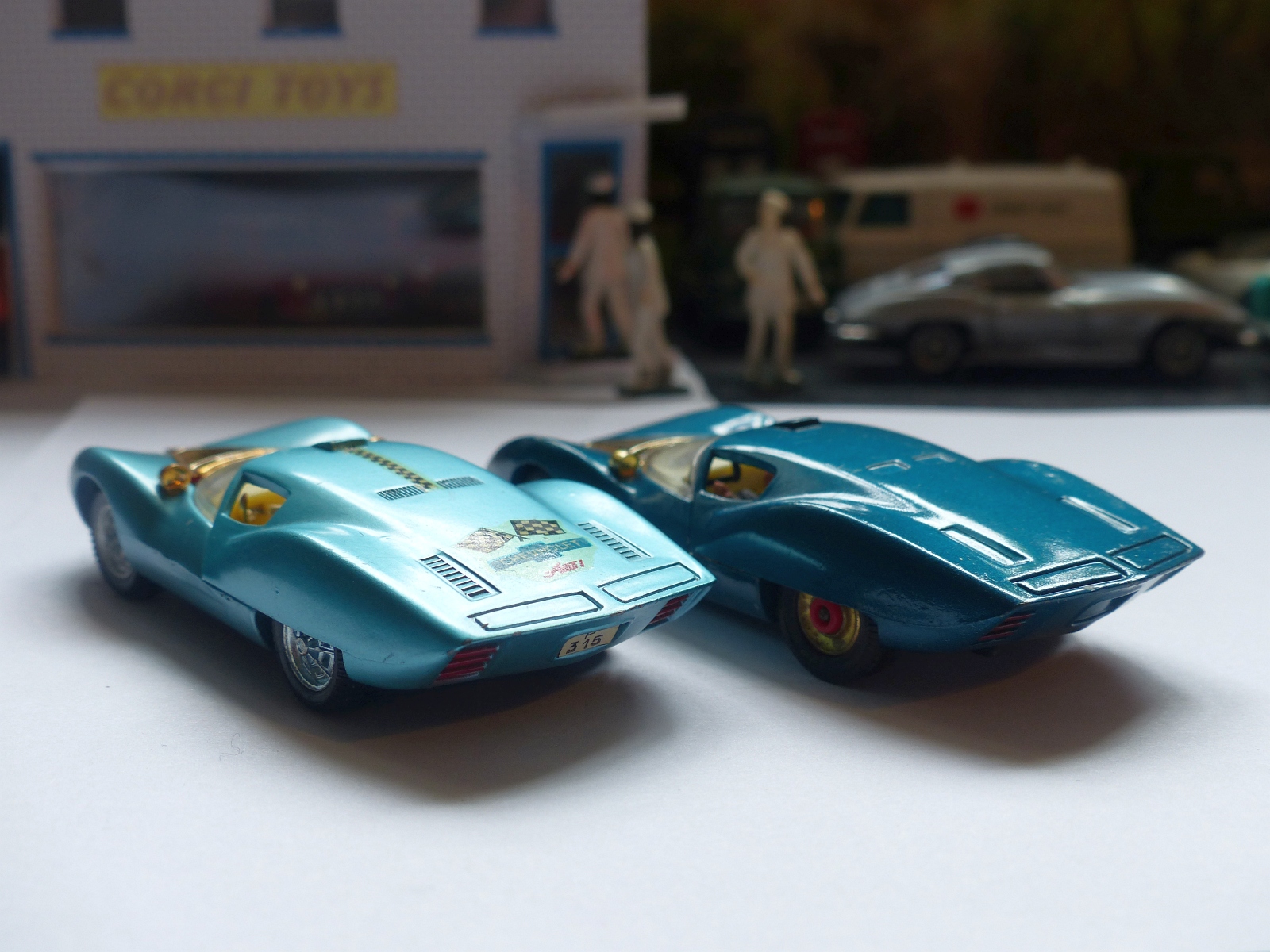
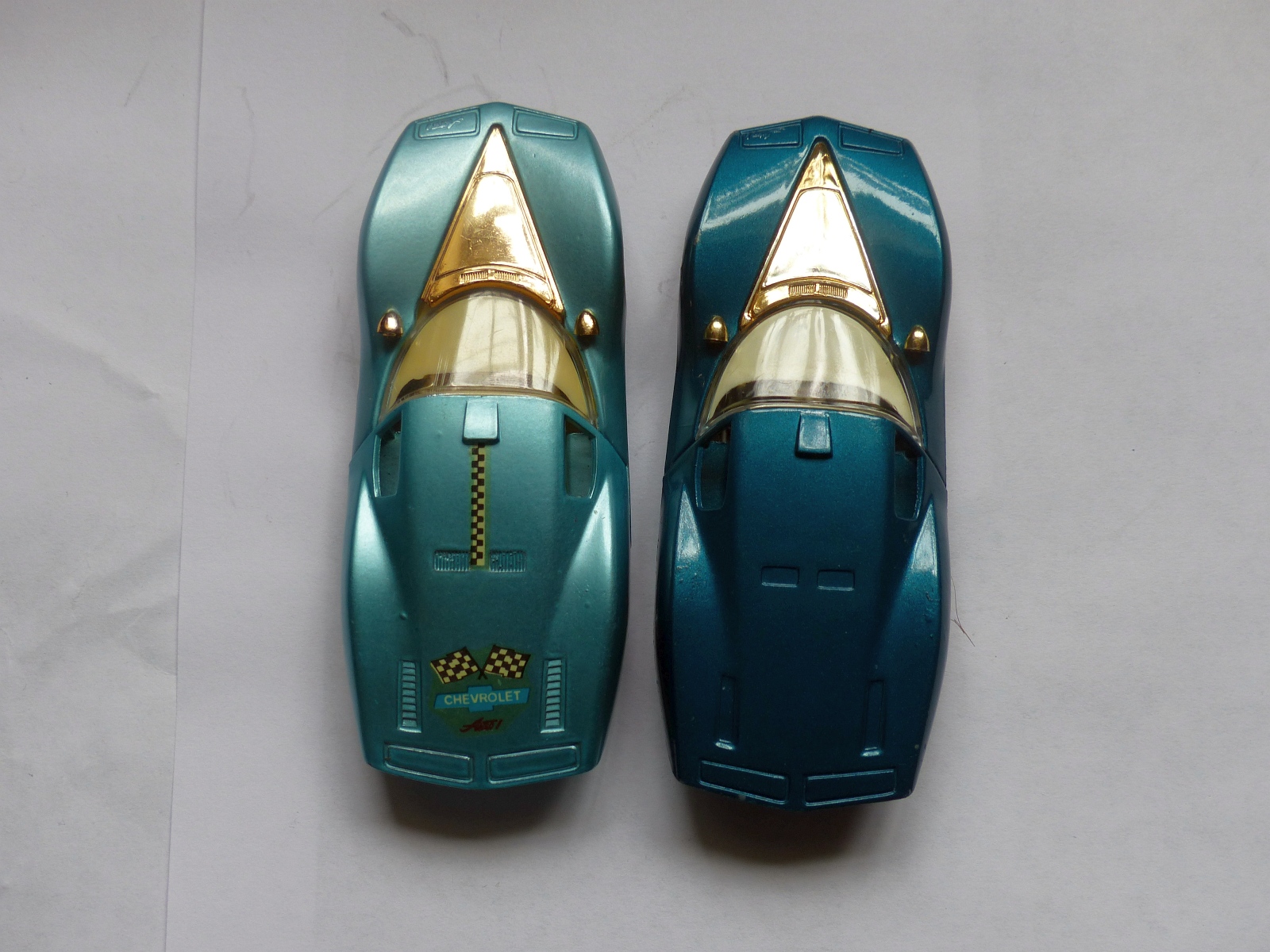
The #347 Chevrolet Astro 1.6
(#315 and #316 for a chrome-plated version)


The #384 Adams Probe 1.6
(#505 and #506 for a chrome-plated version)


The #334 Mini Cooper
(#319 and #320 for a chrome-plated edition) 
There is also a #291 Mini-Cooper Rally listed which I would expect to be based on the same casting.


Auto-Pilen also made a beautiful version of the Corgi #284 Citroen SM. You will also find Dinky copies too but I am not sure if there are any more Corgis. There are a Porsche 917 and Carrera 6 in one list I have found as well as a Citroen DS 23 and GP Beach Buggy which I need to investigate if ever I find one. The list also features the BRM and Lotus F1 racing cars which may be further possibilities.

These models are now quite hard to find here in the UK, although may be common across whatever the Spanish equivalent to a boot sale is. The company produced models through to the 1990s but, to the best of my knowledge, these would be the sole models of interest to Corgi collectors.

They are very well-made, solid and the opening parts operate smoothly. The wheels look great but suspension is seldom very good, either firm or practically non-existent. One nice thing is that the bases are screwed on - so if a model does need repair, or a fresh coat of paint, then that is relatively simple to achieve without having to 'break' rivets. Now, this does, of course, men that one can never be absolutely certain that what you have is totally original but I can live with that.

Prices are similar to their Corgi equivalents from what I can gather so, being comparatively unusual, they seem to represent good value to me. Most that I have found and that you will come across will not have either the box or the plinth to which they seem to have been attached when issued, with a hole evident in the base where a screw would have fitted.

Thursday, 27 February 2025

Simple memories


I just glanced at my desk today and realised how lovely ordinary, not quite perfect, played-with every day Corgi Toys can be. I had been cleaning a few recent arrivals. None would satisfy the purist collector who requires a model to be flawless and, ideally, still in its original box and packing with a membership leaflet too, of course. For me, though, these arrivals are a pleasure to see. I don't know why but perhaps seeing models with signs of wear sparks something in my memory and takes me back to sometime in 1964 when a 12-year-old me would have had these lying around on a layout his dad had helped  build.

In the house where I lived at that time there was what we called a box room. It was about 6 feet square and half the room was occupied by a bedstead. That was almost never used as a bed, however, and instead of a mattress there was a piece of hardboard that fitted across the whole of the bedstead. Onto that I had used strips of masking tape to create road markings, Bayko buildings provided some buildings where I could park some cars and Floral Garden items made everything quite attractive with their trees, walls, fences and paving cards, of which I had a large quantity as they were so useful in making road edges.

The nice thing about this layout was that I didn't have to tidy the cars away every evening. So they survived pretty well with only minor chips from time to time. I did keep quite a few boxes but all the models I liked would usually be out on the layout somewhere.

I remember now how much easier it was to drive the models around where they had free-spinning wheels. My Morris Mini-Minor had these but the Austin Seven had fixed wheels and was much less fun. Now I think about it, the only other models I had with fixed wheels were a Renault Floride and an Austin A40. I had bought the Austin A40 because my dad had one. His was all red and was the 'Countryman' type with an opening window and boot at the back. I didn't know about the Mechanical models and I guess I was too late for these anyway when I started buying Corgis for myself so I had bought the two-tone blue 216 model and used some Massey-Ferguson red paint to try and get closer to my dad's car in appearance. (He worked for an agricultural machinery depot so we always had paint in machinery colours!)

So the Citroën in the picture here would not have been on my layout and I completely missed all the original 1950s issues. My friend Andi in Germany had spotted the Citroën at a very reasonable price and I was lucky to win that one. Both the green / black and yellow / red editions are hard to find in good condition nowadays, the yellow one showing little marks much more obviously than the green. The Citroëns make quite a little collection on their own as you need to find two versions of each - early editions with 'differential' bulges and the later smooth base variety. Then there are the blue-tinted windows and plain windows, probably for each type too. That makes 8 models you need to collect! And you thought that was a simple model in just a couple of colours!

There may even be some variations in the base that someone can tell me about. I seem to recall spotting something (other than the differential or a hole where the revised smooth casting has malfunctioned) but can't recall what now. It may have been that some bases are silver and others grey but I cannot be sure about that.

Somewhat simpler indeed is the E Type Jaguar. As a child I only knew about the red one. I liked this car a lot, much better than the later 335 issue which was annoyingly too big and just didn't look right sat next to the 307. The metallic grey is lovely, though, and I would definitely have been to the shop and bought one had I known at the time. I always found the red plastic top a bit odd and felt it should be black and, of course, you can now buy black replacements which look great. As it was, the top usually was left to one side and I played without it. You could sort of 'get in' with your fingers and drive around that way.

That reminds me of one of my favourites for playing with - the Austin Mini Van. I had two of these and you really could whizz these little cars around like mad, 'driving' them from inside the rear section. You could put things in the back too, although I always wished there had been windows on the rear doors. I think I put some perspex on mine which improved their appearance a bit. I was always impressed that Corgi had put jewels on this lowly van! They made it a bit special.

Back to the E Type, you will find some variations in the intensity of the metallic grey finish, some being quite distinctly black as opposed to grey in my view. The plum red always seems to be pretty much plum red, however. Otherwise I did read some time ago about there being bases with one rivet as opposed to two but I have to say I have not yet managed to find any of the former.

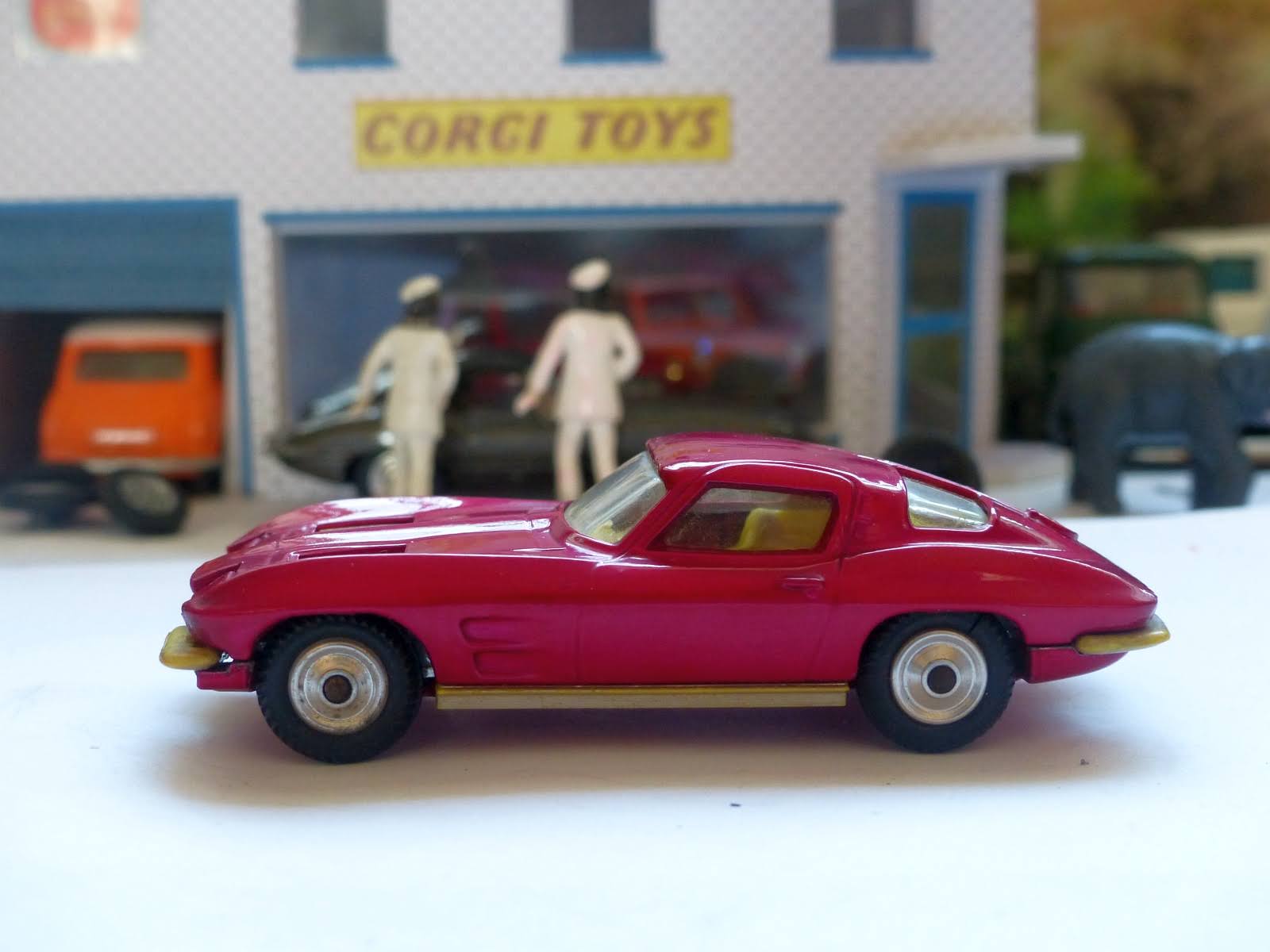
The car most well focussed by my camera is the delightful Chevrolet Sting Ray, here in that gorgeous metallic cerise colour and plain shaped wheels. I know it also looks lovely with the wire wheels but somehow this one always catches my eye and I find them very hard to resist when they come up for sale. Mine as a child was in this lovely shade but I had the wire wheels. The Buick Riviera was the first model to be issued with wire wheels from the start but I have a feeling the Chevrolet may have been the first car we could buy with them if they were fitted before June 1964.

This particular example that I have acquired has lights that look really nice and in line with the front and top edge. Most get loose and never sit quite right. They can also look a bit awkward when open and viewed from the front but this one actually looks fine. I may well hang on to this one in my own collection. Having twin jewelled headlamps was a bit special too. We had had four jewels on the Jaguar Mk X earlier but here we had two full-size side by side. Nice. I did like those jewels and I am very surprised that the Corgi Model Club has been using quite dull plastic instead.

Elsewhere in the picture you'll catch a glimpse of the lovely Rover 2000, the original model in metallic slate-blue. I have written before about this model and the small casting differences in the badge and grille. The colour always seems to be consistent, though, so, apart from the maroon edition and the very scarce cast wheel maroon model, there are not too many to collect of this one. The 'Trans-o-lite' dual headlamps are great and I had no end of enjoyment at night with a torch making beams from the front.

Because the Volkswagen 'Toblerone' Van had completely passed me by I was not aware of these lights until I got the Rover. I must have had some catalogues at the time but I really don't think I spent a lot of time studying them as I simply didn't know about several models. The 253 Mercedes 220SE was a surprise to me when I re-started my collection. I'd always thought there was a blue edition of the 230 model! Something else which I would definitely had bought had I realised it was available was the Oldsmobile Toronado in its first outing as 264 in super metallic blue and almost pure white interior. It didn't do much but looked wonderful and is another I find hard to resist now.

On the subject of Oldsmobiles the last models in the picture are a pair of 235s, one in the more familiar metallic slate-blue (very similar to the Rover colour) and the solid sky blue colour. I didn't have these as a child but would have been very happy had someone bought one for me. They're very simple - and you only need the two for a complete collection - and they're nice to drive around. One of the problems with the Jaguar Mk X and Ford Consul Classic was that their bonnets often opened when you hit the brakes! The Jaguar was hard work driving around corners too. I had one in a terrible shade of pale green which I was never particularly happy with (although I would be very glad to have one in that rarer shade now!) and, as soon as I found the new metallic cerise shade in my local shop, I bought a replacement for the chipped model I had on the layout. Again, I had no idea just how many different finishes that model was produced in. It's probably just as well as my earnings from helping out at a local farm and a bit of lawn-mowing probably wouldn't have been enough. By 1966 it would be records that I spent my money on too, or tapes on which to record tracks from the radio. 

So forgive me for my simple memories from some very ordinary models rather than writing about some exciting new discovery or variation. In a couple of days it'll be March and I'll have nine issues to tell you about so that'll keep me busy tomorrow!


Saturday, 28 December 2024

More interesting Corgis


It's nearly the end of the year and the last arrivals for 2024 are in. As you may have noticed, I have stopped reviewing the Corgi Model Club issues and prefer to spend time now on the interesting variations in the good old originals.

First you'll see what looks like a pretty ordinary Land Rover Breakdown Truck. The 417S models, however, that was issued in December 1962, retained the first type of jib for a brief period before getting the stronger, more solid variety. This one needs a new rear tin canopy with a light on the roof. I ordered a replacement from Model Supplies but it is just bare metal and, surprisingly, the shape is quite wrong too, having a completely different angle to the curve. I shall see if I can find one - there should be plenty around as the 417 will be the same too and if the truck has some damage or wear it might not cost too much either! Failing that I could borrow one from either of the Corgi Model Club or Hornby-Corgi re-issues.


The Jaguar Mark X is always a delight to collect, with its coats of many colours. I've had the metallic blue for some time but it is the metallic green that is the latest arrival, with the correct two cases as well. This is quite different to a brighter emerald metallic green that I had.


Here is something that I knew existed but had not seen before - the VW Breakdown Truck with cast wheels. It is all complete, albeit missing some paint on raised edges. I have had to replace the small winch hook and there is no chevron sticker across the rear. I cannot see any replacements for this small strip so I may have to make one myself. I am assuming that they did all have one. 


Finally, here is a slightly sad-looking Chevrolet Sting Ray. You'll see that the suspension has totally collapsed which is not as common a problem on these as it is on the Mustang, Imp, Ghia etc. I think it is provided by the plastic chrome piece that runs from back to front so I can imagine that this is vulnerable. I shall have to see what I can to make some sort of repair but this is the lovely and quite scarce bronze edition so I am anxious to keep it original. Otherwise it is in very good condition with just a few chips here and there. I may be able to insert some foam rubber above the axle, perhaps. A job for the holidays. 


Saturday, 5 August 2023

Corgi Toys @ 60: The Sting Ray and two Gift Sets


It's August and, as a child starting a long school holiday, you can imagine the delight at seeing this in my St. Albans toy shop in French Row! The Chevrolet Sting Ray was a smart model you just had to have, with its twin jewelled headlamps which could be opened up and closed. This was the first to have twin jewels. The Jaguar Mk X had four jewels at the front but two were smaller and not quite the same as twin headlamps like these. This particular model is in a scarce bronze finish and will have been issued a little later, always having wire wheels.


Now this is an imposter, I add quickly before you all write in and tell me that's not a Corgi. Look closely, though, and you'll see that this is an exact copy of the Corgi from Auto-Pilen in 1970. They added opening doors and a better quality interior but otherwise this is the Corgi casting (or a made from one!)


This metallic pink-crimson edition was the first on the scene, with normal wheels when first issued. It would get wire wheels a few months later.


All the silver models appear to have wire wheels. there are two editions in silver. One is a quite thin, metallic silver finish similar to the James Bond Aston Martin. The other has a more pearlescent finish - I call it champagne silver and it can display a slight gold effect in some lights.


These Sting Rays did look rather better with their lights closed. The device that holds the jewels never quite sits as nicely as it should when open but it was nevertheless a super model and very popular.

Also in August 1963 the Commer Construction Gift set 24 was released.


This was my own set and note the coin that I used to release the different sections. This is a super set and provided us with all sorts of possibilities - four different vehicles with a red base and four different vehicles with a white base. If you happened to have the Police Commer Van then you could extend the range even further as that had the same release on the base! 

The red chassis always had Trans-o-lite headlamps, the white chassis did not.


The last addition for August 1963 was the Gift Set 27 with a Priestman Cub Shovel on the Bedford Machinery Carrier.


This was a long-running item, as can be evidenced by the wheels on the Carrier. Initially issued with normal shaped wheels it gets the louvre-type spoke effect wheels in around 1967 and then the larger commercial truck wheels in 1968.


Whilst I am sure there must be some other small variations in these models, all that I have encountered appear the same, with yellow interior to the light blue cab and a black removable rear axle.


The rear Chevrolet Corvette Stingray! Corgi were not wrong with their choice of colour for the first issue!

Thursday, 19 May 2022

Corvette changes


In April 1970 the fabulous-looking Chevrolet Corvette Sting Ray Coupé, model number 300, appeared in the shops. It was the first model to get an expensive liquid metallic finish, in either bright deep red or emerald green. 10/6d bought you this model with Golden Jacks Take-Off wheels. One of Corgi's most attractive models and still much sought-after today as it simply looks so good on display.

According to the Corgi records, however, production was to end later that year. As with all the Golden Jacks models, however lovely the wheels were and inventive the system allowing their removal and replacement, this was not a fast car on the carpet track and just a small flick on the Lamborghini issued just one month earlier would send it far further than the few inches managed by the Corvette. It was a model to hold and cherish but not play with. People weren't ready for the just holding and cherishing stuff then, and Corgi had already tried this market with their Classics range with no great success but we must now thank whoever was in charge for getting this into production, even if itw as for a very short period.

In June 1972 it is re-issued, now as 387, wit Whizzwheels and a new colour scheme.


As far as I can tell the metallic blue edition was the first colour available. It lost the badge of the front but retained one on the rear panel. That, I have found, tends to be put on in several different orientations, probably because there was no clear guidance to the ladies doing the attachments on the production line. The wheels always seem to be the 'four crowns' type, by far the most common across the range at this time. I have not seen any with the earlier 'pepperpot' wheels nor any with what would have been a far better idea, the chromed variety fitted to cars like the Datsun and Citroën SM.

It lost the jewels in the rear lights too, although there are a few transition models in blue with them still in place. The new issue has just rather sad blobs of mazak where the casting has been changed with little great effort to show the iconic rear lights at all. Dabbed with red paint on the blue model but totally lacking anything on the pink one! Money must have been tight then, indeed!


The pink model appears sometime after the June 1972 release and has the same black interior as the blue. I have not seen a pink 387 with any rear light jewels. Initially it has the same headlamp covers as before but late models have a ribbed cover which is quite distinct. I have only seen the ribbed covers on the pink model.


Under the bonnet there is another surprise. The beautifully detailed engine has a different air filter in one of my earlier pink models. The later one with ribbed light covers has a similar design to the blue one illustrated here, which seems to have been the style from the start.

So there is plenty to collect with this range and all we need now is for someone to make some spare roof panels. These are easily lost or broken and surely shouldn't be difficult to make. I have 7 Corvettes at the moment and need 7 roof panels!

Wednesday, 14 October 2020

More Spanish Delight From 1970s Alicante


Corgi got the rear lights right on the Adams Probe 1.6, one of their more attractive Whizzwheels offerings, but the Spanish Auto Pilen version just has more presence. Look at the deail in the wheels with the spinners nicely detailed in the wheel casting. 


The models really are almost exact copies. Apart from those rear lights - and I have no idea why the Spaniards did that - this is a fabulous item and only made me want to find more.


Probably the Corgi model of a production car that I dislike most has been the Mercedes C111. The heavy, little-detailed casting and round rather than sharp edges just made this so unattractive and the heavy orange paint only served to hide more detail and round edges even more. And that's without mentioning the ubiquitous and so inappropriate Whizzwheels.


Corgi did get the colour almost right, though, the only examples I have ever seen being in a metallic orange and certainly not metallic olive green. Nevertheless Auto Pilen have transformed the model with their lighter touch to the edges, paint that doesn't fill every crack and far more pleasant overall stance and appearance.


They even add jewels to the front, a nice touch, and a far more subtle logo. The headlamps pop up too!


Jewels at the back too and lower reflectors or fog lamps are in place.


The rear compartment also opens to reveal a detailed engine and the 'gull-wing' doors operate smoothly. This is another excellent model, surpassing by a long way what Corgi had done with the casting.


Next, another model I tended not to pay too much attention to. It was odd and the way those two characters were raised by opening the rear compartment always rather confused me as I am not sure that made it much more easy to get out after all. However, it was still well-made and was originally issued with reasonably decent red spot Whizzwheels. Now see what Auto Pilen managed to do with the casting.


They left out the passengers which was probably a good idea and let the seats stay in situ. Maybe the experimental car did have them raising in some way but I'm happy with it as it is.


You'll see that the two models are virtually identical, even down to the polished gold coloured panel and mirrors.


Lastly in this Spanish instalment, here are a couple of Chevrolet Sting Rays. It seems that Auto Pilen released a chrome edition of most (maybe all) of the models that I am hoping to acquire and here is their chrome Sting Ray, looking quite indistinguishable to a Corgi 310 model.


It has the same swivelling headlamp units and you'll also see that the chrome suffers from the same problem that many of the 310s did too, peeling off quite easily and leaving, in this case, a white plastic bumper which would often be bright yellow on the Corgi.

the nice thing about the Spanish version, though, is that it can be replaced easily without damaging the base which is simply attached by a couple of screws. I suppose you can, therefore, never be sure of a model's originality but that's a price I don't mind paying as this aspect also tends to maintain a lower price level across the range than for comparable Corgis.


Incidentally, not everyone will have noticed that the silver Sting Ray was also an Auto-Pilen! The opening doors give that away, and the red interior. The wheels, however, whilst slightly different to the Corgi are a pretty similar wire wheel type as on most 310 models.


I don't have a silver 310 in stock to compare with this but will add some photos just as soon as one comes along.

In the meantime, I am looking for the others that I listed as being likely candidates for using Corgi castings (or copies of them) and hope they prove to be as similar;y impressive as all that I have discovered so far.