Showing posts with label wheels. Show all posts

Sunday, 18 January 2026

Four of one and four of the other


The little Triumph Herald CoupĂ© was a remarkable model and a little more interesting than you may have appreciated. 

Firstly, in November 1961 it was only the second car to be issued with free-spinning wheels from the start. The Bentley Continental was the first, of course, but the Triumph was the first with the smaller wheels. The small wheels first appeared on cars in January 1960 on the Morris Mini-Minor, followed by the Austin Seven a year later and the Chevrolet Corvair in July 1961. All these three, however, started with fixed smooth wheels, then they got fixed shaped wheels and finally the free-spinning variety some time later.

The first Mercedes-Benz 300SL models with suspension, 303S and 304S also had free-spinning wheels which were a little curious, being smooth on both sides. The first Triumph Heralds had a similar smooth free-spinning wheel, in the smaller size. Later the shaped style is fitted and these wheels are smooth on one side and shaped on the other. I can imagine that mistakes would have been made on the production line, with some wheels being fitted with the smooth side out but the two models shown here are not mistakes. The blue one has wheels that are the older type, smooth on both sides.

I had thought for a long time that the first issue must have been gold and white and that all of them had smooth wheels and all the later blue and white issues had shaped wheels but I learned some time ago that the other combinations existed. They're not that common, though and definitely worth a little more than the usual pair.

There are also two type of construction, as I discovered when I took some damaged models apart, mixed up the parts and wondered why they didn't go together again! It seems to concern how the bonnet hinge and radiator grille interact and the bases are quite different, with what look like filled holes painted on one type and just one rivet at the rear.


Both my models have the three rivets unpainted which I think is the earlier type.

I have seen many blue models with each type of base, whether with smooth or shaped wheels. However, every gold one I have seen to date has the three rivet type. I am sure there must be some gold models with the single rivet type but I have still to find one. It took a while to find the shaped wheel edition but, as is the case with so many Corgis, as soon as you find one variation, another one presents itself as a possibility and the search continues!

I probably wouldn't have it any other way.

Saturday, 22 February 2020

A brief look at wheels on models produced in 1960

Some time ago I looked at the possible distribution of wheel types during a production period for Corgis. In particular, I am interested in establishing the comparative scarcity of one or another type for a group of models issued between early 1960 and early 1961.

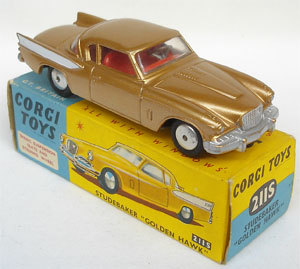
Painted 211S with smooth wheels (acknowledgments to QDT)


These will have all been first sent out to the shops with smooth fixed wheels with later editions fitted with a shaped, but still fixed, wheel. One or two long-running models will also have had free-spinning wheels fitted at a later point.

In a not particularly scientific survey, the chart below shows the distribution of wheel types that I found on models for sale or sold on a few web sites.


The key S = free spinning, F = smooth fixed, F2 = smooth shaped, F3= cast fixed (as on 218).

The models which did not have a great period of production after 1961 show a marked scarcity of the shaped wheel variety - in fact I was unable to see any for the 421 Bedford Evening Standard model.

For those that had a distinctly longer life then the fixed shaped wheel still seems comparatively scarce and similar in proportion to the free spinning wheel that followed. The 218 Aston Martin is a good example where one might have thought that the cast 'spoke effect' type was scarce but, in fact, it seems quite plentiful and it may be the fixed shaped type that is the one to look out for.

One surprise for me is the lack of any 210S Citroen models with free spinning wheels. I have two in stock but that's all I noticed anywhere. They are also both the variety with fog lamps in the casting. I find it hard to believe that the change of upper body casting corresponded to a change of wheel as I had regarded the fog lamps version to have been issued after the 323 Monte Carlo edition had become dated, the holes for jewels being filled with mazak instead. By that time one would have expected the 210S to have been fitted for some years with free spinning wheels.

I should mention that the 211S Studebaker figures are split between two models - the June 1960 issue with silver or gold-plated finish and a later issue with gold paint.

The Jaguar Fire Service model was the last model with normal-size wheels to be issued with the smooth fixed type, which is why I stopped at March 1961. Prior to January 1960, though, there are several models which also continued in production for many years and these I shall have another look at in a while. Generally, though, for the earlier models we know that the fixed shaped wheels are less common or really scarce in some instances and there are likely to be fewer surprises in that data.

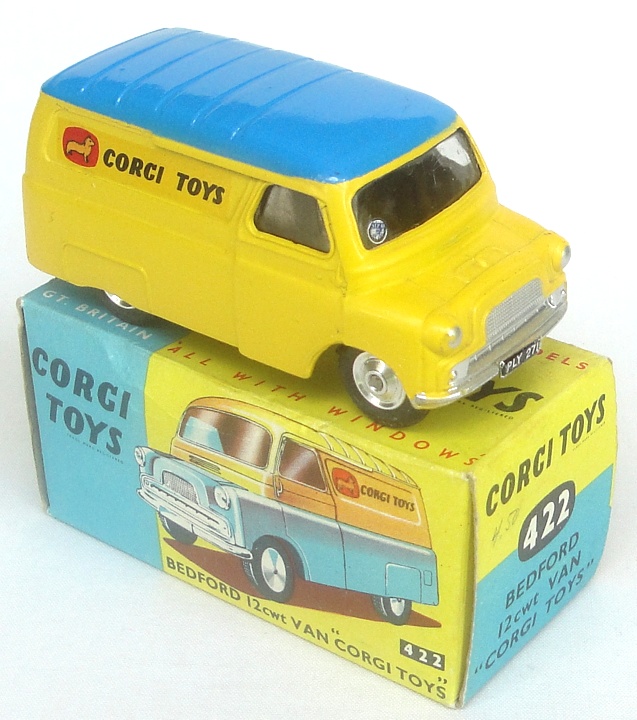
422 with shaped wheels (acknowledgments to QDT)


For now the search is on for some Bedfords with shaped wheels, a Studebaker painted gold with smooth wheels and the errant Citroen with free spinning wheels!

Saturday, 9 June 2018

Corgi wheel changes Pt 2: wire wheels and cast wheels


From early 1962 just about every model car had what I call normal wheels - shaped wheels that spin freely on their axles (and so were a lot easier to drive around corners than the fixed types). A recent article dealt with what had gone before; now I shall look at what follows these 'normal' wheels and how some models with a particular type may be quite scarce and so worth looking out for.

The first new type would be wire wheels, also referred to as spoked wheels. These did look very smart and first appeared in June 1964 on the Buick Riviera. In September that year the Competition version of the Jaguar E Type has them and then The Great Book of Corgi refers to them being fitted to the 303S and 304S in December 1964. 

It also said they were fitted to the 309 Aston Martin Competition model but I have to say that that remains the most elusive of all Corgis for me! I used to have doubts about the two Mercedes too and wondered whether this and the catalogue were actually referring to the cast spoke-effect wheels which both models did get. However, last year I did see a couple for sale which appeared to be genuine 303S and 304S models with wire wheels. Because they were still far too expensive for my budget, though, I made my own with the help of a colleague, as described in an article nearer the time.

Before seeing them I had assumed that the reference to the 'spoked' wheel referred to a cast wheel type that, whilst still not common, is rather easier to find than the wire wheel type. The cast wheel variety can, however, only have been around for a short time as the Mercedes' production is said to have ceased in 1965.

Wire wheels were then fitted to three existing models. These were:

310 Chevrolet Stingray November 1963

320 Ford Mustang March 1965
Ford Mustang Competition December 1965

The Chevrolet is quite easy to find with normal wheels, in its cerise shade at least, but the Mustangs are certainly scarce with normal wheels and this leads me to estimate that the wire wheel type would have been introduced around early 1966 on these.

Several other models were fitted with wire wheels but kept them throughout their production period and so don't get included in this investigation.

The next change was the introduction of a cast wheel with a louvre design which looked a little like spokes. Very few models had these cast wheels from the start. The Sun Rally Rover 2000 in February 1967, the 319 lotus Elan in June 1967 and a Renault 16 in February 1969 were, I think, the only ones with normal size wheels. The Lancia Fulvia Zagato Coupe, some Imps and Minis had some during this period with the smaller size.

Many models changed from normal wheels to cast wheels during production and these seem to have had cast wheels at a very early point, making the normal wheel versions quite scarce:

Chrysler Imperial August 1965

263 Rambler Marlin June 1966
Oldsmobile Toronado January 1967
You can see that the timing of fitting cast wheels in place of normal wheels is pretty random - the Chrysler Imperial stopped being made in 1967 but by far the majority available have cast wheels so they must have been fitted from early 1966. The Oldsmobile, however, didn't appear until 1967 and so the switch cannot have been before mid-1967 and, of course, the Golden Jacks version comes out in June 1968!

Those three, however, are certainly not easy to find these days and command quite a premium.

Not many models seem scarce with cast wheels. It seems that those that did get switched had a reasonably long period with them. Amongst the normal size wheels, the Mercedes 303S and 304S and the two Mustangs can only have had the cast wheels for a short period and are quite scarce. Another is the pale blue edition of the Buick Riviera. Most 245s that I have seen with cast wheels have been in the metallic blue shade, some gold but, to date, only one in pale blue. I did try to buy it but it was in an original Gift Set 31 and that sent the price sky high regardless of the Riviera wheels, unfortunately.

Amongst the smaller wheel size cars, the 333 Sun Rally Mini Cooper had quite a short lifespan and is hard to find with cast wheels which seem to have been fitted only very late in its production. Whilst all the metallic maroon 226 Minis had cast wheels, some blue models got them too. I suspect that all Type 2 blue Morris Mini-Minors should have cast wheels but we may find one with normal wheels. Similarly there can't be many Type 1 blue Morris Mini-Minors with cast wheels, although these were produced in pretty big quantities and so the date of switch in relation to the timing of the body type change is what will govern things - and on that matter I have no clue. 

Another model that one would have thought was bound to get them is the 508 Commer Holiday Camp Bus. Issued in July 1968 it was, admittedly, not around for long but the similar Samuelsons Film Service Van that came out a few months earlier gets both types, as does the revised 470 Jeep FC-150 that comes out a few months after. From what I can tell, though, the 508 stays in normal wheels throughout. I may be wrong. That's another I shall be looking out for. Just in case!

So, there are a few interesting models that could have had nice, short production periods with one or other type of wheel. Because of the lack of information about when changes may have occurred there may be others. You may know some - if so, do let me know.

Here is a chart of what I have found. As with the other one, it may be easier to view and move around in full size at this link.