Showing posts with label Mini. Show all posts

Saturday, 2 May 2026

New arrivals and fond memories


Here are some of the recent additions to my shelves, all from the best Corgi Toys era and each provides a fond memory of the layout that I was fortunate to have at home in the mid 1960s, which would have had all of these at one time or another. When my brother went to start his apprenticeship with Bamfords in Uttoxeter, a small spare room became available. My dad cut a piece of hardboard to fit over the iron bed frame occupying half the room. On this huge space I could mark out roads with Floral Garden fences and pathways and place Bayko houses and garages here and there. I remember how much better this was for driving models like the Mercedes-Benz 220SE, VW1200 and Austin A60 which struggled on carpet due to their very low ground clearance.

Whilst I managed to build up a monstrous pile of Bayko bits and pieces, the Floral Garden items were much too expensive. The few trees and flowers did look lovely, though, but I never did get enough for a good display. I still have the Bayko pieces, and sets do come along from time to time at quite reasonable prices. Floral Garden items are also available but, with one or two exceptions, can be very expensive as you need several items of the right sort to make a useful contribution to a display.


The scarcer blue and white edition of the beautiful #259 Citroen 'Le Dandy' Coupé, in excellent condition and with a lovely original box too.


The #477 Land Rover breakdown Truck, indistinguishable from #417S other than it now gets a big, plastic canopy. This example is in excellent condition.


I finally got round to removing the old transfers, which had been printed with an annoying white background and never looked right, and applying some much better ones to this maybe a little worn but otherwise original 'Pop Art' Mini.


A nice, clean Gift Set 40 with original models and characters in an excellent reproduction box and tray.


A very clean early #210 Citroen DS19


A lovely example of the scarcer cream edition of the #200 Ford Consul.


A rare #252 Rover 2000 with cast wheels from a late Transporter Gift set.


One of my favourites - the Mercedes 220SE in black, as first issued with steering as model #230


A nice late edition of the #222 Renault Floride in metallic blue with a red interior and free spinning wheels


A very good example of the first #303S Mercedes-Benz Roadster with free-spinning smooth wheels and a white interior, a scarce variant.


A working #1401 Service Ramp which is pretty much unmarked. This was issued in April 1958 and did not sell particularly well, being discontinued a couple of years later. It was brought into the Corgi range as it had previously been a Mettoy branded product in red back in the 1950s.

I also now have here in England some marvellous US Army models which I shall feature in the next post.

Saturday, 15 June 2024

Artificial lack of intelligence

Have you noticed the spread of flowery language across sites like Ebay? Take this example:
This Corgi Jenson's Blue Morris Mini Minor Scale 1:43 diecast car is a must-have for collectors and fans of vintage vehicles. The car is beautifully crafted with intricate details and a stunning blue colour that is sure to catch the eye. The 1:43 scale makes it a perfect addition to any collection, and the code 3 ensures that it is a rare find.

The car is made by the well-known brand Corgi, and features the Morris vehicle make. It is a contemporary manufacture and falls under the category of toys and games, diecast and vehicles, and cars, trucks and vans. Add this unique and charming diecast car to your collection today.

As well as the model being artificial, which, to his or her credit, the seller does acknowledge may be a possibility, although it would have been better if they'd said certainty rather than possibility, the whole impression given by the phrasing of this advertisement is bizarre.

On the one hand it is grammatically correct and seems quite uplifting. But it has that unworldly quality, as if spoken by one of the androids featured in the Humans TV series or the film Ex Machina. It's almost unnerving.

Not being able to spell Jensen's made me smile, though, which just goes to show that AI can't do much about human low intelligence!

I do hope that it is now clear that these Jensen's Minis are all just normal Minis with some transfers added by a dealer or, indeed, anyone, as they reproduction transfers are easy to get hold of now (and there even used to be sheets of originals doing the rounds). There is just one Jensen's special issue and that's the light blue Hillman Imp.


Tuesday, 17 August 2021

Jensen's Minis: Myth. No Mystery.

Martin Uden seems to know what he is talking about and has some good background on this:

Jensen's was and still is a food company in Denmark* known for its cheap pâté, it had a very limited run promotional 251 Imp made and as is usual with Corgi promos was issued in a non-standard colour. Always hard to find and our Danish friends constantly remind us that they have NEVER seen a playworn Mini. The really big question is that how could a small Danish food company commission a myriad of Minis over all the years of their manufacture, all of them in factory standard colours and all versions from red smooth wheel Austins to late lilac louvre wheel Morris … it just [does] not make sense . . .
In the mid 80s a trader named David Highnam had an A4 exercise book full of original Corgi transfers and stickers, I bought a fair few and swapped a few with friends (they know who they are) and amongst them was some original Jensen decals … Highnam told me he had approximately 250 of them and this must be where they all started their journey. . .
*It seems that the company is actually based in Germany! Whether it has always been there, pretty close to the border, or has moved is unknown but the logo is still very similar and ir really does look like we have settled who Jensen's are now.


Jensen's Fine Foods GmbH
Hans-Redlefsen-Straße 1
24986 Satrup
Germany

I have written to them too :) It would be so good to have a reply that throws more light on the promotion but that is probably expecting too much as a member of staff 40 in 1964 will be 98 now. Oh dear. Let's hope a young lad or lass in the office remembers something or that the Germans kept good records. 

It is clear to me now that none of the Minis I have seen advertised to date have been genuine. None referred to the correct type of shop and I really do now have to doubt just how much that chap Mike Battsford really did know about the promotion as he had Jensen's down as a Dutch car company.

We are left with the business of the white 'J' label that some have on the end of box. I am not swayed by this either, mainly because it is quite different to anything else that Corgi added to distinguish models and I have yet to see any difference on a 251 Hillman Imp box which, surely would have had the same treatment. I have to say that, just as sellers embellished their descriptions with 'Jensen's' leaflets and cards, or just referred to the [wrong] company in the text, one or two may well have added a label to the end of a box for good measure.

The lack of 'play-worn' Jensen's Minis is actually a good point. None that have been advertised have been much short of mint or, at least, in good to very good condition with minimal wear and only the occasional touch-in here or there. In contrast, a good proportion of the Hillman Imps I have seen in photos have been worn. Especially as we see far more Minis than Imps on the market, one would really expect more to be in less than great condition. As Martin says, no-one has yet seen any - not even in Denmark. It does rather defy logic to think that only the nice examples have surfaced.

QDT rather dismissed this as "I haven't seen it so it doesn't exist". I think that's a bit unfair. A lot of us are saying we haven't seen something in a particular condition as one would have expected.

I don't know whether I will hear from anyone else on this matter. I would very much like to have something from some more ex-Corgi people and Jensen's themselves as this matter does need some sort of firm conclusion and it would be nice to know if I'm right about the 1964 date.

For me, this matter is 99% decided now. There are no Jensen's Minis other than those 'created' by various people over the years. If someone wants to pay a grand or more for a normal 225 or 226 model with what may or may not be an original Jensen's transfer on the doors then I cannot stop them but I do appeal to the auction houses and any seller who actually cares for their customers not to try and say they're genuine promotional issues. If I do see any I will do my best to have them more accurately described, at the very least. There'll be little anyone can do about the price they ask or that someone may bid.

One idea I have is to create a lot of these myself and flood the market with them at whatever they cost me to produce - about £50 or £100, maybe, with a good box. The trouble is that this may simply mean more appear at a higher price as unscrupulous people buy mine and then continue to try and sell them at huge prices to people who'll never have read this and all I achieve is to add to their stock and profits. So, OK, forget that idea. But if you can help me spread the news that these Minis are simply all fake then that'll be a good start.

I have revised my Corgi Catalogue pages now so that only the Hillman Imp in pale blue is recognised as a promotional variation for Jensen's.


Monday, 16 August 2021

Jensen's Mini: Myth or Mystery Pt II

The search for some evidence continues. I am afraid to say that nothing is getting that much clearer but let's see how it all adds up so far.

QDT have written to me again and say:

We have now received information which leads us to feel very confident regarding the early blue 226 model, and, to a slightly lesser degree, the 225 models (especially red) too.
This is based on an article in DieCast Collector magazine in 1999 by someone they regard as a 'well known Mini expert', Mike Battsford (although they then add 'apologies to him if the spelling is incorrect') which shows the red and blue Minis in his collection. 


This certainly shows that these were around a lot earlier than some people have maintained and ends the theory that some believed which maintained that these models only appeared when the reproduction transfers appeared in 2008.

Otherwise, all it does tell me is that this chap Mike had red and blue Minis with Jensen's transfers on and, because he writes for DieCast Collector and is known to be 'a careful collector', we could accept that they exist as genuine promotional items. If this chap Mike Battsford had genuine articles there then, as each in the illustrations feature the early smooth wheels, that tends to put paid to my view that the promotions were a short-lived affair sometime in 1964. 

My reasoning for the date was that the Hillman Imp only appeared in November 1963 and I had always been inclined to the view that a promotion would be relatively short-lived and, even if it had involved more than one model, these would have been produced at about the same time.

QDT add:

This does not necessarily prove anything but we know Mike to have been a very knowledgeable and cautious collector.

I have found no reference to him in a brief search of the name and, if he was that well-known, one might have expected both QDT to remember how to spell his name and some reference to appear online fairly readily. So I am not really very convinced. This chap Mike might merely have had a couple of fakes in the photo and we're none the wiser. I am prepared to accept their view as to his knowledge and caution, however, and keep an open mind.

What does intrigue me, though, is the article appears to refer to the Minis being "a promotion for a Dutch car dealer." Er, hang on, not a Danish Jewellery store then? As you'll see below some of the auction listings have been quite specific about the Danish Jewellery Store. But then they have also talked about a Dutch firm, another Danish store and, as you'll have seen from my previous post, the logo actually now belongs to a German meat company!!

QDT also tell me in some detail about someone who acquired a Mini with 'Jensen's' transfers from a house clearance in 1999. I accept that this proves that the '2008 appearance of reproduction transfers' is irrelevant but it doesn't mean that someone wasn't creating good copies back in the 1990s. After all, this is still a good 30 years or more after the originals. The models would have been considered scarce then, I'm sure, and there would have been plenty of incentive to make some transfers and stick them on something like a Mini that doesn't need to be repainted first.

QDT go on to say:
In summary we are now convinced, beyond reasonable doubt, that the early 226 is perfectly valid. It is, unfortunately, no doubt true that examples of 225 and 226 Jensen’s models have been made, post 2008, using original transfers. This does not mean though that there are not original examples too.

I do feel they're putting too much faith in Mike, whoever Mike is, as far as the Minis are concerned. There is no other evidence there that stands up and rather too many queries. So I have to continue, not a great deal wiser, and I thought I might next share some of the different examples that I have found. 


2004. A very pale blue example with what looks like a genuine transfer. The only example I've seen with fixed shaped wheels. 

A QDT item from a few years ago with what appears to be genuine transfers but, despite their comments about Mike the Mini man, this is referred to as a Danish jewellery firm promotion.


Toymart have this extraordinary primrose edition illustrated! amusingly, it has a 'value' far less than they quote for the blue one but, to be fair, their prices are way, way out of date for many models now and shouldn't be given much credence. I share this as an indication of just how silly things can get. Again, the transfer looks genuine but I very much doubt this is a genuine promotional item or even a sample, the primrose colour lasting only a short while in 1960. If the paint is original, though, this is a very scarce model in its own right with fixed shaped wheels.


This is from an Australian auction several years ago. This one looks familiar, with the 3/3d on the box and the reference to a 'Georg Jensen' leaflet which we now know is the Danish Jeweller and not, it seems, the subject of the promotion at all. This doesn't look good - at best someone has mistakenly tried to add provenance and a box to a genuine car. At worst, and more likely, a normal 226 with good transfers added.


This one appeared in Newbury in 2014 with some very poor quality transfers.


I really don't know what to make of this one from Vectis from April this year. The transfer is dreadful, much like, if not identical to the Newbury one above. However, they claim the box has a J sticker and even go so far as to assert that it is a 'correct' J sticker! Note, however, the more cautious 'believed to have been a Danish promotional issue. I am beginning to think the J sticker could be faked easily too, as the rest of this does not look right to me.


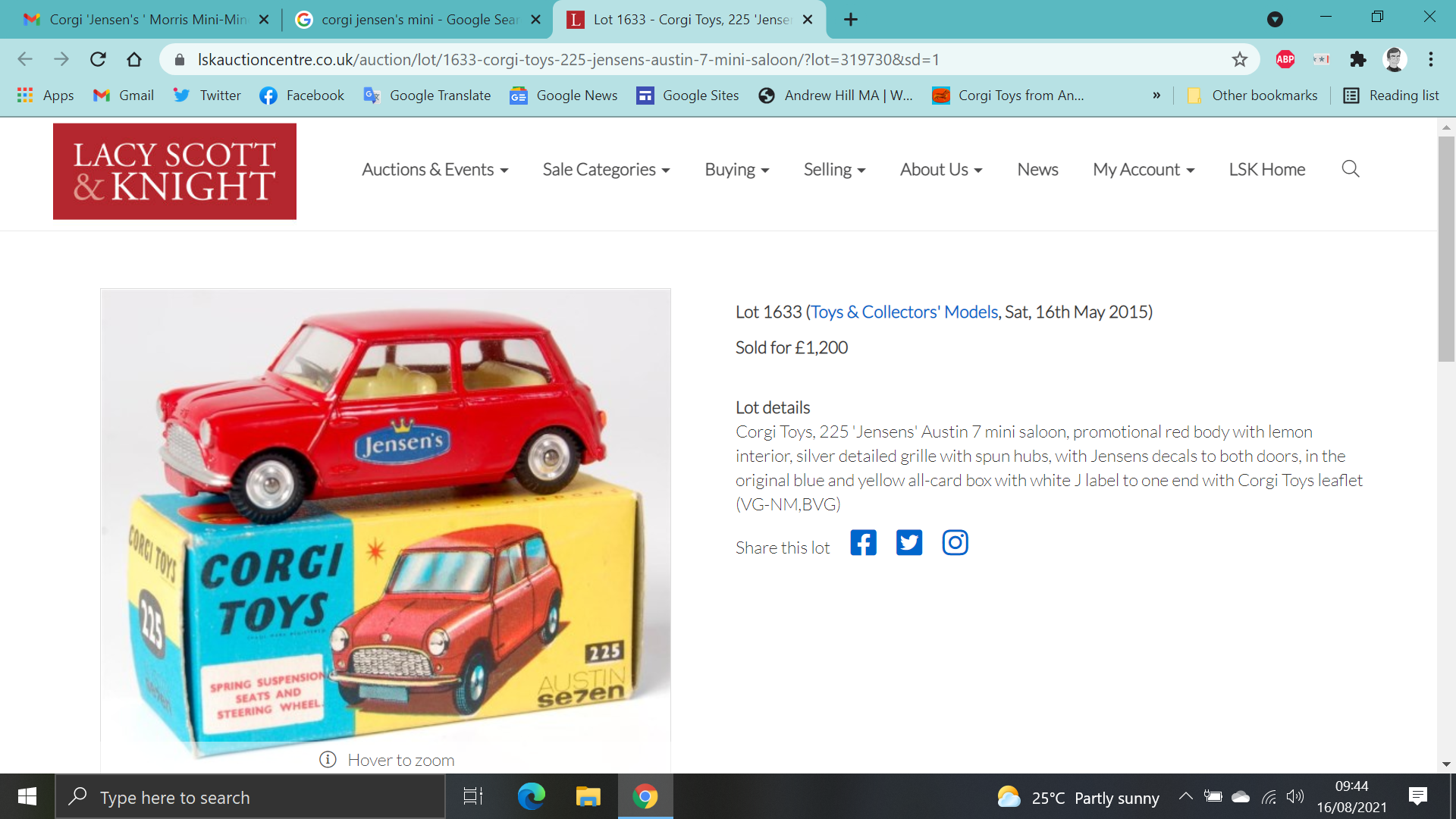
Lacy, Scott & Knight had this - again almost identical item - in 2015. One does wonder whether it might not have been the same one all along? Another poor transfer but another 'J' label on the box. Odd.


Vectis with a very pale blue edition in 2005. The transfer looks good but they refer to a 'Georg Jensen' card which rather ruins this one's provenance. No mention of a label on the box, either.

This is Vectis again in 2018 with a rather tatty Austin and another dodgy transfer but different to the previous one. The box has an odd mark at one end which is more likely to be where someone has rubbed off a price than where a J label night have been attached. This one does not look at all genuine.


And now, just to confuse us even more, another auction house I can't recall the name of had this blue Morris with old smooth wheels in a kind of mid-blue. 

Here, at last, is the mysterious 'J' label!! So I am inclined to go with this box, at least. I can't get a close-up on the transfer but it looks like I'd expect a genuine one to look, rather than the tatty efforts we've seen on so many on here. But then, just as we're beginning to think that everything in the garden may be lovely and here is something genuine, the firm declares, starting in capitals: PLEASE NOTE: The model has had applied ORIGINAL 'JENSON'S'  transfers at a later date. Hmmm. Jenson's. Even if we allow them one typo, it's all a bit weird.

So where does that get us?

A Morris box with a 'J' label is encouraging. There are also one or two genuine-looking transfers on a Morris but in all but this one respect, their provenance is seriously flawed by the reference to a Jeweller in Denmark. If the auction house genuinely believed that to be the case then we can excuse them where there's no additional stuff like cards or special leaflets added to the mix.

I am still inclined against anything but later shaped (and preferably free-spinning) wheels which tie in with the most likely production period. Perhaps samples of a Mini were produced earlier? That's my best shot at an explanation for good transfers on smooth fixed wheels.

I don't buy the red one, other than, again, as possible factory samples, but none I've seen are convincing, either because of poor transfers or boxes with prices on.

We still need to know (a) just who 'Jensen's' were (and, ideally, are now so we can ask some questions) and (b) when these would have been produced so we can try and exclude some base and wheel types. Finally, I'll try and get a good image of a genuine transfer too to provide another way to sort some of the good from the bad.

Anyone with any knowledge about this, please help! 

Monday, 26 July 2021

Minis 4 My Birthday


It's my birthday today so here's a post on one of my favourite Corgis. The little Austin Seven, as it was first named in 1959, first appeared as a Corgi model in January 1961 when it was listed as an Austin SE7EN. By then the actual car's name was being changed to Austin Mini but Corgi's stayed as Austin se7en on the box. In catalogues it started as an Austin 7 Saloon in the 1960 catalogue, where it appears in primrose, a scarce early colour and without any 'Available Later' tag despite not being in the shops, according to the Great Book of Corgi, until 1961. I wonder now whether that launch date is right?

It stays, somewhat inaccurately, as an Austin 7 Saloon in the 1961 catalogue but is now red and it remains red in future catalogues but with just the name Austin 7 in the 1963, 1965 and 1966 catalogues, disappearing in the 1967 one, somewhat later than the Great Book's suggestion of withdrawal in 1965.

It starts with fixed smooth wheels, then gets fixed shaped wheels and finally free spinning wheels from around 1963.

I happen to have just four models on my desk this morning and each is different, something which makes these models quite interesting to collect.


You'll see that these are, from left to right,

  • type 1a text on angled sides, holes in base
  • type 1c text on angled sides, no holes in base
  • type 2a text all on flat surface, no panels
  • type 2b text all on flat surface, no panels, post near sump.

These have free spinning wheels except for the first which has smooth fixed wheels. The base types are the most frequently encountered and I have written more about these across the mini range, for which there is a link on the front page of the news blog.

To the best of my knowledge, all the Austin minis have the first type of body, Type 1 which shows smooth front wings as the most obvious of several casting features. Type 2 of the Mini body has a distinct horizontal line and angle line on the side of the front wings and this can be seen on the later Morris editions. If, as I believe, this casting began to be used in around 1966 then it would seem that production of the Austin would have ended earlier. However, it remains something I always look out for, like the 226 mistakenly painted red and 225 mistakenly painted blue which do appear from time to time.


I only have a US 1960 catalogue to hand but the 1961 catalogue prices it at 3/5d whereas the 1966 catalogue has it at just 3/3d.


The one box that I have shows the higher price of 3/5d. Later catalogues, however, all have the 3/3d price for both the Minis.


Friday, 29 June 2018

What's Your Type?


Some time ago I tried to illustrate the difference between the two main Mini castings for Morris models. Using two black 249 models, however, wasn't the brightest of ideas as the colour made the differences barely visible! Yesterday a couple of wrecks arrived, however, and these make much better examples at this stage of having had the paint removed.

There are lots of changes at the front. The easiest to spot will be the join line between the headlamps - much higher and more straight on Type 2. 

The grille shape at the top centre (where a bonnet release catch may be located) is shallow and flat bottomed on Type 1, deeper and more angled on Type 2.

The proportions are also different in, for example, the windscreen area, being taller on Type 2, although, again, this is a lot easier to spot when you have the two side by side.


At the back the differences are not quite as clear on single items. The size of rear light clusters and proximity to the bonnet line are different. The petrol filler cap is also further from the boot line on Type 2. Type 2 has a larger boot handle.

In contrast to the front plates, the rear plates on the Type 2 are the shallower ones.

The rear bumper is a much neater, shallower element on Type 2.


Another usually easy-to-see difference will be on the side of the front wings. Type 2 has a clear horizontal line running the length of the wing. Type 1 does not, but often displays a line at 45° running from the wheel arch to headlamp surround. That reflects the line between two panels on the real thing at the time.


Although there are many other differences in the side view, I often don't notice them in single models at first. It is said that Type 2 has a 'bulge' at the back which some say is obvious but I seldom see that. Clearer for me are the window surrounds on Type 2, shorter door hinges and thicker A pillar.


No doubt you may have your own 'obvious' difference(s) but for those who have been struggling to see whether their model is a Type 1 or Type 2 casting, perhaps these illustrations will help. Incidentally, don't judge by the wheels! Whilst the fixed shaped wheel will always be a Type 1 model, cast wheels do appear on Type 1 models too.

If you hadn't already gathered, the shinier of the two models shown is the Type 1! These will soon be made into some fresh Mini Coopers and slightly different to any actually issued. One colleague has bought his daughter an orange and white real model and I shall try and create a copy of that for him.

I shall probably not be able to match the skills of Richard Hill (no relation), however, who has recently sent me these photos of his latest reconstruction of something similar.


We both have doubts about the fog lamp arrangement but his use of nice silver bezels for the headlamps and the addition of an accurate-looking driver are appealing. 

And yes, I do know that the Sun Rally model didn't have that fog lamp arrangement anyway and would have been a Type 2!! I guess there would have been two occupants too . . .


. . . and, as you'll see, Richard Hill decided the next day to have another go at those lamps!