Showing posts with label Citroen Safari. Show all posts

Monday, 1 December 2025

Corgi Toys @ 60: lots of valuable issues (if you had the early ones for Christmas!)

A huge number of new issues arrived in the shops in December 1965! I'll list them in catalogue number order, starting with the second appearance of the #242 Fiat 600 Jolly Ghia. It has lost the roof and comes only in a solid but cheerful yellow. Now with two people and a Corgi dog on the back seat too. 


This was not a particularly popular model and the attempt to make a few more sales from the casting was not very successful and it was quietly withdrawn from dealers' order forms after a few months. Really quite hard to find now.

Next is #256, the VW 1200 in East African Safari trim. This was a great model and something I was delighted to play with as it had really good steering operated by a spare wheel on the roof. So much more realistic-looking than the Austin A60 had been and with better ground clearance from the normal size wheels as well! The model came with a baby rhino about to attack the car on a pleasant scenic tray. The sticker on the bonnet was inclined to lift off but that didn't really bother me and I was more keen on things like the jewelled headlights and opening engine compartment at the rear and bonnet at the front. There was no space to carry anything so they seldom did get opened. I was also impressed by the use of a lovely bright silver base-plate to incorporate attractive bumpers and, remarkably, rear mudguards too!


The first issue was left hand drive but you will also find this in right hand drive form. There is also a very later edition where the jewelled lights have been replaced by rather tedious silver blobs. That's not an easy find either.

You may be beginning to see a trend here in these December 1965 issues.

Next is another casting re-use in the form of #325 Ford Mustang 2+2 Fastback Competition Model. Corgi have added bright red stripes and a coat of white paint to the lovely #320 model and it gets a fresh lease of life. There was a set of peel off numbers in the box but the RN2 shown here is not at all common. Nor are the very early models with shaped wheels as illustrated here.


This model can be found with the fullest range of wheels of any Corgi. First it had shaped wheels but only for a very limited time before wire wheels were fitted. Then detailed cast wheels appeared, the ones with fine spokes, before a chunkier style of 8-spoke cast wheel started to be fitted and, just to add more for a complete collection, these came in a gold finish as well as the plain cast silver-grey colour. Finally some wire wheel models had a red sill added! (The Corgi Model Club made a mistake in adding the red sill to their chunky 8-spoke wheel version.)

You will also have fun seeking out the different interiors. Whilst there was no Corgi dog in this issue, the interior was initially the same as was being fitted to the #320. Later the interior is redesigned and you'll find both chalky blue and chalky green versions.

Next on the list for December 1965 is the #468 London Bus, identical to the original issue other than its advertising which now features Outspan Oranges and this will be the most common version of the #468 model.


Later this will get cast wheels, lose its jewelled headlights and then Whizzwheels as well as a wide range of other advertising banners, some of which are hard to find now. Look out for transition models which have cast wheels but no jewels.

Another re-use of a casting is the Citroen Safari model which is basically the same as the January 1964 issue, also #475, but now Corgi Ski Club stickers replace the 1964 Winter Olympics ones.


The skiing character is the same, as are the skis and ski poles. You will find red and yellow with both #475 models. For a change, that's the only variation!

Now for another 'new' model that isn't really new at all. The #477 is identical to the later issues of the  #417S Land Rover Breakdown Truck apart from the new plastic canopy fitted to this one, replacing the tin affair that had been fitted since the #417 was issued way back in 1960.


This another of Corgi's very long-running editions and stays in the catalogue for many years, getting cast wheels, transfers instead of stickers and, of course, Whizzwheels in the 1970s.

Something else with some play value was the #478 Jeep FC-150, although this is yet another re-working of an existing model. The same Jeep in red and lacking suspension or interior was available as Gift Set 14 in 1961. Now the lamp standard has gone but the character still remains (for a while).

The boom can be found in painted silver, plain metal silver and also gold-coloured metal. There is a variation with a red interior and the wheels become cast later in its long life, although it never gets Whizzwheels, oddly enough.


Two more very simple adaptations prolong the life of a couple of other old models. The #1110 Mobilgas Tanker was first seen in 1959 with the Big Bedford cab. All Corgi have done is add the new Bedford TK cab and changed the number to #1140.


The same trick was done with the #1129 1962 Milk Tanker.


Add a Bedford TK cab and call it #1141. Corgi didn't even change the trailer component. Well, they may have changed the coverage of the light blue colour on the tanker towards the rear but, as it is so simple to swap things over, I cannot be absolutely sure. #1129 models seem all to have the blue colour all the way along the lower half whereas the #1141 stops in a 90° corner.

Both these models had very short period of availability for dealers to order and are hard to find now - but do beware of an old rear section hitched to a new front one. With the Milk Tanker, that's not so easy as the 'milk' blue is not the same as the other blues used for the cab. The red for the Mobilgas Tanker, though, is more readily switched.

Finally, for 1965, you could have been one of the first to have bought a Gift Set 32, the #53 Massey Ferguson Tractor with Shovel attachment and driver, towing the #62 Tipper Trailer (with raves) issued in February. The #53 is the last of the shovel attachment types in all bare metal.


This is yet another hard to find item now and a valuable Gift Set when in good condition with its original, nicely illustrated box and display.

If you had been lucky enough to get this lot, as shown here (apart from the late #256) in your Christmas Stocking (well, you'd have need a pillow-case!) then your parents might have forked out 87/2d (that's 4pounds, 7 shillings and 2 pence). Now, however, you'd be able to sell them for £1500 if you' d managed to keep everything nice and original, as well as the boxes, of course. (For reference, inflation between 1965 and 2025 would make the original price around £120 in today's buying terms. So definitely an inflation-busting investment that you could also have had a lot of enjoyment from - on the carpet in the 1960s and in cabinets in the 2020s (and probably the loft in the years in between!)


Tuesday, 2 January 2024

Corgi Toys @ 60: The Classics and Another Citroën


It's January 2024 and your local toy shop has something completely different, the first of a short series of Corgi Classics, vintage cars from the early 20th Century. The first two released this month were the Ford Model T in black as #9011 and in yellow as #9012. Each had a couple in the front and I believe it is the same couple each time.


The detailing is excellent and the intricate models, with many vulnerable features, were packed in a sturdy, thick card box with a separate lid, protected by a piece of foam rubber and an information leaflet.

These models were not cars to be played with, though. They were for display only and it was a quite different market that they would have been intended. They had no suspension and, whilst one or two might have been added to our layouts in the 1960s they were not really 'Corgis' as we had come to love.

Sales were modest but nothing like as successful as the normal range and at 8/11d they were expensive. You could have bought the Routemaster bus for 2d less or a Tractor and Plough set for 8/6d. Most model cars were four or five shillings, half the price of the Ford Model T. They are now very easy to find for just a few pounds and you should have no trouble finding models with intact windscreen and in original boxes with figures should you wish to build this collection. Maybe now that all Corgis from this era are just for display, these Classics will not appear so out of place and become more desirable after all!

Also arriving this month is the second appearance of the Citroën ID19, now in white with a ski rack, skis and skier character, a Winter Olympics transfer on the bonnet.


This is the April 1963 model but with a new fitting to the roof. This is usually red with yellow skis and poles but it also seems to have been issued with a yellow ski rack and there are red skis and red ski pole too. Perhaps every conceivable variation was available at the time or have items since been swapped around? The rack is not easy to replace, however, and both colours do exist. (There will be another, also numbered #475 but with a Corgi Ski Club motif on the bonnet issued in 1965, just to confuse us all!)


This model and the extras all came in a fairly normal-looking box. It is only the second to feature a separate character other than a driver or animal inside. (The first was the Jeep F150 with Tower Platform which had an electrician chap - but even was in the basket and not a standalone display like this one).


Saturday, 1 April 2023

Corgi Toys @ 60: a new Citroen and the Plymouth gets suspension


It's April 1963 and along comes a new Citroen, this time the ID19 Safari as #436. 


This was quite an exciting model with its opening rear hatch, making it the first car we could put things in or pretend to drive from the inside. The Ford Thames 'Airborn' Caravan had opening rear doors but this Citroen was more like a normal estate car. As well as a plastic luggage shape on the roof which could be detached, this has a very new feature - folding rear seats. You moved a small cog wheel near the rear wheel and the contrasting green seat would fold to make a usefully large and flat space at the back.

It had a Wildlife Preservation transfer across the bonnet to help register the 'Safari' title but mine spent all its days on my layout roads in Hertfordshire.


This Citroen would be a popular model and expect to see it again as Corgi revived the casting again and again right through to the early 1970s.

The other arrival on the shelves of your local toy shop was the second appearance of the big American Plymouth Suburban Sports Station Wagon, now as #443 with suspension and a new colour scheme of blue with a red roof.


Both the Citroen and Plymouth have free spinning shaped wheels.

Each of these models also had no variations issued, all having the same colour scheme and features throughout their production. I have often thought that there might have been some #219 models issued with suspension but I have never found any so I imagine they would only be factory samples if any did appear.


Friday, 13 May 2022

The Professor's 'Prototypes'


Updated 15 May with new information


Professor Cary Nederman from Texas A&M University has sent me these three models. He bought them some years ago at an auction and, for some reason, has been staring at them recently and wondering just what they are. In desperation, he turned to me and wrote at length about them but without images. I suggested that it was unlikely that they would be Corgi factory prototypes but the Professor was determined to find out and, without further ado, dispatched them at great cost via UPS to my address here in a small village in Northamptonshire, where they arrived earlier today.

I decided to publish my comments on these items as they may give some assistance to others who think they have something original which may not be. 


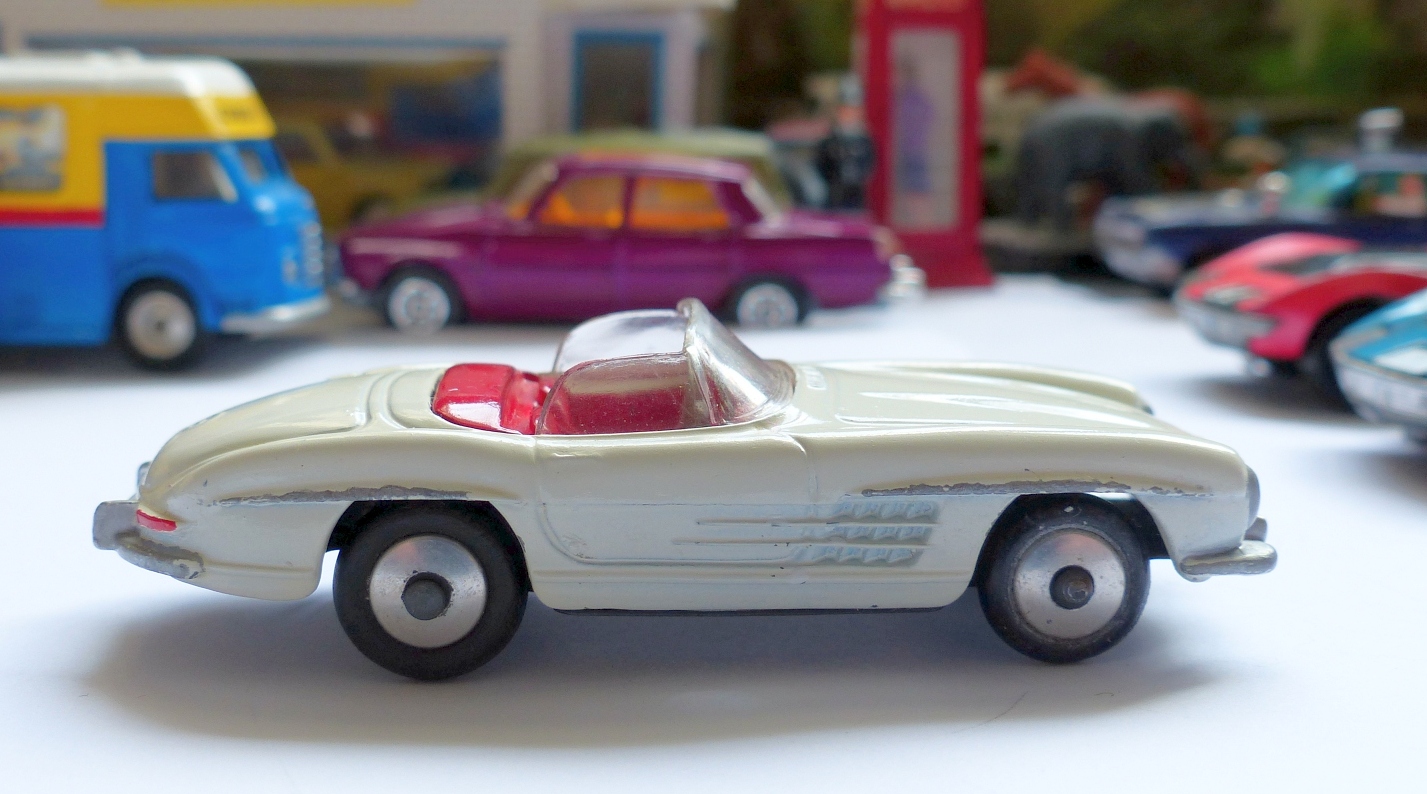
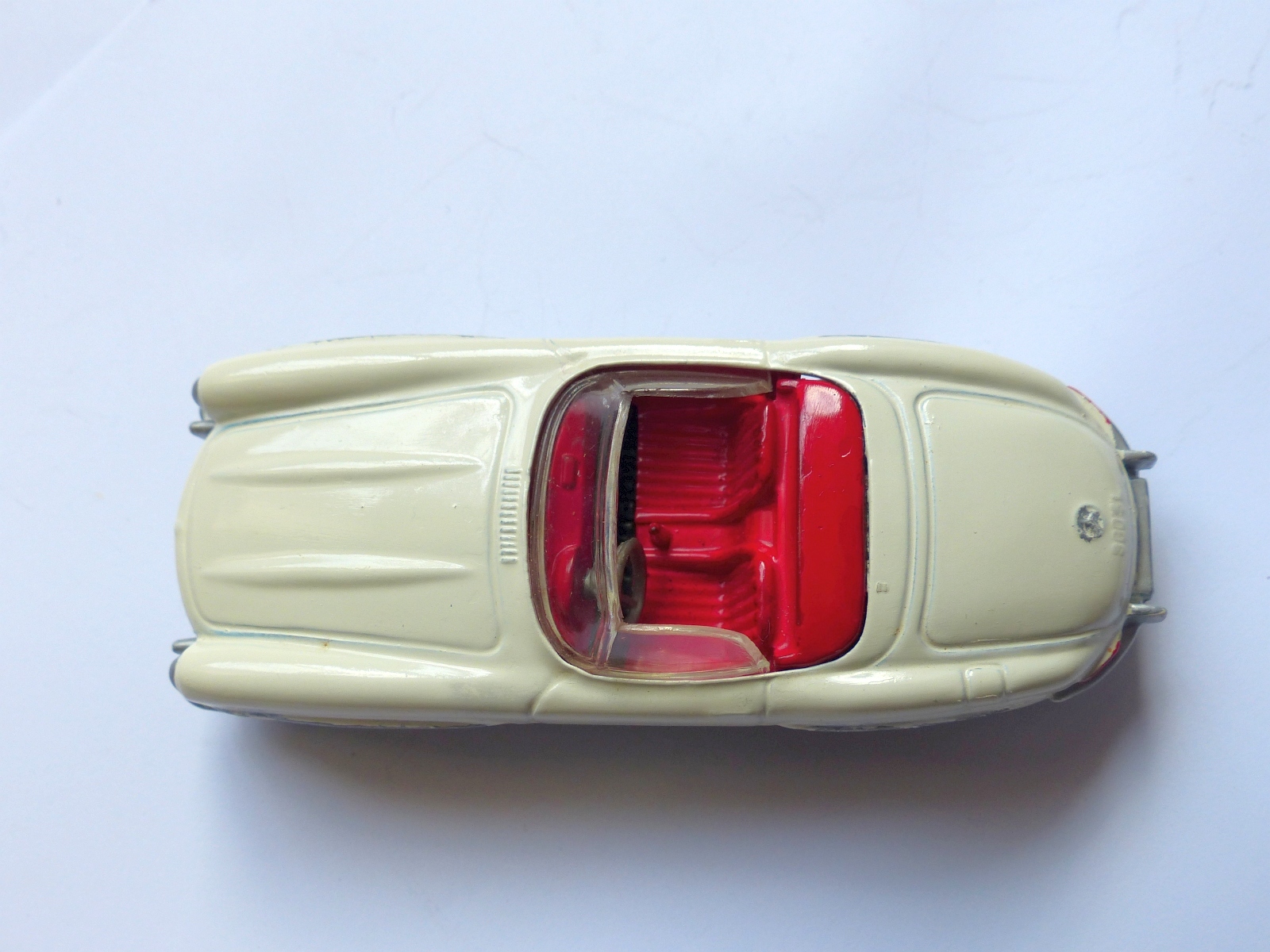
The first item is this white 303S Mercedes-Benz 300SL Roadster. It looks attractive in white with a red interior with the smooth but free-spinning wheels only to be found on this model.


It's missing a stripe but then early models with suspension didn't have the stripe so it sounded like an interesting item worthy of closer inspection.


Unfortunately, there are three things which make this something someone has created at some later date.


The rivet is usually the first thing to look at. Here you can see it is shiny and quite new-looking, and not really like any of the type of head that you will see on this model. It looks to me like one of a type that you can buy in packs of 100 from a replacement parts seller. I haven't tried but I suspect that a sharp knock horizontally might even dislodge it as these are usually glued in place.

The second is the overpaint of silver on the base. That's a sure-fire sign of something being amiss, although you also need to accept that someone may just have tried to touch up some paint on an otherwise original model.


The third sign, though, is more definite and shows some rather poor preparation of the original seating until before the red was applied. Not good and, coupled with the rivets, I was quite disappointed with the chap's work, whoever it might have been.

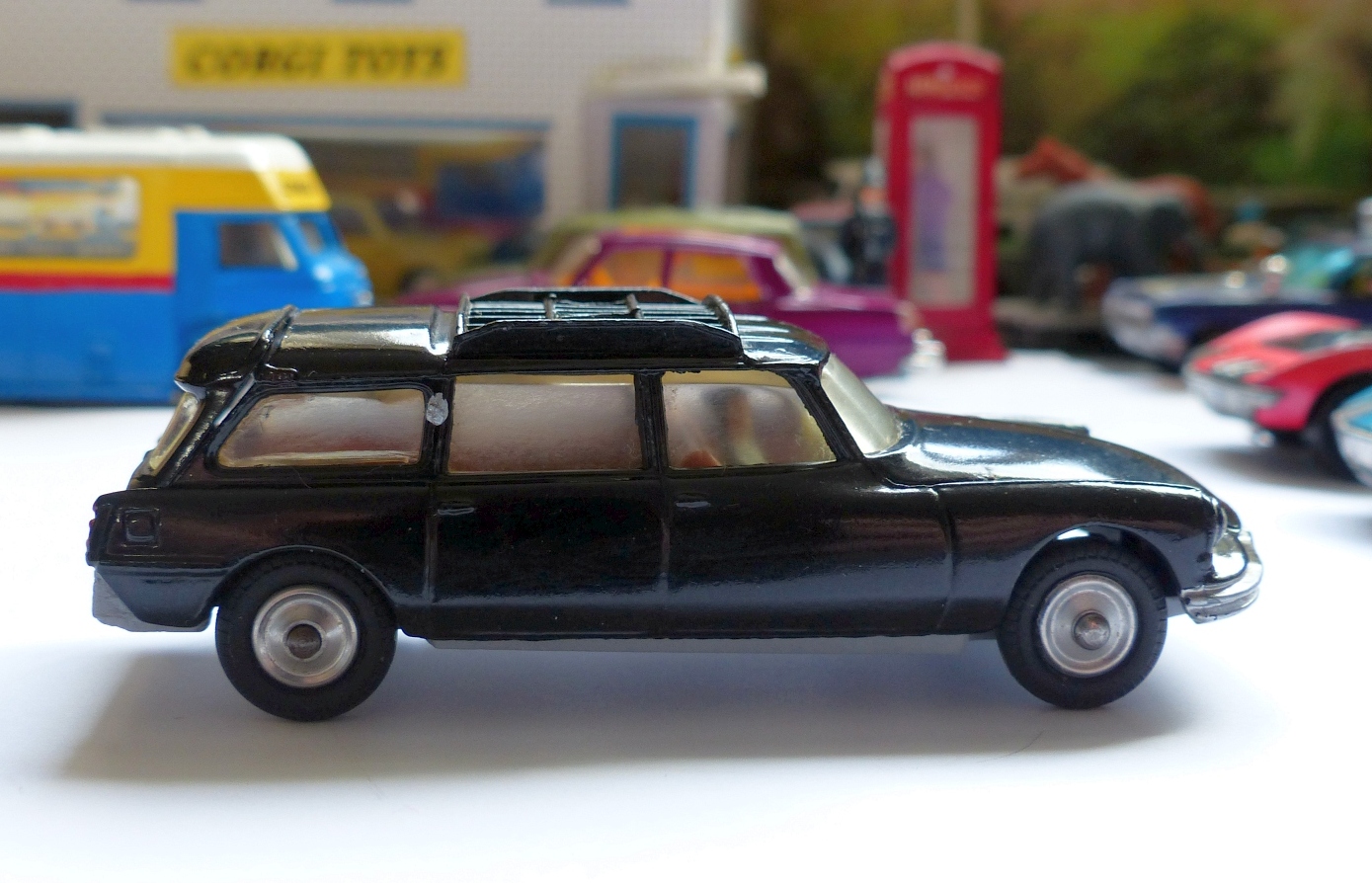
Next we have the almost famous Citroën hearse.


It looks fairly reasonable at first glance.


The rear window looked a bit odd to me and I thought it was a replacement. When it arrived there was what I had thought was glue around it too but, after cleaning, it does seem OK after all and this image just catches it at a bad angle. Of more concern, though, was the distinctly unclear windows pretty much all round. This strikes me as either a poor replacement or, more likely, someone has tried to clean an old unit and not used the best of solvents. Not obvious in these photos but the rear side window on one side is not well-fitted either, leaving a gap at the top I have never recalled noticing on any other of these models.

So my suspicions are aroused quite quickly. The finish on the paintwork is reasonable but the red paint has been added in a different design to that on the factory prototype. That has three distinct blobs of paint on the rear light section. This has the whole sections painted red.

Furthermore, the driver is a uniformed character which I believe I have seen in the early editions of the London Transport Gift Set taxi. My understanding is that the factory prototype had another character, not this one. I have not got a good copy of any image, however, so I am not sure about that. Hopefully someone will advise further, please.

There is also no coffin, although I can accept that it may have slid out and away into some box never to be seen again. This, however, is another fairly amateur production and I suspect that the creation of a suitable copy of the coffin was beyond the skills of this model builder, judging by his standards of window fitting and cleaning.


and, of course, we only have to turn it over and see the silly rivet heads anyway!


Nice grey paintwork on the base, though. Credit where credit is due. Below may be a picture of the actual prototype. I am not totally sure of its provenance, though.


Now for the star of the show. Page 77 of The Great Book Of Corgi has an illustration of the prototype that the factory made in 1959 of a 'Playcraft Promotion' van.


This looks great, from all angles.


The paintwork is very well-done and it has a much more professional air about it than the previous two. My suspicions have already been aroused, though, by them so, if they all came from the same source then it is highly likely that this, too, will be a Code 3 production by someone sometime. I need to gather some evidence, however.

I'll start with the tyres.


They are new replacements from a parts supplier that I have used before myself. Annoyingly, they come with those tiny bits of rubber attached to the tread. No factory production would have had these. However, we must allow for the fact that someone may have simply replaced them on an original model. So what else can I find?

Let's look at the base.


This time there are no rivets, just the twisted spurs which were used on a few models - notably the Ecurie Ecosse Transporter. One would have expected to see some damaged to the grey or blue paint had these been twisted to seal the base after fitting. I can only detect the feintest of marks. The grey paint is excellent but then it was excellent on the Citroën too.

So I need more evidence about this one. 

After a lot of searching I found some that had been sold by QDT and Vectis.


The QDT one made £100 and was described as a good copy of the prototype but with a different illustration in the window. Unfortunately for the Professor, his has the same illustration! His also has some display in the rear window, however, missing from the QDT illustration. There are also differences in the rear light painting, his having none, probably more accurate than the red and orange of this one, which would have been unlikely in 1959 when the prototype was said to have been made.


Above we have two of the Vectis offerings. These both have text along the red stripe at the side and each has a different display in the windows with nothing at the rear. You really would have expected people who go to the trouble of getting the paint right and lettering, transfers positioned well and all that to get the displays right! Painting three, sorry, four colours this accurately would not have been easy.

Finally, there is another problem with the Professors' edition. The wheels, not to mention suspension. His is a 426 Chipperfields Booking Office that has been revised. All the other copies of the prototype have been 407 Mobile Shops. If the prototype was supposedly envisaged and made in 1959, as QDT say the book says, then the 1962 Booking Office would not have been available. Nor would shaped wheels. Or suspension. Sadly, therefore, despite looking rather better on display than any of the copies I have found, it's wrong on at least three counts.

Update 15 May:

I contacted the person who bought my copy of the Great Book of Corgi (2nd Edition) and this has been most valuable. Firstly, the illustration.


It is immediately obvious that neither the QDT nor Vectis auction items were really anything more than rather poor efforts and I was wrong about the 407 being used as a base for the prototype. It just goes to show that you simply cannot rely upon the comments by even the auctioneers who specialise in Corgis! To be fair, Vectis did only sell their copy for £15 but QDT appear to have convinced someone to part with £100 plus not insubstantial fees for something which was quite wrong!

So we can see that the prototype illustrated by Marcel Van Cleemput was, indeed, based on a 426 Chipperfields Booking Office and it appears to have free-spinning wheels, unusual for that model and this was certainly made rather later than 1959. It would appear that people have been confused by the reference to 1959 as when the Display Van was first used at places like Silverstone Race Course (where, coincidentally, my contact for the book had been in charge of the place and may well have agreed to the Corgi promotion there too!) The construction of that prototype would have been somewhat later and that means that the Professor's model is much more accurate than I had appreciated.

It doesn't need the lettering on the red strip and the colours are accurate. Yes, the wheels are still not right but they're close enough for the copy to have some value. We can see that the window display is not correct but none of them have been. So, yes, it is wrong on a few counts but not as badly wrong as I had first envisaged.

So I am going to have to report that these are all copies, made by someone with some skill, certainly in the case of the Karrier Van, rather less so in the case of the Hearse. In this instance I believe the Professor agreed that I would be free to do what I wished with each of the models as he would not want them back and the cost of return, even at the rather more modest method I would employ, would be pretty much equal to the value of two of them. So, once I have finally concluded this bit of investigation, I may have these available for sale. The Karrier does look good, albeit with the slightly wrong wheels, and the Mercedes is an interesting item to add to a collection of those models. The Hearse will always attract attention too if someone cares to put it on their shelf one day.

In the meantime, if anyone has some good pictures of what the other actual prototypes looked like, do let me know. It would be helpful when I reply to break the news to my colleague.

Another update: from someone who knows about these things:
The top model was first reproduced by a very well know restoration specialist here in Sussex, Alan Morris. He did less than 10 examples and they are very nicely done. The colours of his examples are very true to the original, but the pictures inside of course aren’t the same as the original prototype. I’ve sold two over the years (not mine, it’s in the Museum on display) and they fetched £75-100 each, so there are collectors willing to pay for unusual examples of unissued models.

Friday, 8 January 2016

1964 Citroen Safari to Avellino


This is the Winter Olympics 1964 edition, minus skis, poles etc but in very good condition otherwise. This wasn't around that long being replaced the following year with a Corgi Ski Club version. Either can have red or yellow roof racks and the delightfully weird two-tone interiors.

Saturday, 19 September 2015

On Safari with a St. Bernard dog.


I finally found a decent Alpine Rescue version of the good old Citroen Safari that had been around for years. This is, in fact, pretty much spotless in that I can't see any faults other than some fading to the bonnet sticker. It needs another ski, the rescue chap and a St. Bernard dog and will then be complete. Yes, a St. Bernard dog. At least he doesn't have to go on the skis. Whether the rescue man comes with hands ready to grip the poles and holes in his feet for the skis I have yet to discover but I'll let you know when Mr Flowers delivers the bits.

These are making as much as £300 when with an original box and £200 like this which is considerably more than other models with shorter life spans. I am not entirely sure why. It was, admittedly, only around from late 1970 for a year and would have looked dated beside all the Whizzwheel models in the shop at the time but I would have expected that to result in a fair supply from old shop stock being available and not significantly higher prices than other models now.

It may be people wanting all the pieces and thus being able to display them interestingly, especially if this forms the last of a set they're collecting. The red roof suits the car nicely. The blue interior looks like a carry-on from #499 and it inherits its toboggan too and, of course, the skis and poles are the same as for several models before.

The side stickers are shiny, quite reasonable 'stick-on' types but the bonnet looks like cheap paper. This is a clear money-saving element. The previous transfers were much nicer.

This edition gets the cast spoke-effect wheels which are lovely and almost shiny on this example.

I have seen examples with red roof racks as well as others with yellow but so far they all seem to have the opposite colour for skis and pole so it looks like these are pretty much interchangeable and no combination is scarcer than another. That's just as well, bearing in mind how much you'll have to pay for this anyway.

So that completes the Citroen Safari collection, 1963-70.

499 Grenoble 1968 Winter Olympics


475 Corgi Ski Club

475 1964 Winter Olympics

436 East African Safari 

In my next article I'll look at what remains to be found.