Showing posts with label Mechanical. Show all posts

Saturday, 15 March 2025

Yellow, red and orange


It was really nice to return home from a week or so abroad and find three new arrivals waiting for me. Each comes from the very early days of fixed smooth wheels and no suspension or interior but they all have a certain charm and I am more than pleased to add them to my store, with one maybe staying in my collection.


First is a well-played-with 203 Vauxhall Velox. It came with the Standard Vanguard (below) so is a sort of bonus. It's the second edition of the Vauxhall, Corgi deciding that a fresh coat of paint might help them sell a few more in 1959. Most of the early range get a two-tone finish in 1959 and for Vauxhall the previous dull yellow or cream turns to quite a bright and cheery yellow with a red roof (and window frames). I think all these second editions had chrome fluting on the bonnet. This was seemingly randomly missing on the first editions, both in normal and Mechanical form.


The second is another Vauxhall Velox but this time it's the 203M model with not only a nice, smoothly working motor but also a pretty nice coat of orange paint (and no fluting). This is a notably scarcer finish as most I have encountered have been red. Having said that, all the red ones I have had to date have only had, at best, 50% of the paint left! I don't know why but these mechanical Vauxhalls in red seemed to lose their darker paint in large chunks. It's not as if they could have hit skirting boards or other models at great speed. Perhaps they simply couldn't be moved out of the way of a speeding non-mechanical model quickly enough. Anyway, it's nice to have the orange version which still has most of its paint. You'll see that this one also has tinted windows. These appear to be about as common as clear windows on all the older models.


Now for the star of the three, not that it really looks very special at first glance. This is a model that only a few months ago I wrote about, querying whether it actually existed or was just a production sample being offered by some dealer at a massive four figure sum at an auction I had spotted. Well, as several readers assured me, it was an issued model. They'd had one or seen one and I had to admit to being wrong that time. It was just so unusual for me to find a completely new variation after all these years! And now here it is in the flesh, on my desk and I can say it is, indeed, real.

Yes, this one is pretty worn but all original and no-one has been taking it apart. It is the Standard Vanguard III in a pale yellow with a red roof and window frames.


This one has the first type of red finish but the later type of base. I have examples of the normal pale green and red edition having the type 1 red paint with a grey base.

The yellow colour could be one of the many shades I have found for the 207M and the view is generally taken that when the 207was discontinued there may have been a batch of models in the 207M colour that needed to be sold as 207s. So a coat of red paint was added across the pale yellow to produce what I suspect must be quite a small number of these models.


Earlier thoughts that these had been accidentally painted in the second edition 203 colours are not correct.

So that's a new addition to the catalogue and my collection! It's not the prettiest of cars but, judging by how many I have seen in all the years I have been looking, it ranks up there with the blue Mini Marcos in the list of rare issued Corgi models.

Thursday, 14 September 2023

Mechanical model colours update


I have recently updated the table of colours which I have found on early Corgi issues.

The orange Austin Cambridge, red Riley Pathfinder and turquoise Hillman Imp are particularly rare as Mechanical issues. All the non-mechanical issues in 'M' colours are rare as these were only produced when the last of the already-painted bodies for an intended Mechanical model were paired with a normal issue base when the friction motor bases were discontinued.

If you have any other variations, do let me know. I have just added the blue 200 Ford Consul.

Thursday, 12 January 2023

Mechanical models: two base types


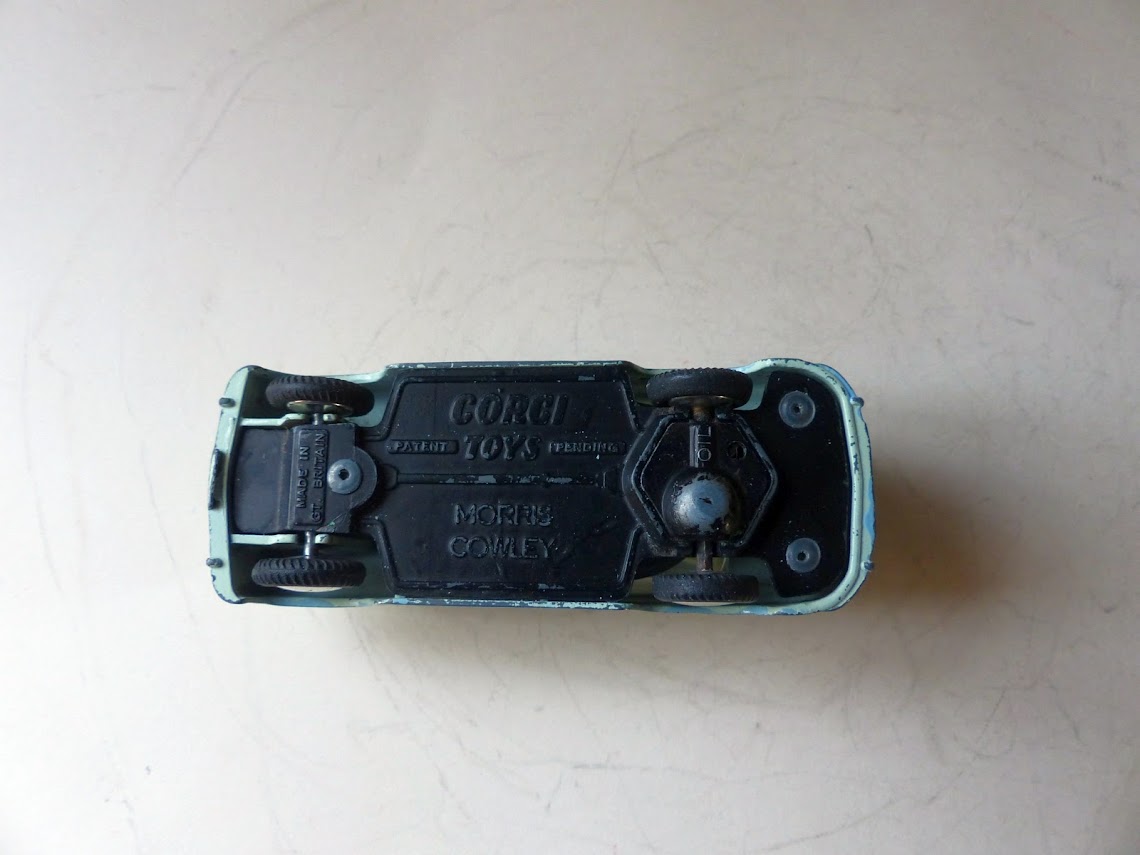
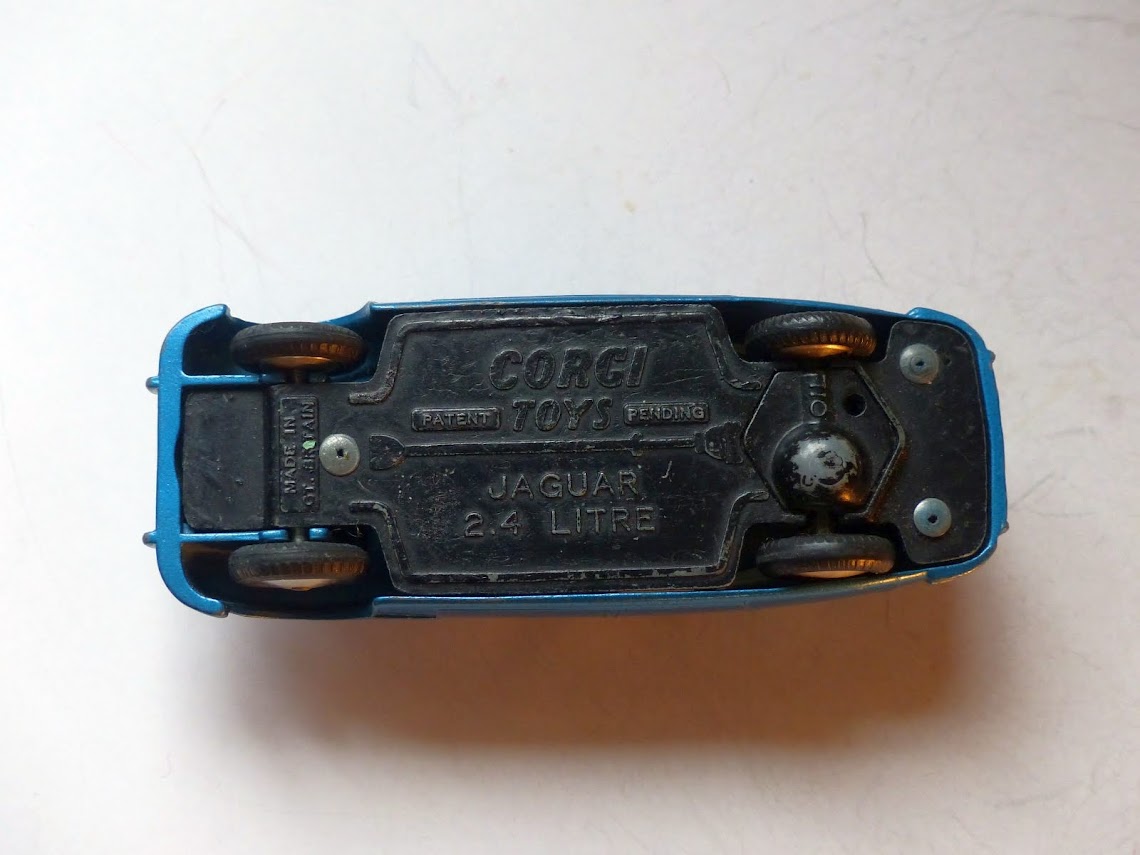
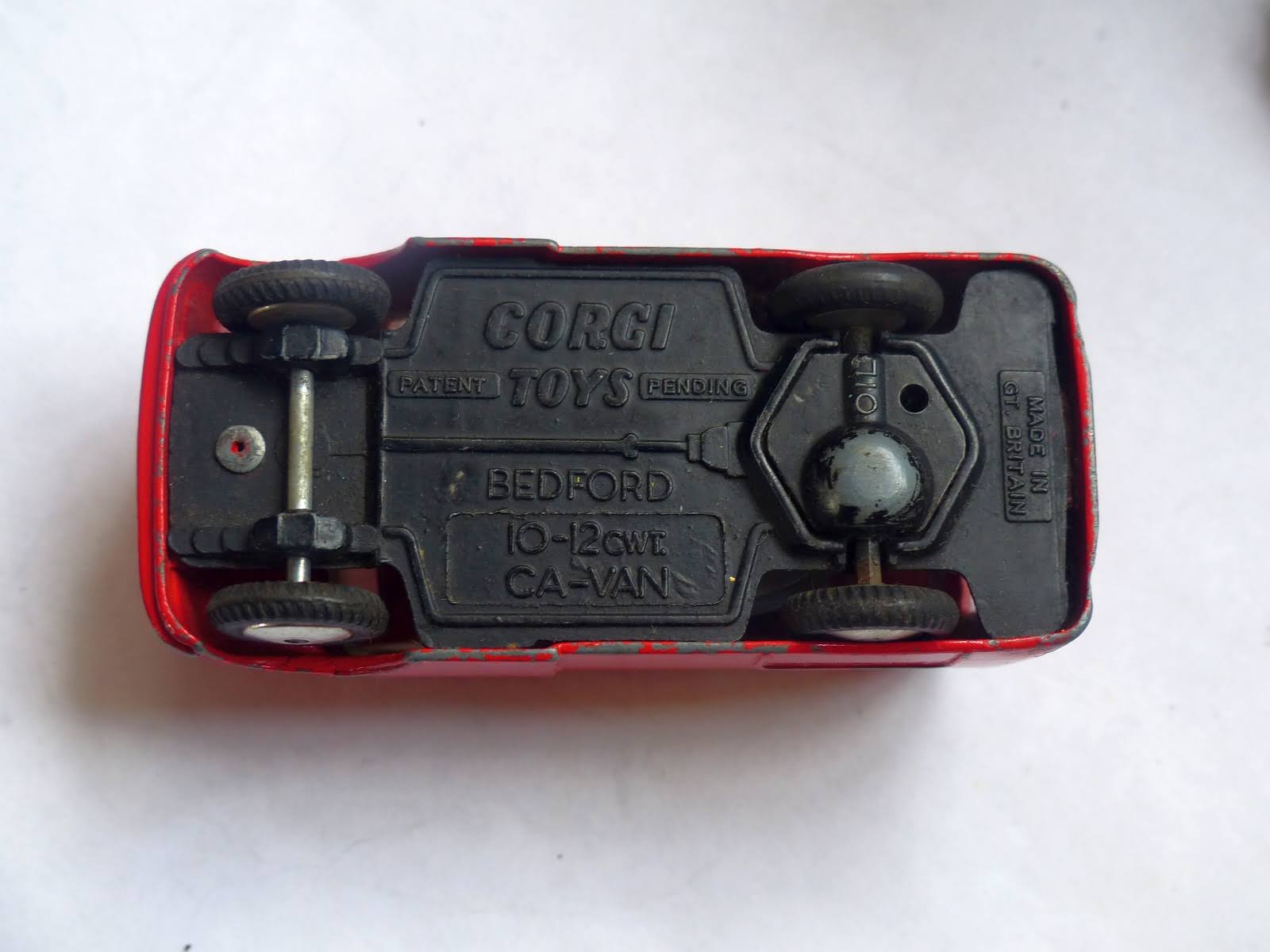
Following my last article on the Rover 90 I took another look at the undersides of my other Mechanical models. Here's what I found: each of the M models up to the Jaguar had both the Type A British Made and Type B Patent Pending text to the side of Corgi Toys and the changed axle text. The Jaguar also has a grey base variant which features the Type B text as you would expect.

I know there are grey base 207 Standards but I cannot say whether there are grey base 207M models. That is something to look out for, perhaps. It does seem highly unlikely, though, that any of the earlier models could have a grey base.

The 209 and 210 didn't have an M edition but the 210 has a variety of base styles I'll write about another day. The 211M, 214M and 216M all appear to have grey bases with Type B text.

I shall return to this topic as I can see that there are also different types of tin base for the non Mechanical models and variations are to be found on later models too. that will take a while to document, however, so don't hold your breath for that. Of course, if anyone has already done this research then I would be grateful for the data!

For now, here are the bases for the 200M,201M,202M,203M,204M,205M,206M,207M,208M,403M,404M and 405M


Monday, 25 April 2022

The Mechanicals

*2/9d in 1956 would have bought you one of several of the first issue of Corgi Toys. Or you could have spent *4/- and had one with a Mechanical motor which had a flywheel providing a continuation of the car's journey under its own steam. The trouble was that the continuation would be just a matter of inches and invariably resulted in the model crashing into the skirting board, a table leg or another model. The model was heavy and just a bit cumbersome. Whilst you could speed in the others, these versions just wouldn't do that, even if you did add oil to the little hole provided to help the gears do their work. The extra 25% or more just wasn't really worth it to many collectors and Corgi abandoned the idea sometime in 1959 with the models ceasing to appear on dealers' order lists in 1960.

Now the comparative scarcity of these models has made them eminently more collectible than the 'normal' issues and they're getting hard to find in reasonable condition and with a motor that still functions.

I have just added a section to my Catalogue to enable people to find them all quickly and see what colours they were sold in at your local toy shop.


These models were listed before but only under the make of vehicle so, if you didn't know which had M variations, they would be difficult to find!

The decision to end M model production had another interesting effect. There would have been a batch of models that had been painted already in the M issue colours and to which a simple tin baseplate would be fitted and the model popped in a normal issue box and sent off to the dealers and to be discovered by a lucky child in due course.

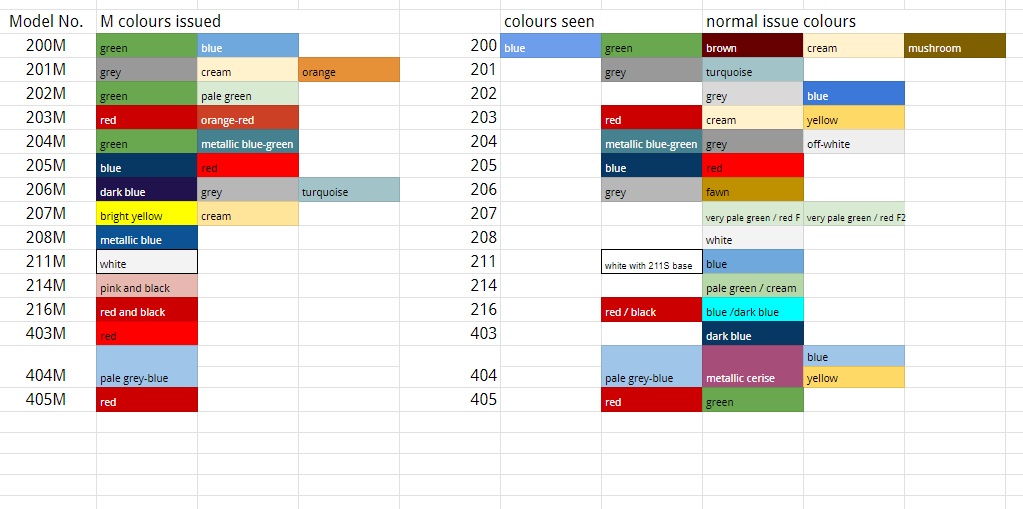
The table below summarises what I know about which may or may not be available. 
(Updated 14/9/23 to add 200M colour)


On the left are the known issue colours for M models. On the right are colours I have seen for the non-mechanical issues as well as the normal issue colours for the non-mechanical models.

You'll see that the Standard Vanguard, Jaguar, Studebaker and Ford Thunderbird are particularly notable by their absence, as well as the Bedford CA Van in KLG Plugs form. The Studebaker is, curiously, known without a motor but with a 211S base in white. Maybe there were no batches of these latter models in the production line with paint when the decision was implemented.

The corollary to all this you may think would be some of the normal issues getting Mechanical bases from time to time. This appear not to have happened accidentally (or at least not made it out of the factory other than in an occasional worker's pocket) or may well have been picked up as presumably the M models didn't have the slope to encounter en route to the box to check that they ran straight and well! Another sort of scrutiny may have applied which would have immediately caught any such oddities, unfortunately, for us now!

Only the Riley Pathfinder appears in both guises in both colours and I assume that the 205M in red was a deliberate choice for some reason.


* our currency prior to decimalisation in 1971 had pounds, shillings and pence. There were 12 pennies in a shilling and 20 shillings in a pound. Prices like 4 shillings would be written 4/- and 2 shillings and 6 pence as 2/6d. The d stood for the Latin denarius, vaguely meaning penny. It may also be omitted so that 2/6 would also be commonly used. 1/2 would be 1 shilling and 2 pence, not a half.

Sunday, 8 November 2020

Ford Thunderbird Mechanical and a question of boxes


This is not something you'll see every day. A really well-preserved Ford Thunderbird in Mechanical form - and the friction motor works smoothly too. It came from an auction in the outskirts of Leicester, another surprise win from a casual bid and I suspect that it may have come from the same collector who provided the Riley Pathfinder and Studebaker that were featured in a recent article here.

It isn't perfect so was probably disregarded by those who seek only mint models in mint boxes but I am delighted to have this and think that the odd small chip isn't such a bad thing and does mean the model has seen the light of day in its 60 years of existence.

The box is a bit of a mess, with flaps at both ends missing but it is the correct box and that's not at all easy to find these days in any condition.


It was the box that first caught my eye, albeit for the wrong reason. I had initially thought that the 'normal' box would have been the old blue style and that this new type would be something of a rarity, especially as the model was really not around for long, barely a year before being discontinued. This model first appeared in March 1959 and I believe that this 214M and its sister the 214 model were two of the first to have only the new style yellow and blue boxes.

From what I can gather the new style of box must have been introduced in December 1958 or January 1959 because the Jaguar 2.4 Fire Chief's car, model 213, only seems to have a new style box and that was issued at the start of the year, making it the first model to have only the later box.

The previous model issued was the 152 BRM F1 Racing Car and that may have a blue box (or a yellow and blue one for later sales).

So I was not right about the box being particularly special but it is still good to have even part of one. Perhaps I should look out for the BRM in the old box, though, as that, and a few other later 1958 issues, may be a little scarce.


Monday, 19 October 2020

Models you really wish you'd kept when you were young!

Three wonderful additions to my collection that may be available to buy. But warning: they're not going to be cheap!


211M Studebaker Golden Hawk
Nice working motor, original box.

205M Riley Pathfinder
Mechanical edition in red, working motor, original box.

273 Rolls Royce Silver Shadow
  Golden Jacks edition in scarce late colour scheme, original box.

Tuesday, 24 December 2019

A Calendar For Collectors

As I have around 400,000 photos of Corgi models, I thought it might be a good idea to gather some into groups and feature them in a calendar. I quickly realised that I could make several calendars and, of course, no single production would suit everyone so I shall add to these with, perhaps, Minis and one for each Catalogue section so I'll be kept well-occupied for a while!

The first three are now available for anyone who would like them for their own personal use. Just download the PDF file from my 'Catalogue' web site and print as you please.


Merry Christmas to all readers and collectors.


Tuesday, 4 June 2019

Corgi Toys @ 60: A ruddy great missile and the little Austin A40


In June 1959 the last of the Mechanical models was issued. It's the delightful little Farina designed Austin A40. The 216M models had a very short production life as it was later this year that the decision to drop the M models from the range would have been made. So there are not many of these red and black 216M models around and they fetch high prices whenever good examples do appear.

The 216 non-mechanical edition was usually blue and dark blue but a few escaped from the factory in red and black. they're definitely not easy to find these days!


You should also look out for the 216 with shaped wheels. These would have been fitted later in the model's production and are somewhat less common.


You need either to peer in through the window or look at the base to distinguish the 216 from the 216M in red and black!

The other new arrival on the shelves of your local toy shop would be the remarkable Corporal Missile on a launch platform as catalogue no. 1112.


This must have been a dramatic new toy to see and even now it stands out in any collection, simply by being so big - nearly a foot long - and just plain impressive. It first appears here with another clever piece of Corgi engineering. I can only imagine that there was this one chap working there who was brilliant at this sort of thing and was responsible for the whole range of military equipment loading and transport gear.


The two wheels can be detached so that the unit can be placed on the ground to receive the missile standing vertically. Four adjustment devices can be set to make it level on almost any surface and four shaped pins hold the bottom part of the missile in place whilst the base itself fits on the shaped platform centre.

Later in the year, an erector vehicle will come along which, with a few knobs being turned, moves the missile from horizontal into a vertical position to fit on the platform. However marvellous all this stuff was, though, sales were modest - the high price and, perhaps, a shrinking interest in all things military, meant that only 26,000 are recorded as sold, the lowest figure so far at that time.


There are no variations at the outset for this item but a replacement nose cone does come along later. That includes a metal section into which caps could be places so that we could make exploding bangs if the missile were thrown so that it landed on its top end. As a consequence, you may not find too many in great condition!


Friday, 18 January 2019

Black and grey bases


An interesting item came in yesterday, this Jaguar 2.4 with a friction motor. It has plenty of signs of wear but the windows are clear and the motor, whilst weak, does work. What immediately caught my eye was that it has a grey base. Every other one that I've encountered, and all those shown on several other sites like QDT have black bases. 


The text seems to be identical. I am aware of only one other model that can be found with either a black or grey base and that's the Standard Vanguard as an RAF Staff Car.


The 208M model first appeared in 1957 and production will have ceased in 1959, none of the M models being that popular. The last three M models were the 211M Studebaker Golden Hawk, 214M Ford Thunderbird and 216M Austin A40 and these were issued in late 1958 or 1959. All of these that I have seen have had grey bases and all the M models prior to the 208M Jaguar seem to have had only black. From this I am inclined to conclude that the change from black to grey bases would have been made sometime in late 1958 and, therefore, few Jaguars will have this.

The 352 RAF Staff Car was not issued until 1958 so I thought that a black base on this model could be quite scarce too. However, a quick look through Ebay and QDT pages shows that all but one for sale at the moment do have the black base. So that idea doesn't seem right! Maybe the 207 model didn't sell well and there were lots left from earlier years' production which Corgi painted RAF blue and turned into 352 models.


There are at least two variations of the bases for all the early models. That includes the tin base models as well as the solid base versions, whether M models or not, and the early racing cars and Bedford CA vans. The typeface for 'Corgi Toys' and the text itself and the layout you will find are clearly different and I shall have to make a study of these sometime.

For now, though, I would be interested to learn of any other models with both grey and black bases like these. There could clearly be an implication for values.

The 1959 Plymouth Suburban Estate car can be found with either a cream or grey base and the 210 Citroen comes either with or without a rear axle 'bulge' so it seems that the years around 1958-9 were a time of some change at the factory in this particular respect.