Showing posts with label Bedford CA. Show all posts

Saturday, 11 July 2026

New arrivals this month, including Noddy's Car

 Some very nice models have arrived recently, some for my own collection and others that I hope a collector will consider purchasing.

I'll start with the Corgi Major 1133 Troop Carrier. I have tried many times to figure out not only the differences between 1118 US Export edition and 1133 but also which 1118s and 1133s had the solid or 'see through' chassis. I have sort of given up and this one disproves another idea I had - that 1133s had a canopy with an indent where the star was placed. This example I am satisfied is an original, bought by its last owner new in America. It has a canopy with no indent and a star but comes in a 1133 box and, hopefully consistent with all 1133s, has the text along the side of the bonnet.


So I shall have to update my Catalogue entries - again! I think it is correct that the 1133 has no insignia on the front or rear and the star is applied to the two doors as well, rather than the bonnet. This has a nice, complete original box - the 1133 issue being the thin card type with flaps as opposed to the thick type with a lid.


Next is this lovely old Bedford CA van, here in Fire Department guise as #405. Note this is not #405M, having no friction motor and a tin base. This is quite rare as the #405 models were usually green with AFT transfers (as the box text declares). 


It has an original metal ladder in black and the later, slightly updated grill casting. The box is not something that is easy to find these days and has survived nearly 70 years pretty well!


At the opposite end of the Corgi spectrum we have the penultimate use of the Citroen casting, now quite disfigured with Whizzwheels and some chap with a megaphone standing in the back together with a row of spare bicycle wheels.


This one did have an aerial that was intact but movement in the box due to the missing inner tray led to it breaking on the way to me. I still have the broken part and it could be reattached by someone with a steady hand and strong glue. I did manage to get the thin pole for the parasol on the Corgi Kit Motel Chalet repaired so will have a go at this and report at some point in the future should no-one buy it in the meantime. I don't think there is anything special about the inner tray by way of design or printing so I may reproduce something as the outer box is perfectly sound.


In its glorious liquid metallic blue finish, the Toyota 2000GT is a lovely looking model, although the Whizzwheels do let it down. I fitted some wire wheels to one a while ago and that made a huge difference. However, I shall try and leave this all original as it has a nice, complete, original box.


The aerial is also in place, as are the jewels front and back. The white ones at the front can often go missing. The box is lovely and has the correct inner section with a cut-out for the screen.


In a less impressive and solid blue comes the very scarce Whizzwheels edition of the Chevrolet Camaro, issued as #304 for a very short period on dealers' order lists in 1972.


This also has a nice original box.


Lastly, and now for something completely different - Noddy's car! I remember buying one of these when I was at St. Andrews University in 1970. Not because I was still collecting Corgis then but Noddy was very cool at that time in that environment, in similar way to the Magic Roundabout, for which Corgi also produced lots of models and characters a little later. These, incidentally, included the final throes of the Citroen casting as Dougal's Car in November 1971.


Whereas mine had a nice original Golly in the back, this one has the politically correct Mr Tubby Bear. Of course, now even the suggestion that Mr Bear might be a little larger than his BMI figure would be regarded as 'inappropriate' or some similar word by the woke community. As for Noddy's friend, Golly, he has now been virtually 'disappeared' like some resistance campaigner in some countries run by the Communist Party. I was ordered by Ebay officials to remove photos of a model, with an original friend, from listings and I am not too sure they were happy with the name Golly either. 

This was, as I recall, the very first signs of wokeness or political correctness, not that either expression was used in conversation or articles at the time. I remember having this feeling that something wasn't quite right about effectively 'banning' a Noddy Car with the first Golly in the back. He had a jet black face, just like Noddy's friend in the stories had. Corgi changed that by painting it grey, which struck me at the time as an even more insulting way to deal with the character! The grey-faced Golly did last a few years, though, for some strange reason being more 'acceptable' to whoever decided these things. Finally, however, he gets dismissed entirely and the fat bear takes his place.

An original with the black-faced Golly is now one of the more valuable Corgis from this era and very hard to find. Amusingly, Steve Flowers at Model Supplies does a reproduction Golly for £6 and I am not sure it is easy to distinguish from an original lump of plastic or rubber. He used to advertise both the black and grey-face options but now I don't know which is supplied. I may enquire. it is easy to remove Mr Tubby and this might make the item more interesting.


As it stands, it is still a nice addition to the Comics collection, for those who like that sort of thing. The box has a tear at the top and bottom on the right but is otherwise remarkably complete and clean. The cellophane invariably gets torn as one or other of the hats scrape by on their way in or out.

It's nice to see both chrome lamps in place. I recall that my own Noddy's Car lost one lamp in a matter of weeks.

So there are some new items in my cabinet here, For prices or any more information click on an image or drop me a line.


Thursday, 1 October 2020

Corgi Toys @ 60: new models, revamped models and a launch ramp.

Here are the new items on the shelves at your local toy shop in October 1960. Quite a selection! I guess this might have been some sort of planning for Christmas too as no further models were apparently released that year.


The first is the launch module for the Corporal missile. It's a highly detailed and wonderfully well-engineered little thing, with stabilisers or feet which screw down individually to ensure correct positioning on uneven surfaces. The wheels can be removed and the support arms fit into grooves on the side of the missile. It has a tow bar and would usually be pulled along behind an International Army Truck with which it appears in Gift Sets. This item would in most instances have been obtained in one of the Gift Sets with the missile and maybe with the Missile Carrier vehicle too so it is unusual to find it in its own box these days. Very few were sold individually, one in a good box now being well worth getting hold of.


Another Corgi Major and the first Chipperfields Circus model arrives in the shape of the International Truck now with a re-worked rear section that carries a jib. Compared to the army models this is rather basic and crude engineering. The jib is bare metal and raised by hand in three steps on a simple ratchet device. There's a large and not very pretty handle to lift or drop the hook.

The six wheels are now painted Circus blue and the old truck gets an extension to its life. Indeed, it will even get suspension later, which the army version never does.


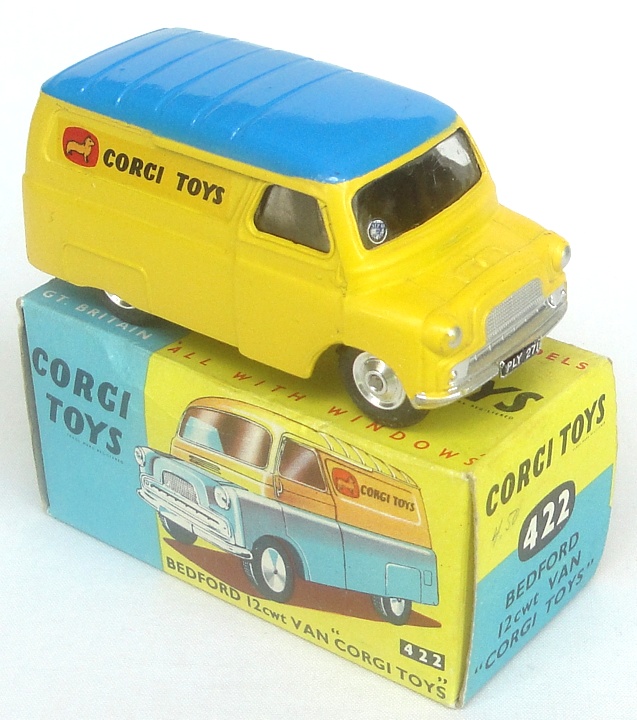
Amongst the commercials Corgi produced another Bedford CA Van with a single screen and revised front end, appropriately bearing Corgi Toys transfers. It gets a new catalogue number, 422, following on from 421 for the Evening Standard version. To the confusion of children then, but much to the delight of collectors now, Corgi seemed to be unable to make their mind up for some time as to where the blue should go and to what extent. So you will find this half-and-half model as well as one that is blue but with a yellow roof and another that is yellow with a blue roof.

The last combination is the one that is by far the most common, the other two being really quite expensive to acquire now. Indeed, I have had to steal a photo of the 50-50 edition from QDT as I have always been beaten in bidding to date and it has not turned up in any collections I've handled.


The wheels are usually smooth on these models and, from my research, exclusively so for the two less common types. The yellow model with a blue roof has shaped wheels on its later issues.


418 is the Austin Taxi. It appears here for the first time in an extremely long run as it will stay in the catalogue right through to the 1970s when a 1:36 scale version eventually replaces it. I think that makes it the longest-running model without a change to the body. Land Rovers and Minis have a good life too but they get quite a few adjustments made along the line. The Austin Taxi stays just as it was in October 1960, getting only different wheels, interior colour, screen tint and a couple of drivers at various points.


Another commercial and another outing for the Karrier Bantam, now as 413, a Mobile Butcher's Shop. It's very similar to the 407 Mobile Shop, little changing over three years and this has the same style of metal with illustrations visible at the rear and paper stickers at the side and front. Early editions have smooth wheels, later ones have shaped wheels, all fixed.


Two cars are issued too this month - the TR2 gets a re-worked front end and becomes a TR3. It is always in a pale metallic olive-green with red seats. Early editions have smooth wheels and later ones shaped wheels but always fixed. Although production continued for some years I don't believe any got free spinning wheels.


The final items on the October agenda is the revised Jaguar 2.4 Litre, now as 208S and with an interior, suspension and a coat of pale yellow paint. Again, early editions have fixed smooth wheels and later ones fixed shaped wheels. This doesn't get free spinning wheels.

Saturday, 22 February 2020

A brief look at wheels on models produced in 1960

Some time ago I looked at the possible distribution of wheel types during a production period for Corgis. In particular, I am interested in establishing the comparative scarcity of one or another type for a group of models issued between early 1960 and early 1961.

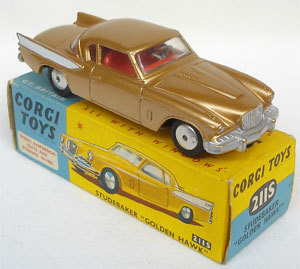
Painted 211S with smooth wheels (acknowledgments to QDT)


These will have all been first sent out to the shops with smooth fixed wheels with later editions fitted with a shaped, but still fixed, wheel. One or two long-running models will also have had free-spinning wheels fitted at a later point.

In a not particularly scientific survey, the chart below shows the distribution of wheel types that I found on models for sale or sold on a few web sites.


The key S = free spinning, F = smooth fixed, F2 = smooth shaped, F3= cast fixed (as on 218).

The models which did not have a great period of production after 1961 show a marked scarcity of the shaped wheel variety - in fact I was unable to see any for the 421 Bedford Evening Standard model.

For those that had a distinctly longer life then the fixed shaped wheel still seems comparatively scarce and similar in proportion to the free spinning wheel that followed. The 218 Aston Martin is a good example where one might have thought that the cast 'spoke effect' type was scarce but, in fact, it seems quite plentiful and it may be the fixed shaped type that is the one to look out for.

One surprise for me is the lack of any 210S Citroen models with free spinning wheels. I have two in stock but that's all I noticed anywhere. They are also both the variety with fog lamps in the casting. I find it hard to believe that the change of upper body casting corresponded to a change of wheel as I had regarded the fog lamps version to have been issued after the 323 Monte Carlo edition had become dated, the holes for jewels being filled with mazak instead. By that time one would have expected the 210S to have been fitted for some years with free spinning wheels.

I should mention that the 211S Studebaker figures are split between two models - the June 1960 issue with silver or gold-plated finish and a later issue with gold paint.

The Jaguar Fire Service model was the last model with normal-size wheels to be issued with the smooth fixed type, which is why I stopped at March 1961. Prior to January 1960, though, there are several models which also continued in production for many years and these I shall have another look at in a while. Generally, though, for the earlier models we know that the fixed shaped wheels are less common or really scarce in some instances and there are likely to be fewer surprises in that data.

422 with shaped wheels (acknowledgments to QDT)


For now the search is on for some Bedfords with shaped wheels, a Studebaker painted gold with smooth wheels and the errant Citroen with free spinning wheels!

Wednesday, 29 May 2019

Unusual arrivals this month

From time to time I list some of the models that have arrived here in the village. Nowadays, having acquired most of the 'normal' models that I needed for the catalogue project, I tend only to buy items that are a little scarce and often more interesting.


The first is this lovely 252 Rover 2000 in maroon. Although I expect some reached shops in boxes, this colour was mostly only found in the Gift Set 41/48 with the 1138 edition Ford car Transporter. These were popular sets so the Rover in this colour is not particularly scarce but this is the first I have encountered with cast, spoke effect wheels.


This style of wheel was used across the range, including Land Rovers and commercial models, from around 1967 and the International Rally edition of the Rover issued in February 1967 only had the cast type of wheel. Most other models started with normal wheels and then had the cast type fitted at some later date which I've tended to regard as being around 1968 in most cases.

The make-up of the Transporter Set changed in early 1969 when a new Scammell cab was also issued. So there may have been a year when the cast wheels might have been fitted to this Rover but I suspect it will have been rather shorter a period, (simply based on my  never having seen any, which may, of course, be inaccurate!)


Next is the very scarce Citroen DS19 with fog lamps included in the casting (not jewels as in the Monte Carlo edition). This example had been sadly repainted and the base had been removed so there wasn't much I could do with it. I had intended to restore it but decided to stop at the shiny mazak stage which I feel is a nice way to display this unusual casting. 

I do have an issued and unadulterated red model with these lights too.


The Mercedes may look unexceptional at first glance but its free-spinning wheels caught my attention and it did, indeed, turn out to be one of the very first 303S models issued with suspension. The interior is the same as the 303 model - white with a black steering wheel. It was not long before this was replaced by a white model or silver plated with interiors in a different style.

This model fetches high prices when it does appear but mine is not in great condition, some corrosion having affected the top surfaces.


Here is something I had been looking for for years - a blue 300 Austin Healey. I had doubts about its existence for quite a while but eventually found evidence that it really had been made, with red seat inserts. This example had had a lot of extra paint applied by one of its past owners, presumably in an attempt to cover up chips and scratches. The colour used was not far off the original but it did look, on first glance, like someone might have started with a cream or red one and painted it blue. Looking underneath it is clear that it was originally blue and the base has never been removed so all is well. There is still work to do to remove some recent paint but that's a slow task.


The Bedford CA Van in Ambulance guise as 412 was a common little item with the split screen but this Mk II version was not referred to in the Great Book of Corgi or accompanying lists and so tends to be missed by people making lists based on that source. It is certainly not a common item and would not have had a long life. Indeed, it is likely that the 414 Military Ambulance would have been the intended 'replacement' and I don't think we'll find that many of these single screen 412s will be around.


It's not very scarce but I find it hard to resist nice examples of the 216 Austin A40 with shaped wheels. Such a pretty model.


This is scarce - the 324 Marcos 1800 with blue stripes is, I'm told the edition for export to Canada. We got green stripes. This is only the third I have encountered in many years. The first was, strangely, at a talk I gave to a Welsh Society meeting when someone in the audience who had worked with Messrs Marsh and Costin on the real cars took one out of his pocket, totally unaware of its value!


Lastly for now, it has taken a while to find this uncommon edition of a 214 Ford Thunderbird with shaped wheels. In reasonable condition, too, and this can only have been one of a very few late models made when this style of wheel was fitted just before the 214S replaced it.
 I am still looking for a decent 215 with shaped wheels. I have concluded that there will be none of the M models with them, but there is a slim chance of the two-tone issues of the Ford, Austin, Morris, Vauxhall, Rover and Hillman having them. I have the Standard and both Rileys with shaped wheels (the Standard, interestingly, also having a different red paint area!) and by the time the Jaguar was in production they were fairly common.

So it has been quite a month for the unusual!


Thursday, 7 February 2019

Corgi Toys @ 60: Two tone and Bloodhound missiles

It would be the case that early 1959 issues were destined to have short lives. All those issued in January and these, issued in February, were withdrawn in less than two years. 

Firstly, the Powers That Be decided that interest in their original launch models could be revived and sales extended a little further if they were given a new 'two-tone' look. Whereas the original issues can be found in a range of colours, these six appeared in just these colours. 

You'll see that some of the paint schemes are more accurate than others!


February 1959 also saw changes to the Bedford CA model, the later single screen casting being used now with its revised front end and minor changes elsewhere, as well as a ribbed roof. The first issued model to get this mark II treatment was the 404 Dormobile. It can be found with a 50-50 scheme as well as a blue body and yellow roof. Each of those variations is scarce and good examples usually cost a fortune.


The Riley is conspicuous by its absence and would have been a lovely model in two-tone. I guess that the red 205, which lasted longer than most of these original issues, was selling well enough. The Standard Vanguard III had, of course, already got the two-tone treatment.

The other issue this month is a reappearance of the splendidly detailed and quite impressive Bloodhound missile, mounted on a khaki trolley. Some nice engineering clasps the missile nose and can be used to raise it whilst maintaining its horizontal aspect. Both items were included in Gift Set 4 and will be in Gift Set 6 later in the year, as well as being issued individually some time later.


It is an odd combination when towed by the RAF Land Rover, with which it is coupled in each Gift Set. The missile seems always to be white and the detachable side elements yellow. I have seen the rocket ends in red or just silver and the vanes or wings can be white but seems usually to be yellow.


Saturday, 4 November 2017

Corgi Toys @ 60: Bedford Ambulance


This month in 1957 saw the little Bedford CA van in St John's Ambulance guise. A common sight at the Hertfordshire Show that I used to go to with my dad (and, no doubt at all sorts of other public events across the country).

In cream with the St John's Ambulance motif, this stayed around until some time in 1960 when it was updated to the single screen casting but retained the same catalogue number. The single screen versions are hard to find, not least because many seller advertise the model just from one side!

412 has an opaque section for windows at the sides and rear. I believe it can be found with both types of grille - the rounded top shown in the image above, as well as a distinctly straighter top edge (although that edition I have yet to obtain).

I am not sure that there will be twin screen editions with fixed shaped wheels and they are likely to be pretty scarce on the single screen edition too.


Wednesday, 16 August 2017

Pale blue Bedfords

I often wonder what the idea of the friction motor was. I guess it was intended to add some realism with the creation of some noise, vibration and, on a level surface, a model could be seen to move momentarily on its own without a giant hand descending from above being required to direct its progress.

It would only last a second or two, though, and then grind to a halt, rather the reverse of what cars and vans tended to do in real life when given a good shove for a bump start, for instance!

My colleague, Herr Richter from Eilum in Germany, sends me this story of two Bedfords.

He found two pale blue Bedford Dormobiles parked nearby. At first glance they looked pretty much the same. 


Looking at the front, however, there were clearly different radiator grills. One was distinctly rounder along the top edge than the other.


At the back, too, more differences, with one having two extra bits - either the rubber protectors that some had fitted, perhaps, or two extra lights of some sort.

Had he been able to lift them up and turn them over he would have discovered two things: that one was much, much heavier than the other and that one had a totally different base.


Herr Richter appears to have found quite a rarity - a pale blue 404 Bedford that is not a 404M! We have seen the metallic cerise and cream 404s but I was not aware of a pale blue variation.

Incidentally, there are also two versions of the pale blue 404M - the front axle can be open or closed, the former missing the lowest suspension section that covers the axle in the latter.


This story also gives me another idea for the friction motor's use. Place these two on a matt to take some photos and you have to be very careful not to find one of them heading off on its own down the merest of slopes. The good old 404M just sits there, obediently going nowhere!