Thursday, 5 March 2020

The mysterious Aston Martin Competition model


Look through the 1965 Corgi Toy Catalogue and on page 12 you'll see the 309 Aston Martin Competition model with spoked wheels


This was an update on the 1963 catalogue in which the illustration showed normal shaped wheels. The little red book that was issued with The Great Book of Corgi (1st Edition) also lists this quite specifically with an issue date of December 1964.

The same catalogue and leaflet also show the 303S and 304S Mercedes 300SL models getting the same treatment. For a long time I had assumed that this referred to the issue of the Mercedes cars with cast wheels with a louvre pattern of the same type found on other models. I had seena  few of those. Then I discovered genuine original examples of the Mercedes with 'spoked' (wire) wheels and had to accept that they did exist, eventually owning both.

The Aston Martin, however, remains, in my opinion, one of the scarcest models of all if, indeed, it does actually exist. The date for sales ending is shown as 1965 so a December 1964 release would imply low numbers anyway. We know that the Mercedes are few and far between. I have encountered three so far in about 7 years and that includes many views of Vectis and QDT auction lists. I have neither seen nor heard of the Aston Martin and that intrigues me.

Fitting wire wheels (as I call them) makes so much sense and I have always though that they would look fabulous on the model. Eventually I found a late issue 309 (with the closed vent) that was in reasonably good condition and available at a reasonable price too and have used this to make a copy of that elusive holy grail of a model. 

The wheels are from a Ferrari Berlinetta of similar vintage and the axles are as fitted to the original Aston Martin model. Removing the shaped wheel was quite hard work and required a bit of patience to file down the ends of the axles without damaging the paintwork but otherwise replacement was a pretty simple job.

This will now take a prominent position in a cabinet at home until either a real one does actually appear at a price I can afford, (or persuade myself that I can afford!) or until someone pays the very silly price that I shall ask for this one. Hopefully the promotion of it will encourage more people to have a look through my catalogue and stock and buy something or, often equally valuable, bring me some useful background information or technical knowledge.


Monday, 2 March 2020

Corgi Toys @ 60: Aston Martin arrival and Gift Set 11


It's March and the local toy shop gets an Aston Martin to put on the shelves! #218 was the Aston Martin DB4 and this would be the very first Corgi to have something that opened, with its opening bonnet to reveal a detailed silver painted engine.

It was available in a creamy yellow and various shades of red. I have seen quite a range from brick red to a quite dark red shade but most hover around the brightish red shown here.

The red model will have lemon yellow plastic seats and the yellow one red seats. The early issues have fixed, smooth wheels and many have had a 'wire wheel' sticker attached which makes me wonder whether a set of stickers may not have been included in the box with these at the outset. They are quite different to the 'white wall' trims that were issued in accessory packs and often applied to Thunderbirds, Renaults and Fiats in particular (being the models available that most suited them at the time).

Later the Aston would get fixed shaped wheels (which, as I have written elsewhere, seem quite scarce), then an unattractive cast wheel attempting to resemble wire wheels and finally free-spinning shaped wheels. The bonnet would also change from having an open, quite large vent to a less substantial and closed one. This change is at around the time of the introduction of free-spinning wheels although you may encounter cross-over variations.

The engine element, initially a separate casting also later gets changed to become part of the main body casting and the bonnet hinge mechanism changes at the same time. I don't know when this change occurs but I believe it is fairly evenly distributed amongst the open vent type.


A Competition edition will appear a couple of years later with jewelled headlamps and a new colour scheme (and again two types of bonnet!). As we all know, this casting would also later be used again for the James Bond issues (despite that being a DB5!)

The Aston Martin was a hugely popular model, even before the gold one appears. The number of variations, however, mean that some quite scarce editions can be found at modest prices.

The other items arriving at the shop this month was the ERF Dropside Lorry with a platform trailer and two loads - the planks and cement bags issued in February. (I have revised my text on this!)


Gift Set 11 was allocated to this set which is always in yellow and blue, with an early style towbar on the trailer and smooth wheels on both at the outset. An accessory Pack C was included too.

This is, in fact, the first appearance of the #456 ERF Dropside Lorry, which does not appear individually until November 1961. So it is likely that, if it has smooth wheels it has come from this set and not an individual boxed item. 

One source refers to the number 1079 for this set which may have been a reference number in the little red book issued with The Great Book of Corgi - that's where the source copied most of his site information from but I haven't been able to check yet. The same site also says that the trailer should be silver with blue mudguards but as far as I can tell all the sets issued had matching blue load areas and yellow chassis.


Saturday, 22 February 2020

A brief look at wheels on models produced in 1960

Some time ago I looked at the possible distribution of wheel types during a production period for Corgis. In particular, I am interested in establishing the comparative scarcity of one or another type for a group of models issued between early 1960 and early 1961.

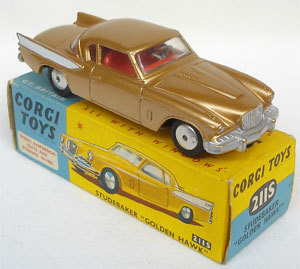
Painted 211S with smooth wheels (acknowledgments to QDT)


These will have all been first sent out to the shops with smooth fixed wheels with later editions fitted with a shaped, but still fixed, wheel. One or two long-running models will also have had free-spinning wheels fitted at a later point.

In a not particularly scientific survey, the chart below shows the distribution of wheel types that I found on models for sale or sold on a few web sites.


The key S = free spinning, F = smooth fixed, F2 = smooth shaped, F3= cast fixed (as on 218).

The models which did not have a great period of production after 1961 show a marked scarcity of the shaped wheel variety - in fact I was unable to see any for the 421 Bedford Evening Standard model.

For those that had a distinctly longer life then the fixed shaped wheel still seems comparatively scarce and similar in proportion to the free spinning wheel that followed. The 218 Aston Martin is a good example where one might have thought that the cast 'spoke effect' type was scarce but, in fact, it seems quite plentiful and it may be the fixed shaped type that is the one to look out for.

One surprise for me is the lack of any 210S Citroen models with free spinning wheels. I have two in stock but that's all I noticed anywhere. They are also both the variety with fog lamps in the casting. I find it hard to believe that the change of upper body casting corresponded to a change of wheel as I had regarded the fog lamps version to have been issued after the 323 Monte Carlo edition had become dated, the holes for jewels being filled with mazak instead. By that time one would have expected the 210S to have been fitted for some years with free spinning wheels.

I should mention that the 211S Studebaker figures are split between two models - the June 1960 issue with silver or gold-plated finish and a later issue with gold paint.

The Jaguar Fire Service model was the last model with normal-size wheels to be issued with the smooth fixed type, which is why I stopped at March 1961. Prior to January 1960, though, there are several models which also continued in production for many years and these I shall have another look at in a while. Generally, though, for the earlier models we know that the fixed shaped wheels are less common or really scarce in some instances and there are likely to be fewer surprises in that data.

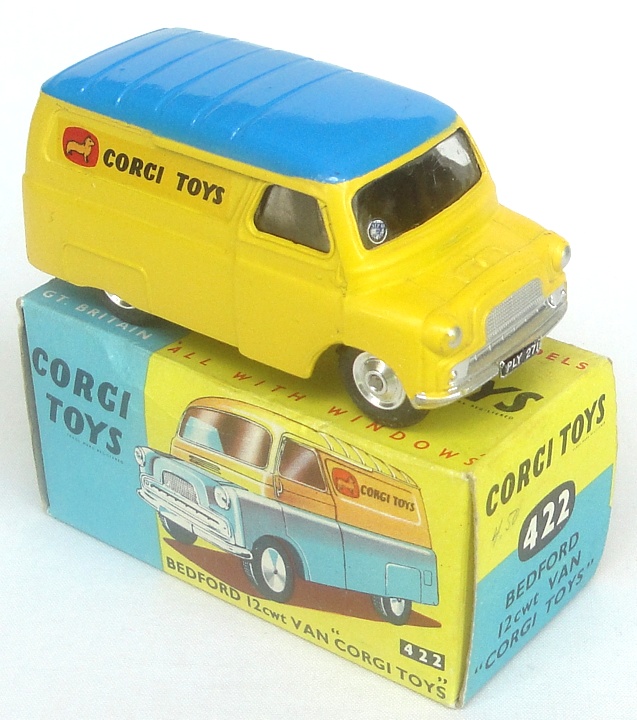
422 with shaped wheels (acknowledgments to QDT)


For now the search is on for some Bedfords with shaped wheels, a Studebaker painted gold with smooth wheels and the errant Citroen with free spinning wheels!

Saturday, 1 February 2020

Corgi Toys @ 60: A Mini, Planks and Cement Bags


It's February 1960 and here's the very first Mini from Corgi. This is the Morris Mini-Minor. (The Austin Seven comes next year.)

First appearing in what I call baby blue, with a cream or red interior. That cream interior, however, seems to be dropped pretty soon so the red one is by far the most common amongst the early editions. Over the years this little car will go through many variations. The most obvious will be the colours as this will appear in a wide range of blues, each seeming to have either a red or (the later and quite different to the cream) lemon interior, as well as deep maroon in 1968. Then there'll be the wheels, changing to fixed shaped, then free spinning shaped, then cast with a louvre effect and very late in its life with Whizzwheels in shades of mid-blue and dark blue, some metallic, and orange coloured models, renumbered 204.

It will also have two distinct body castings and several different bases. I have tried to describe these and illustrate some in my earlier article which you can find at this link


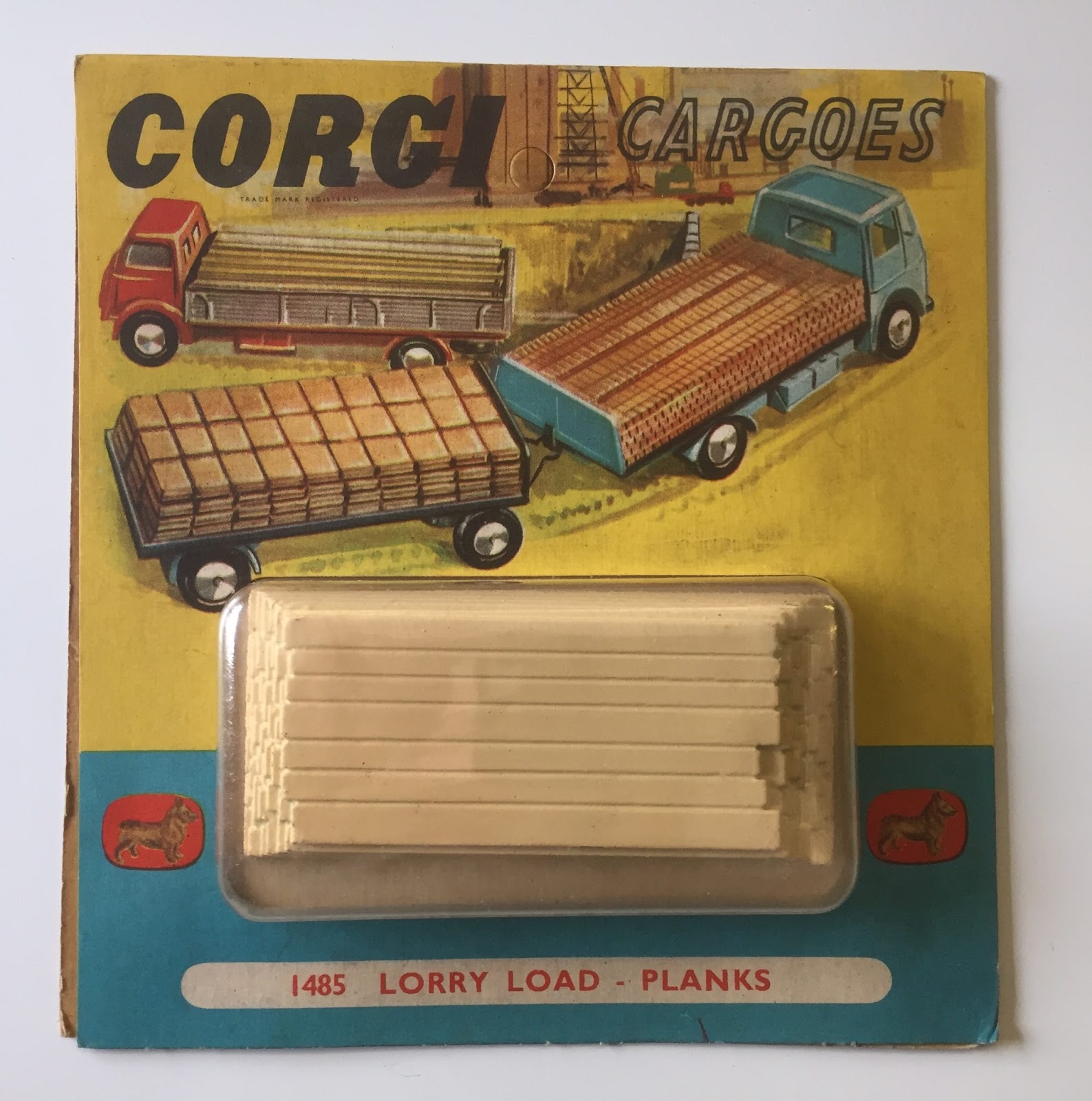
The other issues this month were the first two Corgi Cargoes. 1485 was a block of planks and 1488 was a block of cement bags.


These would fit neatly on either a platform lorry or the trailers and looked quite smart. Until then we had to pile whatever we had lying around. I found matches made good planks but they kept falling off. Bayko bits and pieces were the best loads and I had plenty of that - the doors fitted nicely and were probably a bit safer than the matches although I don't recall any of my friends burning their houses down with the Swan Vestas that we all had.


Tuesday, 28 January 2020

Several shades of Toronado


The Oldsmobile Toronado is a wonderfully attractive model which was issued in January 1967. It was model number 264. The last model I bought to play with was 263, the Rambler Marlin Fastback. That looked pretty good too but doesn't quite match the Oldsmobile which I didn't see until nearly 50 years later.

As you can see in the photo above, there is a range of quite distinct shades of turquoise - from green through to blue.


From my own collection is this beautiful mid-to-dark blue edition with shaped wheels, a rare item as almost all the others I see have cast wheels.


This example is more to the green end of the spectrum.


And this is a very deep shade of blue-turquoise.


Finally, here are two that I have with tow bars - one in a quite bright blue shade and the other a most definite greenish shade!

The Gift Set 36 was issued in December 1967 and is an acknowledgement of the success of the Riviera Gift Set 31 from three years earlier. For a brief period in early 1968 you may have found both in the toy shop. An interesting comparison between the detailed card box and tray and a scene with the girl surfing in one and a rather cheaper-looking window box with models attached to a large chunk of colourless polystyrene by several elastic bands. The later set is a lot easier to display, though, assuming you do have all three of the characters. I could never get the Riviera girl to stay upright and the ropes were a nightmare.

The set and a range of the 264 models are in stock and available at the time of writing. I am looking for a box for the Gift Set - a reproduction will suffice but no-one seems to make one. I have the same problem with the Big Daktari Set 14. I've managed to gather all the parts in each case but they do need boxes.

Apart from the shades of turquoise I don't know of any significant variations of the Oldsmobile. The headlamp covers appear to have two types: a plain silver finish and a bright chromed finish (similar to what you'll find with the later and similarly spectacular Corvette Stingray issues).

I have seen models advertised with tow bars and a normal 264 box. One might think that stocks of the cars with tow-bars may have been left when production of the sets ceased and these were sent off to shops in normal boxes. The problem with this idea is that the Gift Set is said to have remained in production until 1970 whereas the 264 turned into the 276 with Gold Jacks in June 1968! So I reckon these are just cars from sets and the sellers happen to have a box to put them in and don't know any different.


Something I do find strange is how the Gift Set 36 continues to contain the blue 264 model - apparently through to 1970 if the Great Book of Corgi is to be believed - when the Golden Jacks model was available with a tow-bar from June 1968. Perhaps the sets were made up before 1968 and just happened to stay in the lists dealers could buy but weren't actually produced after that. 

The 276 edition has the same body and chromework, with the same near-white interior. A common fault with all models is the little toothed mechanism stops working or breaks and the chrome edges are quite brittle. Remarkably, all the models I've encountered have had good suspension.

Another common problem is how people miss a letter from either the brand name or model type (or both!) For a long time I thought Toronado was a misprint myself!


On the real thing you don't (usually) have to fiddle with a cog wheel under the bumper to raise the lights!


Tuesday, 7 January 2020

The new old Corgi Collection

I don't know how many times I have said to fellow collectors how much I wished someone would try making the original Corgi Toys again. Not with Vanguards style wipers, realistic wheels and troublesome mirrors but plain perspex windows, shaped wheels like they used to be and suspension. And rubber tyres. Models that really do look and feel right and which may even need a second look to check that they are not actually originals from the 1960s.

At last, it seems, someone has taken a chance and is making a start. Hornby Hobbies plc have licensed the oddly-named Blue 14 DTC Brands trading as Corgi Toy Collection to sell and distribute reproduced models in the UK. Interestingly, text in one of their leaflets states that Blue 14 DTC Brands have an exclusive license to sell and distribute Corgi Toys in the UK. That would imply that they're handling the new stuff too as well as these reproductions - indeed it makes me wonder whether I'm going to be in trouble for selling a few of the old ones! I suspect that statement may be a mistake but never mind that now; back to the models.

This does look like great news. The first model has arrived and it's the 474 Thames Ice Cream Van with music chimes. Although I never wanted one of these as a child or even now as I found the hugely out-of-proportion handle affair at the back ugly - and it never seems to work for long either, the delicate tines on the element producing the notes breaking easily - I do respect the fact that lots of people do like it and originals sell for a fortune.


The van is an excellent and very faithful re-make of the 1965 edition. I am particularly pleased with the shaped wheels and windows. The colours are exact and texture of the plastic and weighting of suspension seems right too. Even the chrome, whilst maybe a little too bright, is OK. I suppose, if anything, the whole thing is a little too 'perfect', with precise silver and red painting whereas the originals would have missed bits!

It has all the right original stuff in the box (except, of course, a membership form). There is a sheet of stickers, instruction sheet, plain reinforcement card and a further packing card featuring the 60s kids in full colour. A small chunk of polystyrene replaces the cardboard to prevent the rear handle piercing the box.


The box itself is pretty good in terms of design and colours. A good effort but marks lost for someone using the wrong font for the list of features and product name. It is also just too shiny, as if printed on photographic paper where a dull surface would have been preferable in my view. The designers have cleverly retained almost all the original text and illustrations, changing 'Made In Great Britain' to 'Designed in Great Britain' on one panel and putting all the necessary 'new' stuff on a bottom panel where it will be least obvious if on display.


With this first issue I received a really good reproduction of the original Corgi badge (without the hole element and with a tie-pin and clip fastening rather than safety-pin type of operation). Additionally there is a pile of leaflets promoting the Collection and a certificate of provenance for this model.


This is simply great value at £1.99 which is the most you would pay for this at this time. Indeed, as I have signed up for the next release I actually get the van free of charge! You might bear this in mind if you were thinking of bidding for one on Ebay where, of course, annoying people are trying to make a quick few quid, some not even declaring this as a replica. It is good enough to fool a good few, especially if they ditch the box and most accompaniments.

The next issue planned is the 339 BMC Mini Cooper. A leaflet also displays a 155 Lotus F1 Racing Car, 258 'Saint's" Volvo P1800, 267 Batmobile, 325 Ford Mustang Competition Edition, 330 Porsche Carrera 6 and 417 Land Rover Breakdown Truck.

With the Mini there will be a 1505 Garage Attendant Figures Set, 1966 Corgi Catalogue and a tin to hold our certificates. The tin looks deep enough for more than eight sheets so I'm hopeful this will develop . . .

Oh, I can now add too that the reproduction of the Ice Cream Van is so good that the chimes are already beginning to miss a note from time to time!


The illustrations show some remarkably nice models, the only downside being the text on the base which tells us that these are made by 9 year old re-educated children working 18 hours a day in a 5 acre factory on the outskirts of Tianjin. I shall have to subscribe, though, and will report on all these as and when they arrive.


I am struggling with an image of an Ice Cream Van on the streets of Tianjin.


Monday, 6 January 2020

Corgi Toys @ 60: Chevrolet Impala


The first issue in 1960 was the impressive Chevrolet Impala in sedan form in January as catalogue number 220. The State Patrol edition had been issued at the end of 1959 so this was not the first time people would have seen the Impala although I suspect that in most shops this and the 223 State Patrol may have arrived at the same time.

The first models would appear to have been the salmon colour and the blue model with a lemon interior and they would have had smooth fixed wheels. They would also have had the base type as shown in the centre of the illustration below. Later, models with shaped wheels and, towards the end of production and somewhat scarcer, with free spinning wheels will come along and, at some point in the fixed wheel period, with the different base.


I have also noticed a slight variation in the plastic interior piece. It appears to fill the space available better in the middle one shown here. At the rear edge there also appears to be a gap at the corners on the later models.


This will prove to be a very popular and long-running model, to be revived in 1965 when someone slices the casting in two and inserts a chrome section which makes four new and still impressive models.


The chart above shows how I have found the various Impala editions spread with regard to wheel types over the years.