Tuesday, 28 January 2025

Nearly the scarcest Major


If you were to compile a list of the Corgi Majors with the smallest numbers sold (and excluding the Rocket Age items) then this model, the 1141 second issue of the Bedford Milk Tanker would be at the top. The records show that only 20,000 of these were sold, a very small number, less than the very hard to find 351S RAF Land Rover and only a few more than the equally elusive 500 US Army Land Rover.

2nd and 3rd places in that would, incidentally, go to 1135, the Military Equipment Machinery Carrier (28,000) and 1132, the Bedford Low Loader (44,000).

This one has just come in and the owner says that he had it from new but, understandably, no-one can really ever be sure about these things. You may not see many of these for sale but when they do appear the prices seldom match what one might expect by virtue of their scarcity. The problem is that the tanker part is identical to that which was attached to the Big Bedford cab in its first appearance back in May 1962 (and actually no different in design to the Mobilgas version in April 1959). It never gets suspension and, as far as I am aware the tanker element never gets free-spinning wheels.

The 1131 Machinery Carrier had a blue TK cab and there are two variations of this, one having a distinctly lighter shade of blue. I remember this as I had one myself with a yellow rear axle. I believe that this pale blue is the same as the Milk Tanker shade and so, if you happen to have one you can make up this 1141 model quite easily.

The same applies to the Mobilgas second issue too, although it is hardly worth the effort because the 1140 model sold nearly 100,000. Although still not huge, an original (or something looking like an original) should be easier to find and probably not worth the effort.
 

Saturday, 25 January 2025

Dragsters


There are nine models from the era that I specialise in which I have largely managed to avoid over the last 50 years or so. These are the 'dragsters' - weird but not exactly wonderful vehicles designed, as far as I can tell, purely for racing down a straight track for a minute or two at most. As I live a mere stone's throw from the Santa Pod Raceway, I thought I'd better have a look at these at last.

They were issued between April 1971 and February 1973, some only staying in the catalogue for a year or so, a couple lasting a bit longer. They were numbered 161-167, 169 and 170. What happened to 168 I don't know. 

At the end of 1971 Corgi Track Sets were shown in the catalogues but I have never seen any.


It seems that these tracks, with a Power Blaster and various accessories were intended for the Whizzwheels models and especially things like these Dragsters, the illustrations featuring what look like the Quartermaster Dragster and an Adams Probe 1.6 model. (Not to be confused with the 'Rockets' Track sets and accessories at a smaller scale)


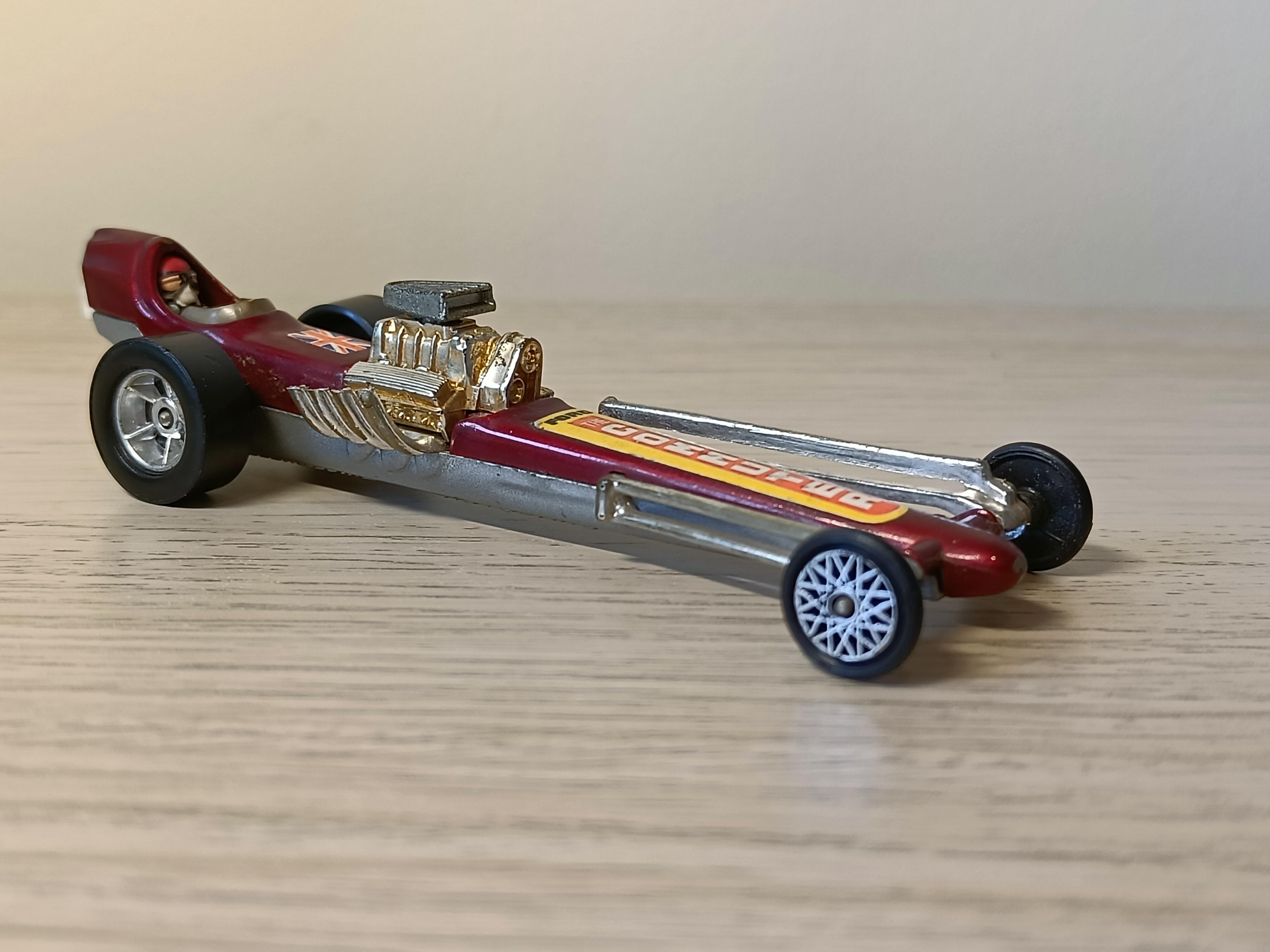
April 1971 was the first one - the 162 Quartermaster Dragster.


June 1971 saw the next dragster in a similar style - the 161 Commuter Dragster. Here is one with a silver base although most appear to be all metallic deep red.


In July 1971 Corgi make massive modifications to the 163 Ford Capri, turning it into a Santa Pod Gloworm Dragster which is quite a dramatic-looking thing. Whereas the first two did little other than look like pencils with wheels, the Capri has a button at the front which makes it open up as you can see. 


October 1971 sees another Ford casting destroyed as the lovely old Mustang becomes the 166 Ford Mustang Organ Grinder. Unlike the Capri, nothing special happens with this model but then it was only 45p compared to the Capri at 65p.


December 1971 sees the issue of this strange thing. It's the 167 Ison Brothers 'Wild Honey' Dragster. I guess the Isons liked the Beach Boys. The little model is like nothing before, though, seemingly something like an ancient Austin 7 maybe, but certainly nothing from any previous Corgi production that I can recognise. I have to acquire one of these to see whether it does anything other than look odd. It has rather tedious Whizzwheels and doesn't last long, either, being removed from the catalogue in 1973.


In February 1972 this extraordinary machine appears. Apparently it is a 4-engined Adams Drag-Star Dragster, model 165. You can see how imaginative these Santa Pod people were. It shares the almost standard Dragster rear wheels and the front will be familiar too. They're the open 8-spoke type. This one's 'added feature' is an air brake that pops out at the back.


Sometime later, in October 1972 the third and last of the pencil shaped dragsters comes out, the 170 Radio Luxembourg edition, looking very similar to the first two but with slight changes to the driving section and rear. The wheels, though, look identical.


The next issue is in December 1972 and is just called a US Racing Buggy, numbered 167. Again, I don't recognise what it might have been based on, if anything. It has knobbly tyres, two people inside and, quite frankly, is not at all impressive and does nothing that I can see. I haven't yet bought one and really do hope I don't have to and maybe one will be included in a job lot one day. They didn't last long, not being listed after 1973.


The last of the series is model number 169, probably the weirdest. It's called a Silver Streak Swedish Jet Dragster so I assume it was just a jet engine attached to four wheels and not a lot else. It is quite unlike anything else and would surely have appealed to a totally different market and seems more like an 800 series model but for the 'Dragster' name. This came out in February 1973 and stayed around until 1977, along with the Radio Luxembourg Dragster. The others generally disappeared from dealers' order forms in 1973 although many will have been available on shelves in shops I expect.

It's an odd collection and somehow marks the end of Corgi as I wish to remember the brand. After this, we see a rag-bag of production throughout 1973, with a few 1:43 scale items and the larger 1:36 racing cars vying for position on shelves with a whole raft of aircraft.

Things get even worse in 1974 with only the lovely VW1200/1300 Driving School car in 1:43 to relieve the gloom amongst even bigger racing cars, tedious utility vehicles and some nameless 'Hi Speed' 700 series models. I can only suspect that Corgi management had given up trying to give any sort of direction and you have to feel sorry for the reps at this time.

By 1975 there does seem to be some effort at a recognisable brand in the shape of the larger 1:36 scale models but it is all just a little too late now.

Thursday, 23 January 2025

By special rep request? Hmmm. . . .


I need help with this one. As a Curator of the HobbyDB.com Corgi database I get many items added by collectors which need to be verified. As I have added many variations myself when that project was started many years ago, most of the new additions turn out to be custom paint jobs or, at best, a production sample rather than a nice surprise of a new issued item I was not aware of. This one, though, is intriguing.


As you will see from the photos below, this does look pretty good, a 207 in the 203 2nd issue colours. The silver paintwork is possibly a bit too bright but it does appear to have been sprayed with a mask rather than painted as many later revisions tend to be.


The headlamps are very precise, more like the Chinese Re-education Camp models we see from the Corgi Model Club. I don't recall ever having nice near-perfect rounds on headlights on these models but I guess someone may have had a good day. (Incidentally, now we have another model and a blue box for some reason)


In its favour, there are a few flaws and chips which I am sure someone trying to create a variation would not have left. The box is also nicely worn as if it's been kicking around in someone's possessions for a good many years. Again, someone in the business of creating this would probably have found a good one and a factory sample wouldn't have had one at all.


Now here's another problem: the grey base. All the models I have encountered of the 207 with a grey base also have the later style of shaped wheels and the red paint on the roof does not extend down the pillars as this one does. A grey base on a model in a blue box is also not very likely so that odd one above adds to the doubts.

I would say that the base certainly has not been removed but that wouldn't preclude someone skilfully masking the wheels and base to create this. I'll also ignore the boxes as these could have been added by someone at some point whatever its origin.

As I have not seen anything like this in all the years I have been viewing Corgis from this era my first inclinations are to say that this is a smart creation by someone. There's good reason for someone to do so as it would be valued at getting on for four figures as a genuinely issued model and three figures as a factory sample. The person submitting it, however, believes it to be genuine and has submitted many good models in the past. He is not someone I wish to insult by not verifying this addition, and yet I do have doubts. These were enhanced when I saw he had added this initially:


The super-detailing on the bonnet emblem and door handles are classic signs of someone who has created a model with some painting and simply couldn't resist these little extras while he had the silver paint on the brush in his hand! Those headlamps, too, aren't right, nor is the rather bright paint and the way it very precisely follows the inside edge of the bumper. For this model, however, I have no more images.

It was the same contributor, however. This one, surely, is not an original and prompted me to respond as such and ask for more images and also one of the base. That was when I found he had published more images of what appears to be a second or even third model and which I have illustrated above.

For a while I have wondered whether, following my first comment, he has quickly covered the super-detailing, adjusted the silver paint on the lights and bumper and removed the wheel covers but the coverage of red paint does look different and I do think the three are different models. The last one above could be a factory sample as I have seen such additions on samples I can attest to being genuine but the other one has left me intrigued and needing some other opinions.

Perhaps you are aware of this variation and have seen a few which I have simply managed to miss in all this time. That would be a reasonable explanation and all will be well and this gets verified.

JKDiecast, a dealer, have one on their site at £1350 with a blue box which they describe as a 'factory error or rep special request'. The main images above are also featured on a Japanese web site  - the same model and yellow and blue box - which is odd. Now it may be that the HobbyDB chap merely copied their photos or that the Japanese site copied those on HobbyDB so I am not a lot wiser there. The dealer model would tend to confirm this is real - although it would be very convenient to have a seemingly independent HobbyDB back-up of this to support the £1350 price tag. Maybe the contributor is the dealer? But then he would have used his own model, one would think. I don't wish to cast aspersions on anyone but we have seen reputable dealers selling 'factory errors' before which turn out not to be quite what they seem and not worth the vast sums often paid by a collector. The 'rep request' is a new one on me too.

So, to conclude for now, I may be getting sceptical in my old age but I remain reluctant to approve a value of over a thousand pounds for this one, which verification would effectively award when clever and skilled people can take a £30 model and create it, which can fool very nice, well-known dealers and, of course, their customers.

Saturday, 18 January 2025

Spare time


I have just acquired two Datsun 240Z models, the #394 edition that was available from 1972 and stayed around until 1977. The early issue had the open 8-spoke wheel which replaced the ugly types that had been fitted on Whizzwheels models previously. Only a few models got this wheel: the #284 Citroen SM, #316 Ford GT70, #329 and #391 Ford Mustang, #393 Mercedes 350SL and #396 the other Datsun 240Z. Each of these, except the Ford GT70, also gets the later closed 12-spoke chrome wheel. (Maybe the Ford GT70 does get them but I have yet to find an example).


It was only when I was taking these photos, however, that I realised there was another interesting difference. In the back there is a spare retained by some cross-shaped device.


In the earlier edition teh wheel is quite small and look solid plastic and the retaining piece appears quite flimsy.


In the later edition there is what looks like a treaded tyre, similar to what is on the model and this fills the retaining device which also seems a little sturdier (although that may just be how it seems).

The stickers were supplied on a separate sheet with the model so you will find these in a variety of places or, as in the case of the later edition here, not attached at all.

The interior of the later edition also looks slightly darker but that may be because it has been exposed more to light than the other one.

The wheel in the earlier edition looks suspiciously like what might have been a 'pepperpot' or 'four crowns' style of the old Whizzwheel placed face down. It makes me wonder whether the model was going to get the older style and the spare was never changed. As we know, Corgi never paid a great deal of attention to the spares. Witness the #202 Renault 16TS with Whizzwheels but a nice #260 style wheel as a spare and, of course, the Lamborgini and Ferrari Dino still have the intended 'Golden Hacks' wheel as a spare.

What I need to figure out is whether the change of spare happened at the same time as the change of wheel - in other words are there a possible four variations of this model or just two?

When I first found the Datsun many years ago, I remember noticing that one has a nice and bright metal fitting for the bumper and spotlights whereas another had what seemed to be black metal. Perhaps this was merely how the bright metal aged? Or are there two types of bumper fitting? Something I need to look into again.

It is, I suppose, equally likely that the #396 editions will also have a different spare and I'll try to obtain a pair to compare in the near future. These models tend to be pretty cheap still, although well-made and with jewels and opening doors and an attractive interior. It had a long life and even re-appeared in 1998 when a special edition made for a racing driver who raced in these and whose name escapes me. I was in correspondence with him at one point as he wanted to sell the whole of his stock of around 3000 which Corgi had made for him. They appear from time to time and are worth getting if you collect the  British-made 1:43 editions.

Wednesday, 1 January 2025

Corgi Toys @ 60: The Army's coming!


You would be forgiven for wondering whether the US Army had taken up residence in a big way in 1964 because January 1965 saw a massive set of models which Corgi might have thought ideal for the GI's kids. Actually, some were for the British too, but this was certainly quite a dramatic development. We had seen military machinery and wonderful missiles take centre stage from '58 to '60 but after that things rather went quiet with Agriculture and the Circus occupying the military pages in the catalogues.. Five years later and we're back getting the children to prepare for battle once again.

The first model is the lovely Commer ­¾ ton reworked as a Military Ambulance. It is essentially the #463 Ambulance from February 1963 with a khaki finish and red cross transfers.

Next is a similar Commer ¾ ton van - this time the #464 County Police Van in khaki and with a white star on the cab roof and Military Police transfers on the sides.


Although there are two versions of the original police van, only the first type was in production when these army versions were made and so it has the bulb that flashes when contact is broken and made by a cam on the front axle. The model does not stay in production long enough to get the second type.

It does, however, appear to get a clear bulb in place of the original blue one. This also matches the illustration on the box and is not just a matter of some owner having switched them over.


Next is another commercial vehicle brought out of retirement in the form of the VW Van. This is the December 1962 #434 Kombi with khaki paintwork and U.S. Personnel transfers


The fourth new model in January 1965 is another appearance of the Land Rover in khaki with a matching plastic canopy.


You can find this with either a lemon or red interior. To all intents and purposes this is #500 from December 1963 which was then a US Army Land Rover according to the box. Now it is described as a Land Rover Weapons Carrier. I have written before about these two models. #500 is very scarce and you really need a friend across the Pond to find one for you as that's where they all went. There are two key differences to tell them apart. The star of the #500 is a creamy colour. That on the #357 is much more white. If you're still in doubt then you need to look at the rear window. The #500 has a different type of window unit - the early type found on all 406S and first 438 models - which fits flush with the body at the back and creates a sort of frame effect when viewed from the rear.

Returning to the GI kids' toys, we have the Oldsmobile Super 88 Sheriff's car from June 1962 getting a khaki coat of paint, stars on the roof and doors and an H.Q. Staff transfer on the bonnet.


Completing the 350 series is #359, a US Army Field Kitchen. In March 1963 you could have bought some ice cream in the sunshine from a blue and cream Smiths Karrier 1 ton van just like this one. Indeed, I'm not completely sure that it would not have been the same guy inside! These are darker days, however, and the US Army need refreshment in the field and the ice cream van has been requisitioned, repainted and Arlo Guthrie would probably have told us that it was dissected, inspected, directed, injected with, objected to, rejected and then collected.

The last three are Corgi Majors. 


This is the US Army Truck #1118 which becomes #1133 Troop Carrier with some new transfers and a different tin canopy, now showing an indent where the star is placed. There are also usually stars on the doors and characters along the sides of the bonnet. These trucks can be quite confusing but I am pretty sure all the #1133 editions will be similar and have the 'closed' type of chassis and stars in the same places. There was a US issue of #1118 which had a star but no indent on the canopy, possibly a star on the bonnet but no characters on the sides of the bonnet.

Next, you'll recognise #1134 as the Mobilgas Tanker with a coat of khaki paint and new transfers. 


Despite the Bedford TK cab now being attached to many similar models, the tanker still retains the old Big Bedford variety with no suspension.


Strangely, however, the last of the January 1965 issues does get the newer cab. It's the #1131 Machinery Carrier from November 1963 with a coat of khaki paint over everything and transfers on the rear axle unit and a star on the cab roof. 

The #1135 can be found with either a red or lemon interior.

Production numbers are really quite small for all nine models but especially for these three Majors.

1133 56000
1134 43000
1135 28000

The lower numbers are similar to the sales of the Corporal Missile or Golden Guinea Gift Set. The higher are similar to the Whizzwheels Rover 2000TC and the Agricultural Set GS5 to give you an idea of how few there are of these that are likely to be still around.

This is an excellent collection to build and good examples always seem to sell for high prices - and the boxes for even more! You may think that there are different shades of khaki when you look at models for sale but this is the result of models being handled a lot. Originally they would have been (and some remain) matt in a lightish shade of khaki. A little oil from one's fingers, however, rapidly turns this to a darker shade and some even appear to be quite shiny too (although that may well be a restored version with the wrong type of paint!) Once darkened they'll not get light again but you will find several of the models available at more reasonable prices as a result.

Monday, 30 December 2024

No tape required!

 I have just received a parcel which only too well demonstrated how not to wrap a valuable Corgi model. I had purchased a Corporal Missile on its launching device with an original box from an Ebay seller with the tag grandadsattics83 and also paid £10 postage. That did seem quite a lot for a parcel from Essex to Northamptonshire but I assumed he was using Royal Mail's Guaranteed Next Day delivery service or something similar. For quite a valuable item such as this that seemed reasonable enough., Although, £3.39 will buy a suitably tracked and insured service online via Royal Mail's 48 service, and is what I use by default in the UK these days, I accept that not everyone buys postage online or bothers to look at different options to those a post office chap or lady will suggest.

The service was actually Evri, which was a bit disappointing as they would only have charged grandadsattics83 £3 or so, but I guess that's life and some sellers may make more money on their postage fees than they do on the products!

So £10 I could sort of swallow and the Evri girl who delivers here is friendly and hasn't yet resorted to chucking things over the garden fence. It was the packing that troubled me. First of all, the parcel rattled - there was something loose inside and you can all imagine what a missile does, especially the heavy Corporal Missile, when unrestrained. The box did have its original packing piece but clearly that wasn't sufficient to retain the contents in one place en route.

I would like to have unwrapped the parcel by not having to rotate it but that proved impossible. Good old grandadsattics83 had used best part of a roll of brown sticky tape on each of several layers of bubblewrap. You try separating brown tape, or any tape, for that matter, from bubblewrap. If you're very lucky you might locate the start of the several yards (or even more frustrating, the hundreds of individual small pieces,) of the stuff used but usually you're not and you're left to fight with a piece that goes beneath another or trying to cut your way out without damaging anything.

As I had no option but to unwind all this ridiculous tape my heart sank every time I heard the thud of something moving from one place to another inside. Eventually I got down to the last layer.  More yards of tape on bubblewrap.

Why do people feel they have to add tape to bubblewrap in the first place? All you need to do is wrap the model in some soft paper, fold some card around a box, if there is one, to prevent it getting squashed or pierced. Indeed, there is a lot to be said for flattening the box - where it's a thin card type that you can - and packing that separately anyway. Then wrap some bubblewrap or similar protective stuff around the contents and pop it in a sturdy box. Add more protection around this as needed so that it doesn't move. And, of course, if something is in a box, add some protection inside the box as, even if the original packing pieces are present and correct, it is highly unlikely that 60 year old carboard will be enough.

Sure enough, on finally getting to the lovely old box, there was the missile lying next to the launch device and not in its proper place. However, apart from what might be an extra chip on the shaft, I can't see any obvious damage to the missile. There are a few dents in the packing piece but they may have been there before. All in all it was quite a relief that there was really not a problem and I knew that the box would need some repair anyway.

Looking at grandadsattics83 feedback he gets plenty of compliments for his wrapping. It is because people generally seem to think that bundling piles of tape tightly around bubblewrap is good practice that I decided to write about the frustrating side of things for us buyers. The matter of wrapping this stuff very tightly around a model that's not in a box is also worth mentioning while I'm at it. I have had several items arrive where the wrapping is so tight that it is straining the suspension or maybe a screen on a convertible. Even an old 50s saloon with no suspension can be at risk as you try to find a way to start cutting into that crazy wrapping without metal touching model.

As I said, all you need to do is wrap a model with plenty of the right material but no tape is required. The outer box should be enough to keep everything in place and it's hardly likely to unwrap itself en route, is it?

Of course, if all you intend to do is pop the model in some bubblewrap and then a jiffy bag then you would need some tape, I suppose. But I am really very much hoping none of my readers would consider such a package so, again, no tape required. 

And no, you don't even need that little bit to hold things in place while you search for a box. Find the ruddy box first, add some newspaper, old Christmas paper, those foam shapes, chopped up old Amazon delivery bags or containers, preferably not shredded paper which can go everywhere when you pull it out and it shatters into a million small particles but, OK, shredded paper if that's all you've got, put your model in its nice soft paper and un-taped bubblewrap in a bed of the aforementioned, check nothing moves that shouldn't move and close the box.


Sunday, 29 December 2024

Corgi Catalogues and how to get pleasantly lost in my Corgi Toys websites

 Because I am familiar with all the bits and pieces lying around on my websites I have not appreciated how confusing some parts may be to visitors so I need to do something about this. First of all, I have two areas called 'Catalogue' or 'Catalogues' which need to be distinguished rather better. If I need to consult a Corgi Catalogue, one of the little books or leaflets issued in the past, then I know that I can click on the link word Catalogue in the text of the home page of corgi.toys, which is where I usually start. (If you start elsewhere there are explanations further down this page.)


I can also click the image that has the text Catalogue beneath it.


These don't take you to the old Corgi Catalogues just yet - another click or two is required. This is a bit more obvious with an illustration of the 1967-8 Corgi Catalogue and that word Catalogues below


Click on that image and finally you're getting closer, on a page titled 'Catalogues' no less.


This page is not very pretty but does have links to various years for which I have original Corgi Catalogues and have made images available to view. So clicking on 1972, for example, takes you to a page usefully entitled 1972 and with the 1972 Corgi Catalogue pages displayed.


Unfortunately, the pages are not all that big and you might want to look a little more closely at some. The individual pages don't have links but if you click on the title, 1972 in this case, you will be whisked off to yet another website where I did upload decent size images.


So, finally, you can have a good read without needing a magnifying glass.

You could also have gone straight to a particular year's Corgi Catalogue by clicking on 'Catalogues' in the menu that should appear on the page with links to various groups of Corgis and lists, which looks a bit like this.


The menu features 'Catalogues' as its second item at present.


That's probably the simplest, but less obvious, method to get to a a particular year's Corgi Catalogue.

That is all very laborious, though, and hasn't changed since 2014 when I first got the catalogues. At that time I reviewed them all in this blog. So you could also find some catalogue pictures and comments about the quite interesting content that I wrote many years ago by clicking on the word catalogue in that mass of words here, usually on the right when viewed on a monitor.


Another starting point for many people may be corgi-toys.net, an address that I obtained in 2013 when I started and a long time before corgi.toys would have even worked. I was rather more sensible in those days, it seems, and actually listed Corgi Catalogues in the menu. 


Click on this and it takes you to yet another 'Catalogue' page!


The page starts by showing the 1972 Corgi Catalogue but there is a list of years to the left (on a normal monitor, not sure how it appears on a phone) and clicking on any of these will take you to the year in question.


These images are much bigger and seem to be on a totally different set of pages to either of the others mentioned above!

Going 'Home' from this last site will take you to corgi-toys.net. That is an older site but it seems reasonably OK for now and the links take you to the right places. There is no obvious way, however, to get back to corgi.toys if that's where you started. So I have a fair bit of work to do to try and tidy all this up.

Lastly, you may also find some of the old articles have links to a very ancient website I made when I started all this over ten years ago.


It does still look nice but the software I used simply couldn't handle the huge number of pages I had accumulated and it could take up to 30 minutes to make some minor change! Everything also had to be stored locally on a drive here in the office as well as online whereas now, whilst I have back-up copies of images locally, everything else is online and edited online, thanks to Google. Using Google also keeps the sites working within acceptable limits for the different devices people use nowadays to view web content. Whereas once upon a time everyone would be staring at a small, often slightly flickering screen of 640 by 480 pixels now my pages probably appear in all shapes and sizes on smartphones large and small, tablets this or that way and even tv screens.

I make no promises and certainly no New Year's Resolution to this effect but I shall certainly think about making a search for the main areas you need to access less of a Magical Mystery Tour.