Monday, 2 April 2018

Corgi Toys @ 60: A Loader and a Ramp


Here's a model you could really play with. Fold down the massive rear ramp and attach the winch to stones or whatever was lying around the floor and attempt to wind it in. Slap up the ramp closed and set off. Unfortunately, there was nothing else available in the range with which to unload at your destination but if you'd chosen a car then it could be rolled or pushed off.

This would last through to 1963 when the Bedford TK style cab would replace it. The 1100 Bedford Carrimore Low Loader model did not have suspension and the only variations I am aware of are the yellow and red cab colours, mid or dark blue (both metallic) shades for the carrier section and late editions will have shaped wheels in place of the flat ones. QDT have an example with a red handle on the winch but I am not so sure that wasn't just a one-off oddity.

I wonder what colour cab it had. Either would seem appropriate. This is a new combination for me and I hope to have this particular one in a while. It looks like a late model


The other item released in April 1958 was the Corgi Service Ramp.


This is almost identical, apart from colour, to the Mettoys 'Castoys' service ramp produced in 1950 and is one of two models that were continued into the Corgi era. (The other was the Karrier Bantam truck). Now quite hard to find - indeed, I am looking for one myself at the time of writing - in fully functioning condition, this is a splendid piece of engineering that might have been a great addition to any garage display.

It even has holes so that you can fix it to a surface to prevent movement as you pull the lever to raise whatever you have driven on to the ramp.

To the best of my knowledge these Corgi ramps were always silver on a blue base.

Here is the best picture I can find of the original Mettoy product.


Tuesday, 13 March 2018

Corgi Toys @ 60: ERF Lorries

Less than a year after they issue the Commer lorry with a platform rear along comes an ERF version.


This lasted well into the mid-1960s but I am only aware of the light blue cab and dark blue platform colour scheme for this model. There were at least two schemes for the Commer but just the one for the ERF over those 7 or 8 years.

There will be a change to shaped wheels roughly half-way through production and both types are common. I have not had a chance to study these in depth, however, and believe that there will be several small differences in the casting to look out for which I shall have to document another day.

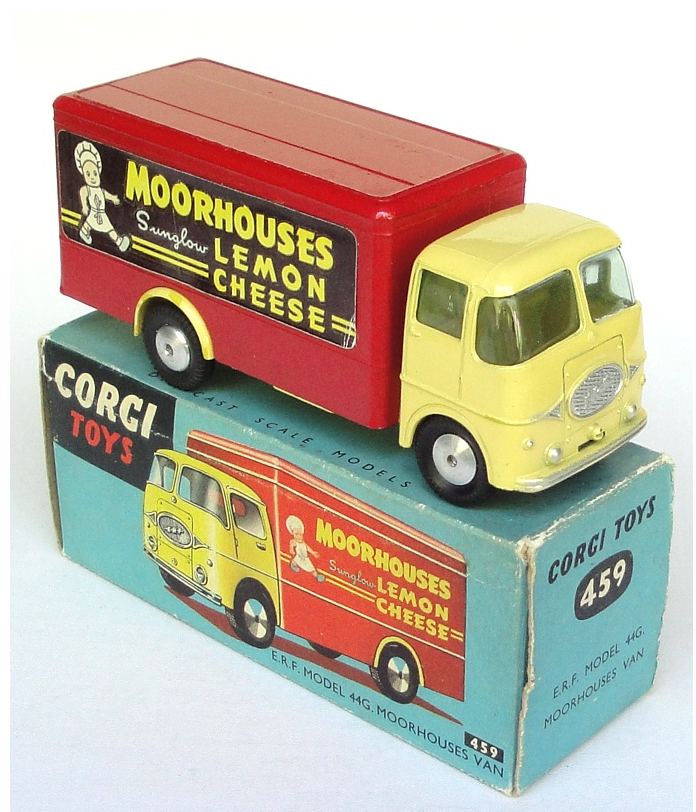
The second March lorry was described as a 'van' but I have to say I would have called it a lorry had I seen one at the time. Similar to the Commer Wall's Refrigerator 'Van' from 1956, this is a cab, chassis and large box affair with rear door lines in the casting.


Again, I am still looking for a good one of these for my own catalogue and have not looked at any models closely. I believe that they are all the same colours but suspect there may be some casting differences. Perhaps not so many in this one as it was withdrawn from production in 1960 after just a year or so. I should imagine, therefore, that all these will have smooth wheels.

The advertising is by paper stickers which tend to wear although I have been impressed at how wel the colours have survived over 60 years on most that I see. If they have passed the point of no return, as it were, then some replacements do seem a good match, although they will look odd on a slightly worn model.


Thursday, 1 February 2018

Corgi Toys @ 60: The Americans Arrive!


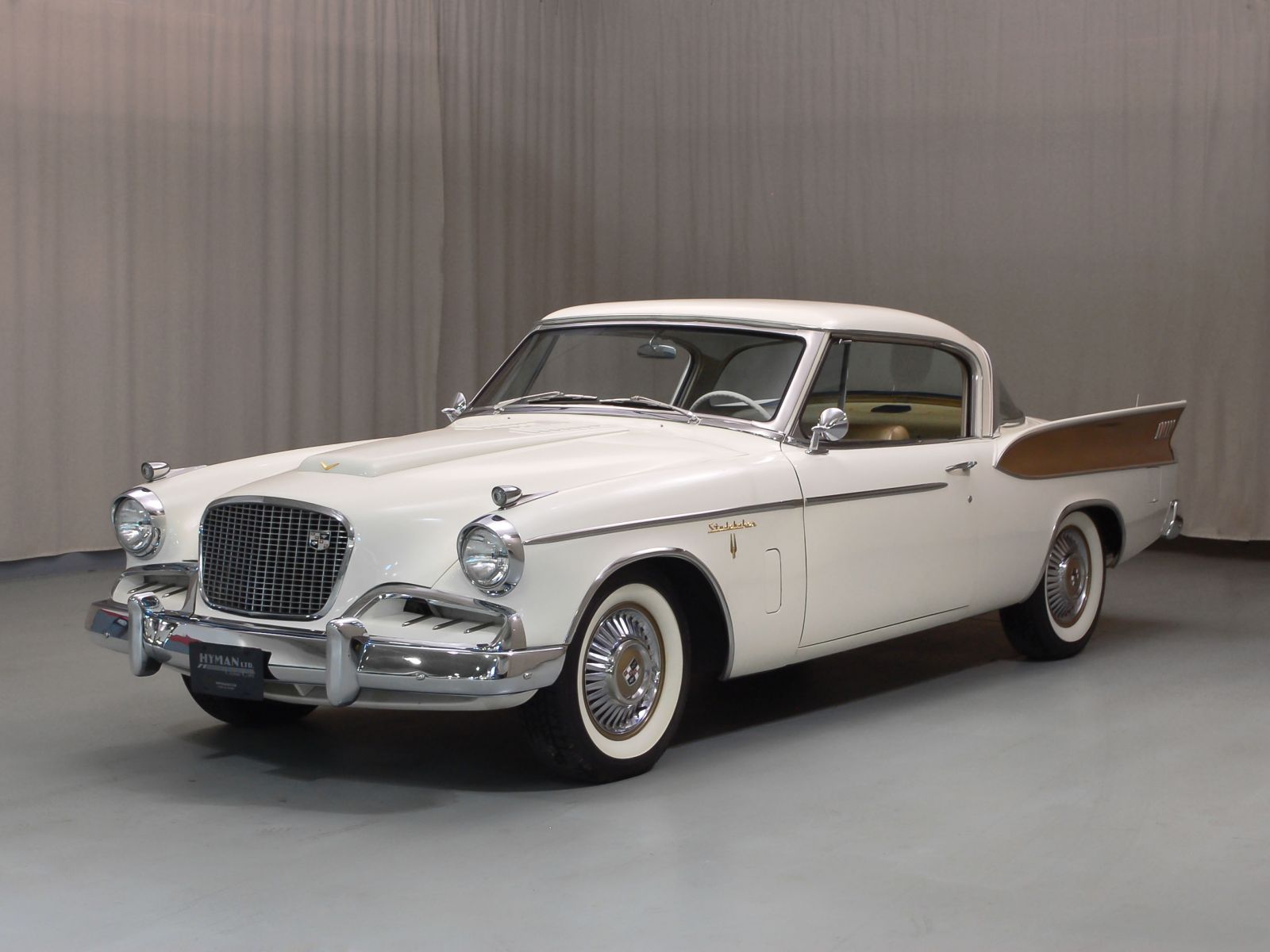
February 1958 saw the arrival of the magnificently named Studebaker Golden Hawk on the Corgi shelves at our local toy shop. Compared to Morris Cowley or Hillman Husky that we may have been pushing around the layout, to be able to announce the name Studebaker Golden Hawk to your friends was a little special.

The chances of seeing one of these cars in the Hertfordshire lanes where I lived were next to zero. Even in the fairly wealthy city of St Albans where I went to school a Vauxhall Cresta was about as long a motor car as we might see.


This was Corgi's first American model. The 211 was available in a solid mid-blue shade with gold-painted fins and the 211M version was white, also with gold-painted fins. All the 211M models will have fixed smooth wheels and I think almost all the 211 models will have these too. In May 1960 the 211S was issued, with suspension, an interior and gold paintwork or silver plating and so it is very unlikely that any 211 models will have been around when the switch to shaped wheels was made.

I would imagine that, if any exist, they'll be expensive.


The 211M model only lasted until the following year as these 'mechanical' models were not selling well and were all withdrawn during 1959. Examples in good condition with nice running motors are now not at all easy to find, nor are they likely to be cheap.

The other issue this month was Corgi's second Gift Set. Appropriately named Gift Set 2, it contained a green version of the 406 Land Rover, now, for the first time, with a tan canopy made of tin. The Land Rover pulled a 102 Pony Trailer that had been issued the preceding month. This may have been red on a black chassis or cream on a red chassis. A pony with a blanket would be in the trailer. Although shown here with a brown blanket, I am fairly sure that the first ones had blue blankets, red and brown appearing somewhat later.

All the first editions would have had fixed smooth wheels and the trailers would have had the wire drawbar.


The illustration above shows a dark pony that is quite incorrect for the set!


Notice how this tray has holes for the pony's feet between the Land Rover and trailer. These are genuinely original but it seems that the tray was later revised without provision for the pony outside the trailer. Unfortunately this old box has seen better days but it is an intriguing item that I had not encountered before.

As readers may well have gathered, the topic of Corgi Pony (or Horse) Trailers is one which I have been surprised to find remarkably fascinating! And here is another chapter.


Tuesday, 2 January 2018

Corgi Toys @ 60: Two Trailers

January 1958 brought two things you could tow behind your Land Rover or Commer lorry; 101, the Platform Trailer and 102, the Pony Trailer. The Platform Trailer can be found in many combinations of chassis and load section colours but I think there would only have been these three available initially.


These would have had the simple wire drawbar. It would not be until 1962 that that got replaced in a boxed edition, although in March 1960 the records show that a set comprising an ERF lorry with cement and plank loads had a cast drawbar. I am not so sure that is correct, though. You will also see a blue and red trailer carrying a Chipperfields Circus elephant cage and a blue and cream trailer carrying milk churns but both these will have cast drawbars. There is, of course, also the yellow trailer from the Farming Set but that also only appeared later and had a fixed cast drawbar.

The Pony Trailer I have written about on several occasions. What seemed a very straightforward issue - just the choice of three colours, I had thought, turned out to be a lot more complicated! However, here in January 1958 you would have opened the box to find just one of two possible editions: a cream horsebox on a red chassis or a red horsebox on a black chassis. Either would have a wire drawbar, exactly the same as was fitted to the trailers.


In the box would be a brown pony with a blanket on. The blanket would usually be blue. I have seen other colours but believe that the early ones were always blue. If you had one of the very early editions then you would have struggled a bit to get the pony out because there was no 'handle' or protrusion at the top of the ramp to help you in lifting it to unlatch and then drop it down. Pretty soon after the first issue, however, the casting of the ramp was changed and a 'handle' added.

Both the cream and red and red and black editions can be found with and without handles. The red and black one carried on rather longer than the cream and red and even got a fixed drawbar at some late stage. There is no documentation on this but my guess is that it would have appeared a little before the time when the brown and cream Pony Trailer appeared for the revised Gift Set 2. That would correspond with the 1962 debut of the same thing on the Platform Trailers.


Monday, 4 December 2017

Charm on the farm


If you had been looking for a green series II Land Rover then September 1962 would have provided the first opportunity when Corgi issued Gift Set 22. This was a huge set containing lots of farm models and extra bits and pieces. Two items in the early sets were unique: the all yellow flatbed trailer and a mid-green 438 Land Rover with no canopy.


Shown above between the Public Address model and a Series 1 406 it is a pretty similar shade to those two and quite distinct from the deep green that you would have found in a box at the shop later that year.

Indeed, many Gift Set 22s seem to have the deep green model so my guess is that Corgi replaced the mid-green version at some point. The Gift Set did not sell particularly well as it was expensive at 50 shillings. That's almost one and a half Transporter Sets. So, for a number of reasons, the mid-green Land Rover in 438 Series II form is a rare item. Indeed, for a long time I have not been totally convinced that it existed. I had peered at small images on various sites trying to decide whether what appeared a lighter green was, in fact, just the light or even an old 406 that had been put in the set.


This example of the Land Rover is pretty worn, missing a spare wheel and quite a lot of paint. The hook is also missing its tip. The screens are fairly clear, however, and the suspension sound. I tell myself that clean, shiny Land Rovers never look quite right anyway!

The trailer is cheerful. It looks slightly too big behind the Land Rover but it is the same as the other later-issue 101 Platform Trailers issued, having the fixed drawbar and free-spinning shaped wheels.


The search is now on for a slightly better example to be kept in a collection so these will be available to buy soon and the proceeds put towards the next ones. On past form, however, it may be a few years before another of either of these items comes along other than in a Gift Set at a thousand or two pounds (which is what this one is going for!)


This week we have seen gold-plated Corgis on the market for pretty huge sums but it is really sets like this that I prize. Despite what some may think the gold models might fetch, these farm models and similar regular issues have that certain charm and, in my view, are what Corgis are really all about.


Sunday, 3 December 2017

Very orange and very expensive


Some nice people in Yorkshire have asked me to sell their little orange Mini. I knew these were quite scarce and even my very battered examples often sell for £50 so I realised that this was something a little special, despite the annoying Whizzwheels.

It did come as some surprise, however, to see just how much one of these in A+ condition with a pretty good late box was worth. QDT had one for £450 a few years ago. The buyer paid £335 which would have finished up as a cheque for not far off £450 by the time the usual auction fees, tax and delivery had been added.

So this is one little valuable item indeed.


I have to say, though, that I didn't know why.  The 204 Whizzwheels Mini was first issued in February 1972, accompanied at the time by the Chevrolet Camaro, Mini Marcos and Chevrolet Corvette Sting Ray Whizzwheels editions, all of which had seriously short production periods and are now some of the most expensive to buy in good condition. None quite make the heights of the Mini's figures (ignoring for now the blue Mini Marcos which probably would if ever one were to appear).

I can only imagine that the production numbers for the Mini in this short space of time have had to be divided between the three different bases (matt black, glossier black and silver), the different colours (metallic blue, non-metallic blue, orange with a black roof and all orange), the different screens (clear or tinted), the different interiors (yellow or red) and, yes, even different wheel styles (4 or 5 spoke). 

OK. Now I understand. In theory that could lead to 96 different models but I am pretty sure that some of these combinations don't exist. Let's say there would be just 20 editions. Even for a production run of a quite massive 100,000 (for those times) that would be a mere 5,000 of each of the different models. Naturally some would be rather more and some rather less but my best guess as to the maximum that could possibly have been made of this particular (more 'normal') model would be 10,000. That is not very many at all. It's very likely that it is a lot less and other people have done the same sums at some time and that, friends, must be why we're now talking about such high price for this little orange car.

Collectors also like Minis. And complete collections. So they'll need this one. Available now. At a price.


Corgi Toys @ 60: Citroen DS19 and Gift Set 1


December 1957 and we see the first foreign car. A good choice and still an icon today, model number 210, the Citroen DS19 came in two brightly coloured editions: pale yellow-beige with a cherry red roof and metallic blue-green with a black roof.

This was the first saloon not to have an M version. I believe that there was simply not enough room to fit the mechanism in due to the minimal depth of the rear part of the car. Nevertheless, there are two types of base for the Citroen: one completely flat at the rear axle and another with a small lump.

The lump is similar to the 'differential' unit that the M cars had but is somehow a bit inappropriate as the Citroen was a front wheel drive car!


The 210 model gets an interior and suspension three years later. Most 210 models will have smooth fixed wheels but you may find a few with fixed shaped wheels if you're lucky.

Some catalogues also list a red 210 but I am sure this is an error, or maybe a sample of some sort. Red was the colour used for the 210S but I suppose there could have been a few  red bodies made without suspension or interior during the changeover period.

The other new addition to the Corgi catalogue in December 1957 was the Gift Set, and, in this instance, suitably called Gift Set No.1. This comprised a Carrimore Car Transporter and four British cars.

The box illustrated a pale blue Austin Cambridge, red Riley Pathfinder, dark green Rover 90 and brown Ford Consul. Quite what you would actually find in the box in 1957 (and certainly nowadays!) is largely a matter of conjecture.

You would get four models in blue boxes and two 'spacer' boxes. These empty boxes were initially yellow with black text, then yellow with red text and then the Corgi dog logo replaced the text. I don't know the dates for these changes.

Many sets that I have seen have two sports cars and two saloon cars rather than four saloons but it is impossible now to know what they may have contained originally. I know that some collectors are keen to try to match the lid, although they will be hard pressed to find a grey transporter section! You will find both the red and blue as well as blue and yellow versions, however.


For the American market Gift Set 1 became Gift Set 1A and initially the letter A was added to the lid, together with a label to say that the set contained American cars. This would have been rather later - more like 1959 or even 1960 - as it would not be for several years that there would have been four American cars. By that time a new box lid, featuring a selection from America, France and Britain was printed and Gift Set 1B was the strange 'export' edition. Again, quite what would really be inside I cannot be sure.