Showing posts with label cast wheels. Show all posts

Saturday, 25 October 2025

Some interesting little Imps

 Many, many years ago I came across a #251 Hillman Imp in bronze with jewelled fog lights. This week another one arrived and, unlike the first one, this is in pretty reasonable condition.


It is a strange model. It has the same jewelled fog lights as were added to the first Monte Carlo Hillman Imp #328 but the windscreen is the later style with two horizontal lines as was fitted to the second Monte Carlo (Sunbeam) Imp #340.


It is the same bronze colour as was used for the Transporter Gift Set models, which were also available individually in boxes for some lucky buyers at the time. Although this one came with an original #251 box I have no idea whether that was added later and believe this would have been part of a late set and not issued individually. With its normal shaped wheels it is not the last of the #251 production as I also have the delightful and very scarce edition with cast wheels.


The timeline for Imps starts with the blue (and maybe individual bronze) issues in November 1963.


These were withdrawn from dealers' order lists in 1966 and were absent in the 1967 Corgi Catalogue.

The Car Transporter Gift Sets 41/48 were available from December 1966 to 1968 and these contained the bronze edition.

The first rally edition, #328, had a short life from January 1966 to February 1967 with the #340 edition appearing in March 1967 and staying around until quite late in 1969.


All #328 models had shaped wheels and no lines on the windscreen. They can be found with either yellow or white interiors.


The double lines on the screen were absent from the #328 model but do appear on all #340 models, even the early ones with normal shaped wheels. Later (and most) #340 models have cast wheels.

All the 506 Police Imps were the Sunbeam version, using the #340 style of base, and all these had the double lines on the screen and cast wheels.The Police models often display marks at the front where the holes for four jewels were filled in.

So it would seem that cast wheels were first fitted to Imps in late 1967 or early 1968 and the one I have in bronze would have come from one of the last Transporter sets in 1968.

The bronze edition with jewelled fog lights is likely to have arisen when the #328 was replaced by the #340 and bodies given a bronze coat of paint instead of the metallic blue and, as this would have been in early 1967, I can only imagine the small batch getting this treatment were sold in a few Transporter Gift sets in early-mid 1967. Although it is possible that they were sent out to dealers as a sort of one-off addition, maybe free to them, I suspect the box with this one has been added at some time between 1967 and 2025.

I shall, therefore, put this one with the cast wheel edition in my own collection cabinet and transfer the box to one or other of my #251 models that I have available for sale. I might sell the other two but they will not be cheap as I do think they're pretty scarce models and, at the moment, I have nothing to compare them with in terms of valuation.

I do seem to be accumulating rather a lot of models like this - genuinely very scarce ones for which I have little guidance as to what they may be worth. It is probably the case that values for items like these will very much depend upon the depth of the pockets of those who would like them. For my own part, my resources are quite limited and, even if something wonderful appeared on the market that I had always wanted but never owned, my limit would have to reside in the three figure numbers. For someone fortunate enough to have a far greater amount of funds available, and with other living expenses taken care of so that whatever he has he may spend freely on a hobby such as Corgi Toys, then should he wish to have a model, and that model is likely to appear just once in a blue moon, then he will pay a vast sum for the satisfaction with just a mere small dent in his bank balance.

Thursday, 4 July 2024

Late model differences


A 413 Mobile Butchers Shop came this week and prompted me to write about the small but important differences that you may find in models issued at the very end of their production period. The Karrier is a great example as it must have looked so dated on the shelves in 1964 and to discover that there was actually one of these old things with suspension was quite a surprise a year or so ago when I first found one. I now see that there is a reference to 413S in some Corgi documents although the boxes still read 413. This is certainly a rarity.


Another scarce one is this 210S Citroën DS19. It seems that Corgi decided to continue to produce these after having adjusted the casting for the 1965 Monte Carlo version to provide holes for the four small jewelled fog lamps. Instead of fitting jewels, though, we get some bright metal blobs instead. I have seen these fetch £150 or more at auctions but they do seem to appear regularly and maybe are not as scarce as I had originally thought. I now have four in stock although this latest addition is by far the best. Interestingly, only these models with the fog lamps have free-spinning wheels.


Free-spinning wheels are the difference on this late edition 223 Chevrolet Impala. It was a popular model, the very first Impala issued, in fact. and stayed in production for a long time before being sliced in half for the MkII version. Shortly before that some models got free-spinning wheels fitted but these are not at all as common as you might expect.


Corgi started fitting the shaped wheel in place of the smooth wheel in 1961 and some of the later editions of the 207 Standard Vanguard had them fitted. They also made another change that people may not have noticed, however, and that was in how the red paint now only covered the roof, not the pillars. Although shaped fixed wheels are less common on many models from this period (205, 209, 213, 214, 215 and 216 can be found, and 210 is common) only the 207 had this additional change.


Whilst late Buick Rivieras with cast wheels in metallic blue are quite common, and you find a few gold versions too, the pale blue Buick with cast wheels is very rare.


Wheels, again, are the thing to look for on the innocent and ancient-looking Jeep FC-150. This long-running model first appeared with fixed smooth wheels and the vast majority that you'll come across will have fixed wheels of one type or the other. Very few do exist, though, with free-spinning wheels and are worth picking up when you do see them as it is not something that sellers will realise is rare at all.


The penultimate one for now is the maroon Rover 2000 with cast wheels. Together with the equally rare gold Hillman Imp with cast wheels, it was produced for a Car Transporter Gift Set 41/48 which also featured the more common grey Ford Cortina Estate, Morris Mini Minor and Mini-Coopers all with cast wheels. Incidentally, a blue Cortina with cast wheels is also a desirable model.


Here is the Hillman Imp, which I had omitted from the article when first published.

There are, of course, many more models I could write about in a similar vein. I may return to this topic in another post. If you have any particularly interesting and rare late variations do let me know.

Wednesday, 21 July 2021

Cast wheels on a pale blue Buick Riviera!


So the hook's broken and this Buick Riviera has been well played-with, for sure, but look - it's got cast wheels! These are almost unknown on the pale blue model. Usually it is just the late turquoise blue and some normal metallic blue models that have them. They're not that common on the gold editions but really scarce on the pale blue.

I would not have even known they existed if it had not been several years ago when I saw them on an immaculate edition in an original Riviera Gift Set. I tried very hard to buy the set but someone else clearly had seen what I'd seen and I had to drop out when the bidding went past £500 for the set. Add auction fees and heaven knows how much for postage and something approximating to packing and there'll have been little change out of £650 for a set which would usually peak at around half that, and that would be on a good day for the seller.

Since that disappointing experience I have looked high and low for another and finally I am the proud owner of a pale blue Riviera with cast wheels. And a broken hook and grotty paintwork, but I don't care.

The screens are clear and undamaged and the suspension is sound. The Trans-o-lite tubes are all OK and there's even quite a bit of chrome left on the bumpers. That'll do for me.


Tuesday, 15 October 2019

Ghia Gold


When this arrived I was convinced that I had found yet another colour Ghia L6.4. I even started writing about a honey-gold finish instead of the lemon-gold I knew about. But when I got out an example of lemon-gold that I had in stock it's clear that they're the same colour!

I had this trouble with some of the blue shades of this car but the worst problem was with the blue-green metallic Land Rovers. I have had several of these, purchased in the belief that this was a new shade I had not encountered before only to find that they were identical to all the others bought before! I managed to accumulate almost as many 438s as I did Renault Florides, indeed, still am accumulating, in my search for one without holes in the wing.

Anyway, this Ghia is quite a smart model and these later models even have suspension that has lasted - unlike their earlier cousins - by virtue of some better produced device in the chassis. The interior on this one has also turned tan. I guess this must be due to light exposure because the elements of the plastic section that can be seen in the boot and under the bonnet are still bright yellow. It did come with a box but I suppose it may well have been on display or the box has been added later. There is one difference, however, and that is the colour of the cast spoke-effect wheels. My previous example has the normal silver-grey colour but the latest model seems to have a distinct gold hue to the wheels.


So, whilst my addition of a honey-gold edition has been unnecessary (and I shall get around to deleting it sometime from the catalogue) I shall include the different wheels at least.


Wednesday, 29 May 2019

Unusual arrivals this month

From time to time I list some of the models that have arrived here in the village. Nowadays, having acquired most of the 'normal' models that I needed for the catalogue project, I tend only to buy items that are a little scarce and often more interesting.


The first is this lovely 252 Rover 2000 in maroon. Although I expect some reached shops in boxes, this colour was mostly only found in the Gift Set 41/48 with the 1138 edition Ford car Transporter. These were popular sets so the Rover in this colour is not particularly scarce but this is the first I have encountered with cast, spoke effect wheels.


This style of wheel was used across the range, including Land Rovers and commercial models, from around 1967 and the International Rally edition of the Rover issued in February 1967 only had the cast type of wheel. Most other models started with normal wheels and then had the cast type fitted at some later date which I've tended to regard as being around 1968 in most cases.

The make-up of the Transporter Set changed in early 1969 when a new Scammell cab was also issued. So there may have been a year when the cast wheels might have been fitted to this Rover but I suspect it will have been rather shorter a period, (simply based on my  never having seen any, which may, of course, be inaccurate!)


Next is the very scarce Citroen DS19 with fog lamps included in the casting (not jewels as in the Monte Carlo edition). This example had been sadly repainted and the base had been removed so there wasn't much I could do with it. I had intended to restore it but decided to stop at the shiny mazak stage which I feel is a nice way to display this unusual casting. 

I do have an issued and unadulterated red model with these lights too.


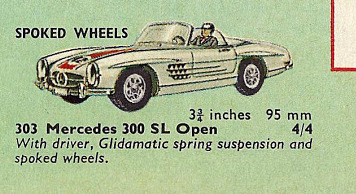
The Mercedes may look unexceptional at first glance but its free-spinning wheels caught my attention and it did, indeed, turn out to be one of the very first 303S models issued with suspension. The interior is the same as the 303 model - white with a black steering wheel. It was not long before this was replaced by a white model or silver plated with interiors in a different style.

This model fetches high prices when it does appear but mine is not in great condition, some corrosion having affected the top surfaces.


Here is something I had been looking for for years - a blue 300 Austin Healey. I had doubts about its existence for quite a while but eventually found evidence that it really had been made, with red seat inserts. This example had had a lot of extra paint applied by one of its past owners, presumably in an attempt to cover up chips and scratches. The colour used was not far off the original but it did look, on first glance, like someone might have started with a cream or red one and painted it blue. Looking underneath it is clear that it was originally blue and the base has never been removed so all is well. There is still work to do to remove some recent paint but that's a slow task.


The Bedford CA Van in Ambulance guise as 412 was a common little item with the split screen but this Mk II version was not referred to in the Great Book of Corgi or accompanying lists and so tends to be missed by people making lists based on that source. It is certainly not a common item and would not have had a long life. Indeed, it is likely that the 414 Military Ambulance would have been the intended 'replacement' and I don't think we'll find that many of these single screen 412s will be around.


It's not very scarce but I find it hard to resist nice examples of the 216 Austin A40 with shaped wheels. Such a pretty model.


This is scarce - the 324 Marcos 1800 with blue stripes is, I'm told the edition for export to Canada. We got green stripes. This is only the third I have encountered in many years. The first was, strangely, at a talk I gave to a Welsh Society meeting when someone in the audience who had worked with Messrs Marsh and Costin on the real cars took one out of his pocket, totally unaware of its value!


Lastly for now, it has taken a while to find this uncommon edition of a 214 Ford Thunderbird with shaped wheels. In reasonable condition, too, and this can only have been one of a very few late models made when this style of wheel was fitted just before the 214S replaced it.
 I am still looking for a decent 215 with shaped wheels. I have concluded that there will be none of the M models with them, but there is a slim chance of the two-tone issues of the Ford, Austin, Morris, Vauxhall, Rover and Hillman having them. I have the Standard and both Rileys with shaped wheels (the Standard, interestingly, also having a different red paint area!) and by the time the Jaguar was in production they were fairly common.

So it has been quite a month for the unusual!


Friday, 25 January 2019

Odd wheels and a chassis


January is not the most exciting month of the year but it has brought on to my desk some interesting items. I'll start with this lovely chassis, which is part of the export edition of the 464 Commer Police Van. Now, where will I ever find a Type II rear section in this colour? (It's the one with POLICE in the casting).


Next is this metallic turquoise-green Land Rover. This is the issue which, in this colour, already comes in all sorts of flavours, including shaped wheels, the normal type of cast spoke-effect wheels and Whizzwheels, hooks in tin and plastic, the plastic ones being grey or black and, if that's not enough variations for you, there are two types of interior as well! Now add this shiny, quite different design of cast wheel to the catalogue!

Below is the type of cast wheel that can be difficult to clean when it goes grey and is the type found across the range on many models.

I have seen the shinier, fatter rim type on the later blue and white horseboxes too, and may well have posted something about them a while ago.


Lastly, this 400 VW 1300 Driving School car has come in and has silver wheels. I am pretty sure that all the others I've seen have had distinctly gold wheels so this is a little unusual too.


This one is missing its stickers, which come in three flavours: British, French and German. They all have an L plate, though, so no translation issues there! I may have to acquire some stickers for the doors and it would be quite nice to have something different. I may even make some myself, now I think about it. There is no obvious steering wheel inside on these models so it is, I suppose, suitable for LHD or RHD.

One other odd thing about this one is that the tyres, now hard and seemingly original, are too big for the wheels, with quite a bit of play in the same plane as the wheel's diameter. I am wondering whether these silver wheels are smaller than the gold ones. Unfortunately I have sold the previous model I had so will have to get another to compare. One cannot tell from the photos, but here is the last one I had.


Saturday, 9 June 2018

Corgi wheel changes Pt 2: wire wheels and cast wheels


From early 1962 just about every model car had what I call normal wheels - shaped wheels that spin freely on their axles (and so were a lot easier to drive around corners than the fixed types). A recent article dealt with what had gone before; now I shall look at what follows these 'normal' wheels and how some models with a particular type may be quite scarce and so worth looking out for.

The first new type would be wire wheels, also referred to as spoked wheels. These did look very smart and first appeared in June 1964 on the Buick Riviera. In September that year the Competition version of the Jaguar E Type has them and then The Great Book of Corgi refers to them being fitted to the 303S and 304S in December 1964. 

It also said they were fitted to the 309 Aston Martin Competition model but I have to say that that remains the most elusive of all Corgis for me! I used to have doubts about the two Mercedes too and wondered whether this and the catalogue were actually referring to the cast spoke-effect wheels which both models did get. However, last year I did see a couple for sale which appeared to be genuine 303S and 304S models with wire wheels. Because they were still far too expensive for my budget, though, I made my own with the help of a colleague, as described in an article nearer the time.

Before seeing them I had assumed that the reference to the 'spoked' wheel referred to a cast wheel type that, whilst still not common, is rather easier to find than the wire wheel type. The cast wheel variety can, however, only have been around for a short time as the Mercedes' production is said to have ceased in 1965.

Wire wheels were then fitted to three existing models. These were:

310 Chevrolet Stingray November 1963

320 Ford Mustang March 1965
Ford Mustang Competition December 1965

The Chevrolet is quite easy to find with normal wheels, in its cerise shade at least, but the Mustangs are certainly scarce with normal wheels and this leads me to estimate that the wire wheel type would have been introduced around early 1966 on these.

Several other models were fitted with wire wheels but kept them throughout their production period and so don't get included in this investigation.

The next change was the introduction of a cast wheel with a louvre design which looked a little like spokes. Very few models had these cast wheels from the start. The Sun Rally Rover 2000 in February 1967, the 319 lotus Elan in June 1967 and a Renault 16 in February 1969 were, I think, the only ones with normal size wheels. The Lancia Fulvia Zagato Coupe, some Imps and Minis had some during this period with the smaller size.

Many models changed from normal wheels to cast wheels during production and these seem to have had cast wheels at a very early point, making the normal wheel versions quite scarce:

Chrysler Imperial August 1965

263 Rambler Marlin June 1966
Oldsmobile Toronado January 1967
You can see that the timing of fitting cast wheels in place of normal wheels is pretty random - the Chrysler Imperial stopped being made in 1967 but by far the majority available have cast wheels so they must have been fitted from early 1966. The Oldsmobile, however, didn't appear until 1967 and so the switch cannot have been before mid-1967 and, of course, the Golden Jacks version comes out in June 1968!

Those three, however, are certainly not easy to find these days and command quite a premium.

Not many models seem scarce with cast wheels. It seems that those that did get switched had a reasonably long period with them. Amongst the normal size wheels, the Mercedes 303S and 304S and the two Mustangs can only have had the cast wheels for a short period and are quite scarce. Another is the pale blue edition of the Buick Riviera. Most 245s that I have seen with cast wheels have been in the metallic blue shade, some gold but, to date, only one in pale blue. I did try to buy it but it was in an original Gift Set 31 and that sent the price sky high regardless of the Riviera wheels, unfortunately.

Amongst the smaller wheel size cars, the 333 Sun Rally Mini Cooper had quite a short lifespan and is hard to find with cast wheels which seem to have been fitted only very late in its production. Whilst all the metallic maroon 226 Minis had cast wheels, some blue models got them too. I suspect that all Type 2 blue Morris Mini-Minors should have cast wheels but we may find one with normal wheels. Similarly there can't be many Type 1 blue Morris Mini-Minors with cast wheels, although these were produced in pretty big quantities and so the date of switch in relation to the timing of the body type change is what will govern things - and on that matter I have no clue. 

Another model that one would have thought was bound to get them is the 508 Commer Holiday Camp Bus. Issued in July 1968 it was, admittedly, not around for long but the similar Samuelsons Film Service Van that came out a few months earlier gets both types, as does the revised 470 Jeep FC-150 that comes out a few months after. From what I can tell, though, the 508 stays in normal wheels throughout. I may be wrong. That's another I shall be looking out for. Just in case!

So, there are a few interesting models that could have had nice, short production periods with one or other type of wheel. Because of the lack of information about when changes may have occurred there may be others. You may know some - if so, do let me know.

Here is a chart of what I have found. As with the other one, it may be easier to view and move around in full size at this link.


Monday, 27 February 2017

The Mystery of The Wheels


The 1961 Corgi Toys Catalogue was the first to illustrate the Bentley Continental. This year was the start of all the exciting 'features' that were being incorporated in many new models. Corgi threw everything at the Bentley - as the catalogue text says: steering, jewelled head lights, ruby rear lights, opening boot, spare wheel, chrome plated radiator and bumpers, special hubs...

Special hubs? The illustration doesn't show anything different - they look like the flat wheels common at the time.


As we know the car appeared with all those lovely features except for the special hubs. It was the star of the show anyway so I, for one, didn't pay any more attention to the difference at the time. It had the shaped hubs but then so too did plenty of other models so I don't think this was the first time they'd been seen, nor would it have been the first with free spinning wheels. Or was it? Could it be that the first occasion when free spinning wheels were made available was, indeed, on the Bentley in April 1961?

We know that examples of most other models released before that could be found with shaped hubs but most were still fixed. Only a few, like the Aston Martin, Morris Mini Minor and Austin Seven would get free spinning wheels but they might well have been rather later than April 1961. We know that Corgi were playing with the idea of making the wheels spin independently at about this time as some 303S and 304S Mercedes re-issues with suspension had the old style flat wheels spinning freely so it is possible that this may have been what they meant when the catalogue was drafted.

Alternatively, there may have been a plan to create a wheel that more closely resembled the classy hubs of the real thing, perhaps with bright chrome. I have no idea. All we know for sure is that the Bentley was the only model ever produced with pale grey tyres!

There was another mystery in the 1963 catalogue, also repeated in The Great Book of Corgi: spoked wheels for the Mercedes 303s, 304S and Aston Martin 309.


The catalogue has quite clear pictures of what look like the spoked wheels used for the Buick Riviera, Chevrolet Sting Ray and others fitted to these models.


It would have been a popular move and one that made a great deal of sense as the spoked wheels were really nicely made and suited models so well. Existing wheels could have been used so there need have been no special new tooling or change in the production process other than adding a box of the spoked wheels to the selections for these lines.

What seems to have happened is that a cast wheel, with a spoke effect design (to be used across the range in years to come), was fitted to later editions of the two Mercedes models. These were discontinued soon afterwards so they're not at all common. The 218 yellow or red Aston Martins had had a crude spoke effect cast wheel only ever found on that model and it was also fixed the the axle and not at all attractive. That was discontinued in 1962, though, and mercifully we never saw those wheels again.

I have never seen any 309 Aston Martin, however, with anything other than free spinning, shaped wheels. I am surprised that they didn't fit the same cast, spoke effect wheels as they used for the Mercedes, especially as they presumably were planning these at the same time. If there ever were any Aston Martins with those cast wheels or spoked wheels then they must be seriously rare. It is not particularly difficult for someone with the right tools to switch the wheels so I am inclined to be a bit suspicious of any I did encounter anyway. But if someone would like to have a go I would love to see one!

Update 9/3/17:
I have just seen this on Ebay.


Interestingly, the seller has not shown the base which always makes me wonder, especially as this is a dealer who should know to include that. He's asking £250 which, if it's genuine, seems very reasonable. Unfortunately, I can't afford that. He has another in better condition but with the cast, spoke effect wheels, at £350. Something wrong there. It ought to be the other way round. Anyway, it looks like the Mercedes may exist.


Monday, 27 June 2016

Pony trailers and horse boxes

Life was fairly simple at the beginning when in early 1958 you could have bought just two types of the Rice's Pony Trailer - cream with red mudguards or red with black.


They will also have had fixed wheels and a piece of wire acting as the drawbar. These early models were drawn by a green Land Rover #406 with a tan tin rear cover. (That was also the only #406 with a rear cover).


In December 1962 the #438 Land Rover with suspension appears and early Gift Sets had a dark green one with a cream plastic cover pulling red pony trailers. These were replaced by a fawn brown pair, the pony trailer having silver mudguards and a solid silver drawbar. The trailer still did not have suspension but the wheels were now free spinning.


A new Gift Set comes out in time for Christmas 1968, a mere ten years after (no, not the band, they didn't hit the charts until 1970). This is Gift Set 15, designated Corgi Pony Club and has a new trailer, now described as Rice's Beaufort Double Horse Box. It's a splendid affair with two ramps, each with cork matting and the wider trailer has a clever partition that can be moved to ensure just one horse exits or enters at each side. This version also gets suspension.

The horse box is #112 and becomes available to buy in its own box in early 1969. These all seem to have had the attractive cast, spoke-effect wheels familiar to collectors at that time. The early Land Rovers, however, still had the normal wheels. I don't know when they got the cast type but the normal wheel are not that easy to find now so I suspect they were not around for long. All the blue Land Rovers with normal or cast wheels had grey plastic tow bars.

I have not yet seen or heard of the trailer with normal wheels and suspect that it does not exist with them


What did surprise me, though, when looking around, was the use of the eight-spoke wheels on some of these trailers! These also differed in having a black coupling. I have only ever seen red couplings on the others. Again, I have no idea when these were introduced. It is, I suppose, even feasible that they preceded the spoke effect ones as these eight spoke wheels look the same as those used on the 1967 Maserati #156 and also its replacement #159 which was also issued at the same time as the trailer.


Then, sometime from 1970 onwards, I cannot be sure when, Corgi fit Whizzwheels to both the Land Rover and the horse box, each retaining its catalogue number. The horse box loses suspension and the base has been slightly adjusted to ensure the thin axles stay in place. These last versions of the set are not very popular but are also not very common and have started to command quite high prices. I say 'last' versions as I am assuming that those other eight spoke wheels did, indeed, precede Whizzwheels

Although it is not clear from this photo, the trailer remains the same shade of blue as before but the Land Rover now comes in a distinctly darker shade with Whizzwheels and has a black plastic tow hook.

The two brown horses in the illustration above are probably not correct. I am pretty sure from looking at catalogues that it will have been the black horse and smaller white pony that occupied the Pony Club trailers. The #102 trailers always had a brown horse with a blue blanket on its back.


The blue 'Pony Club' Land Rover with normal wheels. I wonder if I'll ever find a trailer to match?