Showing posts with label blue. Show all posts

Sunday, 7 December 2025

Looking at Land Rovers again

I have written a great deal about Land Rovers but I decided to take a fresh look at what I had in various cupboards and boxes and to see whether I could make a better job of categorising the main #438 issue in deep green (shades).

I have found just three distinct models amongst my collection. That is, of course, not to say that there will be others but let's start with these for now. Please note that this is a major update of the original article and I have updated the references below for the types and some features since first publishing this. Apologies for having had to have several attempts at this but I believe I am now settled with the proposed types.

The principal distinguishing feature is:

the bars on the cab roof

I find three distinct types of cab roof bars

1 The three bars are of similar length and seem to be a separate plate

2 The bars are much shorter

3 The bars are full length and no evidence of a plate


The appearance of some form of 'plate' for the three bars varies quite a lot in the first two examples, sometime it is very obvious, like an additional piece of metal on top of the cab. In other examples it is much more flush with the cab roof surface and less visible. Nevertheless, the roof is quite different on the third variety with all three bars extending to the front and what seems like a different casting for the roof.

Within the first two type of roof I have found two types of rear window

the rear window

i frame within window

ii no frame


The window unit that shows the 'frame' is designed so that the rear cab window fits to give a flush finish at the back. The later style of unit is more simple and the window appears to be inset.

Because it is quite possible for some old window units to have been used at a later stage of production, I don't regard the window as a specific 'Type' but will refer to 1i and 1ii or 2i and 2ii in listings. As far as I can tell there is no 'frame' unit in any of the Type 3 or later models.

the vent leaver

For this particular group, I see just two styles of window lever.


i A small vertical edge lever

ii A larger triangle shape


All Type 1 and Type 2 models have the small vertical edge lever and Type 3 models have the triangle shape.

Later editions of the #438 will have a third variety - a much smaller triangle - but I have not seen this on the deep green Land Rovers. It appears to be standard from the metallic green turquoise models onwards, all the way through the Whizzwheels editions too, although I wonder that there may be some transition examples to seek.

the registration plate

Again, for this particular group I see two types of registration plate panel on the front wing.

i A small rectangular panel


ii A larger rectangular panel

As for the lever, there is a third variety of panel - a definite square shape - and this also seems standard for all later issues from metallic green-turquoise on.

All Types 1 and 2 appear to have the smaller rectangle and Type 3 have the larger rectangle. The more recent metallic turquoise and other later issues have a square plate.

the grille

i No gap between the grille and bonnet

ii A clear gap between the grille and bonnet

You will also note clear difference in the casting of the headlamps and badge.

All Type 1 and 2 appear to have clear lines around the headlamps and no gap, Types 3 having the  less well-defined lights and clear gap.

Below is a table summarising the three main types I have found amongst the blue-green models.


I have found only one example of Type 2i so far amongst green models. The others seem reasonably plentiful. I would be interested to know of how other collectors have found these types to be distributed as well, of course, of further varieties. I mention the possibility of a Type 4 below.

Needless to say, there will always be something different too - and here you can see a couple of 'outliers'!

The edition with red seats is quite uncommon but may appear throughout production - I even have Whizzwheels and Gift Set 19 models with red seats! So there is likely to be red seats in all types.

The distinctly blue-green model, however, is a bit unusual. At first I thought it was just another blue-green #438 but this one stands out and is quite different to all the others. It is not, unfortunately, though, RAF blue for the 351S! It is a Type 2 in the table above, with short bars and I am assuming it is just from a batch of production with a touch more blue in the paint mixture than usual. I would like to learn about any other instances of this quite distinct blue-green shade.

I had thought I might be able to distinguish a dark green and a deep green for this issue but I find so many shades in between that I have decided not to list them. (It is not as distinct as the two greens found on the #301 TR2 and #405 Bedford models).

Lastly on the subject of #438s for now, don't forget the 'farm green' issue from early Farming Gift Set 22 issues. This is a very distinct flavour of green, similar to the green shade used for the Gift Set 2  #406. In fact, I tend to refer to the 'farm green' model as a #406S but the number is hardly relevant as it was never issued individually anyway. With these being produced for a very short time in that colour, it is almost certain that they will all fall in Type 1 in the table above.

Looking at the other Land Rovers, I have found these:

GS17/19 red
Type 1i
Type 2ii

416S
Type 1i

GS2 fawn
Type 1ii
Type 2ii
Type 3

406S
Type 1i
These are interesting and, like the 'Farm green' issue from GS22, they all seem, at first glance to have no evidence of a plate for the bars and yet have all the Type 1 features, length of bars and also all I have seen have the frame in the rear window. 


On very close examination, though, I can see the Type 1 'plate' element but, being the very first castings of the Series II, it is not at all obvious and it must be only in later production that the plate becomes more prominent. So I shall list these as Type 1i too.


It does, therefore, seem that the Type 1 casting is the first for Series II Land Rovers, followed by Type 2 with a different plate for the bars, then Type 3 with a revision to the entire roof as well as several other elements and finally Type 4 has a very tiny triangle shape, very smooth roof edges and other differences and appears to be introduced with the advent of the metallic turquoise and blue GS15 editions. I am sure there will be transition models to look for but so far even the metallic turquoise and blue GS15 Land Rovers with shaped wheels and a tin hook, which I have seen, and which would be the very earliest, all have the small triangles. Perhaps the Type 4 was introduced during the life of the blue-green #438? Only time will tell.

While I had the floor and several other horizontal surfaces covered with Land Rovers this afternoon I also spotted something interesting about the blue Land Rovers issued either as Gift Set 15 with a double horsebox #112 or Gift Set 19 with an airplane on a trailer.


The shade of blue for the Pony Club Gift Set 15 model remained pretty consistent as a bright and cheerful shade of blue throughout all its years with normal shaped wheels, then cast wheels and on to Whizzwheels too. At the very end of production, however, it seems that the mixture gets changed to a moodier shade with more violet added - clearly quite different as you'll see above. I have only seen this shade on issues with the later style of interior, with its moulded steering wheel. I had thought, therefore, that perhaps this was the paint created for Gift Set 19 which came along towards the end of the life of Gift Set 15 with a model that I had from that set having the same shade.

Now, though, with everything displayed, I have seen that all the other Land Rovers I have with beacons from this set have a much different and darker metallic blue finish. They also have no spare wheel on the bonnet but that's another story entirely. Just as I was beginning to conclude that production must have started with the same shade as Gift Set 15 and then switched to the new darker blue and then ditching the spare wheel I find these two.


The red interior is the old style with a separate steering wheel but finished in what I'm assuming is the later shade of blue! I can only conclude that there was a day when the ladies at the factory ran out of solid yellow plastic interiors and found some old red thin plastic types lying around and fitted those instead for a batch.

Incidentally, you may just be able to make out that the windows on the lighter blue GS19 model are amber tinted, in the same shade as the beacon, which is also made of perspex, all quite different to the others that I have which have clear windows and a red, softer plastic beacon. I have yet to encounter another like this. The trailer for the plane was in the same lighter shade and examples of the Land Rover with the spare mounted on the bonnet are few and far between. I am actually of the view that none of the darker shades will have this feature but I have to research this a little longer. Again, let's see what collectors can add to the list!

Saturday, 15 November 2025

Blue Beauties


I had this selection of recent additions to my collection on the shelf next to where I write and it just occurred to me how lovely they are and, in particular, how I have liked blue editions of many in the range. I was going to write about some annoying careless packaging but instead decided to be more cheerful this morning and leave that until later.


The Oldsmobile Super 88 is a very plain Corgi. Nothing opens, no suitcases or jewelled lights and the huge white stripe always strikes me as odd but there is something about this model in this colour that makes it one of my favourites and I was so pleased to find this lovely example recently. The shade is typical mid 1960s and you can almost hear the Beach Boys record playing in the background.  The more common metallic shade seems quite boring in comparison.


Now you don't need me to remind you that the Jaguar Mk X can be found in a really large range of colours, including several variations of blue, from solid sky blue to what is often called 'kingfisher blue'. This deep metallic blue is one of the best I have had and even the paint around the headlamps has survived the last 60 years (and a trip from Germany where my friend Andi found it). 

As a child I had the rather unpleasant pale green version. All the first issues were either solid sky blue or that green but I can only imagine I didn't have any choice when I bought mine. I remember returning to the toy shop a couple of years later when working for a local farmer meant that I had some money to spend each week on Corgis. There on his counter was a metallic cerise Jaguar Mk X that he had been showing to someone else and it was such an improvement that it was the first 'duplicate' I acquired. It is only over the last ten years or so that I have realised just how many colours that were issued. If I had known I would have asked the shop owner to look out for this one, for sure.


Another model with a fair range of colours is the Ghia L6.4. My first one was a strange, darkish turquoise-blue shade with a red interior but the duplicate I acquired in sage green was my favourite at the time. I was particularly fond of the cream interior and delighted to find a more normal metallic blue version with that cream interior some 50 years later! Of course, I now appreciate that there are many shades of the metallic blue and the model I should have illustrated here is the one with matching door panels as opposed to the odd red ones in this example. They are original, though, but I have never seen red door panels in the sage green car. They do appear in some gold cars with cream interior. The few bronze editions that I have had have only had all cream interiors too.

This was the first Corgi to have opening everything and it was a delight to own and play with. I shall probably always have one of these to look at somewhere around me. People do buy them every time I advertise them and then I have to start looking for another but, luckily, they are a bit easier to find than the Jaguar!


The Oldsmobile Toronado was after my time, to coin a phrase, in that by 1967 I was listening to Radio London, collecting 7" singles and albums by the Byrds and The Mamas and The Papas, singing Monkees songs and writing poems to possible girlfriends. It was one of the first 'new' Corgis that I found when I started all this Corgi stuff in 2012 or thereabouts. Again, that lovely metallic blue finish and very bright and clean-looking, almost white, interior appealed to me. The opening twin headlights were nice, especially with the chromed finish and operated so much better than those on the Chevrolet Sting Ray of earlier times.

It didn't do much else than flash its headlamps and shine with all that glorious chrome (the chrome sills were great) but the design just works for me. 


For a long time I was confused by what appeared to be variations but eventually I realised that the #264 model in a box did not have a tow bar and those that did were from Gift Set 36 with a Glastron Speedboat. I did, however, much prefer the look of the early and quite scarce editions with normal wheels as opposed to the more common cast variety.

Whilst on the topic of attractive 'blue' Corgis, I have written before about how I searched for a metallic blue #230 for  while before appreciating that Corgi had revised the Mercedes 220SE as #253 without steering and modifications to the boot and pillars. I did love the steering on the #230 model and the black model is likely to rank in my all-time Top 20 but I do like the blue #253. It must be that cream interior again!


I cannot allow any text on this topic to be published without reference to what could be my favourite Corgi - the metallic blue Ford Mustang.


Here it has wire wheels as that was the first photo I found. I think the one with plain wheels may be the one that actually tops my own poll. I will have to write a note to myself not sell the next one I find in good condition! Maybe this article will do.

For now, though, I hope you will excuse my rambling about some not particularly different or hard to find models but, instead, remembering just how nice ordinary Corgis can be.


I am aware that I have not mentioned a whole host of other models in blue that may or may not deserve mention. These few just happened to be next to me.

Sunday, 1 September 2024

Metallic blue and metallic green

In a chat a couple of days ago a collector was interested in the metallic green and metallic blue colours that Corgi had used and reckoned that several models had the same colour. I have also wondered about this and thought the best thing to do would be to get out as many as I had lying around and take a closer look.

Let's start with the mid metallic green, first seen on the MGA, Rover 90 and Citroën, with the second issue of the Austin Cambridge possibly getting it as its second colour in the two-tone edition.


Whilst the MGA and Rover 90 are very much alike, the Citroën is a bit lighter and the Austin seems to have more blue in the mix. They are certainly all pretty close but I would say that only two have the same paint. Those two being produced at the same time encourages this view too. 


There are not many in the lighter metallic green shade. One I do not have to hand is the two-tone Ford Consul which has a similar shade as part of its finish. Of the others then the Renault and TR3 are so close I am inclined to say they're the same. Both the colours of the Thames and Bentley look very much the same too but, in my opinion, differ slightly from the others. The Minivan is an outsider here, being quite different.

Now for the blues.


I'll start with the light blue finishes and the Rover and Jaguar are close but not the same. The Buick is also different with a touch more green. The other Jaguar is out on its own with nothing like it!


Amongst the darker shades of metallic blue I had expected to see some matches but no two appear the same.


In the last group of mid metallic blue shades it is the same story. When you put one next to the other, no two match here either.

Now I do know that there are also many shades within the production period for some models, especially the Ghia, Jaguar 2.4 and Rolls-Royce in this group and for the Oldsmobile and Hillman Imp in the other group. In the light green section the Bentley and Thames each have quite broad shade ranges (especially in the pale colour). So it is quite possible that, had I used some other models, we might have found more matches or more differences. I am inclined, therefore to conclude that, apart from a few models where production took place at the same time, for the vast majority of Corgis issued, no particular policy of using the same colours applied. Particularly where the different production periods are separated by several years then any match would seem accidental if, indeed, there has been any. Paint of different quality and composition will age differently too so, with some of these that I have illustrated being more than 60 years old it is difficult to be certain about anything!

With the new Corgi Model Club issues, we get to see the design sheets which specify the colours they want the Chinese factory to use. I was going to say that that might give us a guide as and when they produce some items which might be in the same colour but, unless the Club had access to records which specified the original colour then they may well just be working from an old model themselves. So that might not be of any help either.

If anyone does know all about Corgi paint suppliers or specifications for old models then do get in touch. In the meantime if you have any other matches, tell us about them.

Friday, 2 September 2022

It's an ugly little car . . .

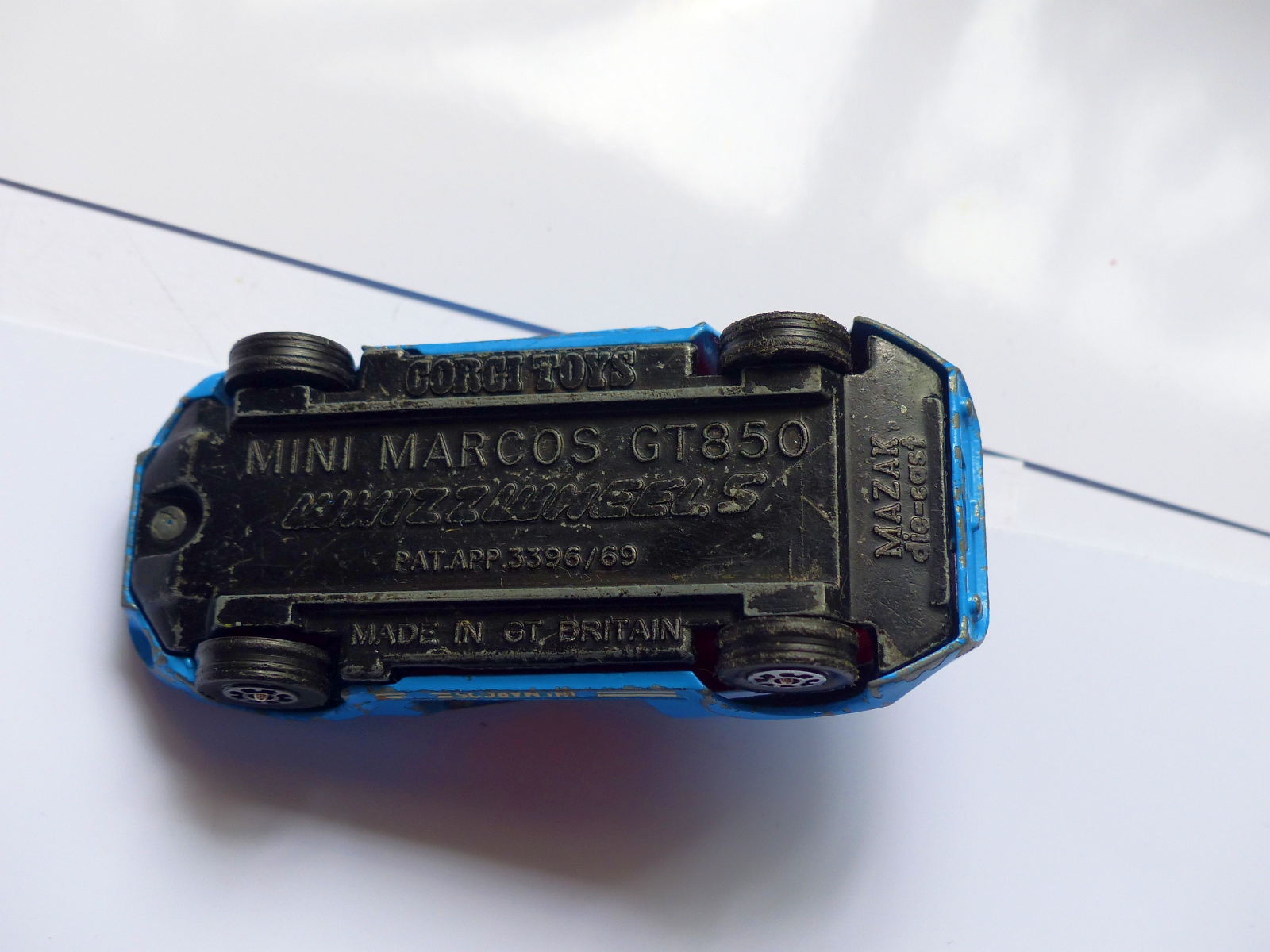
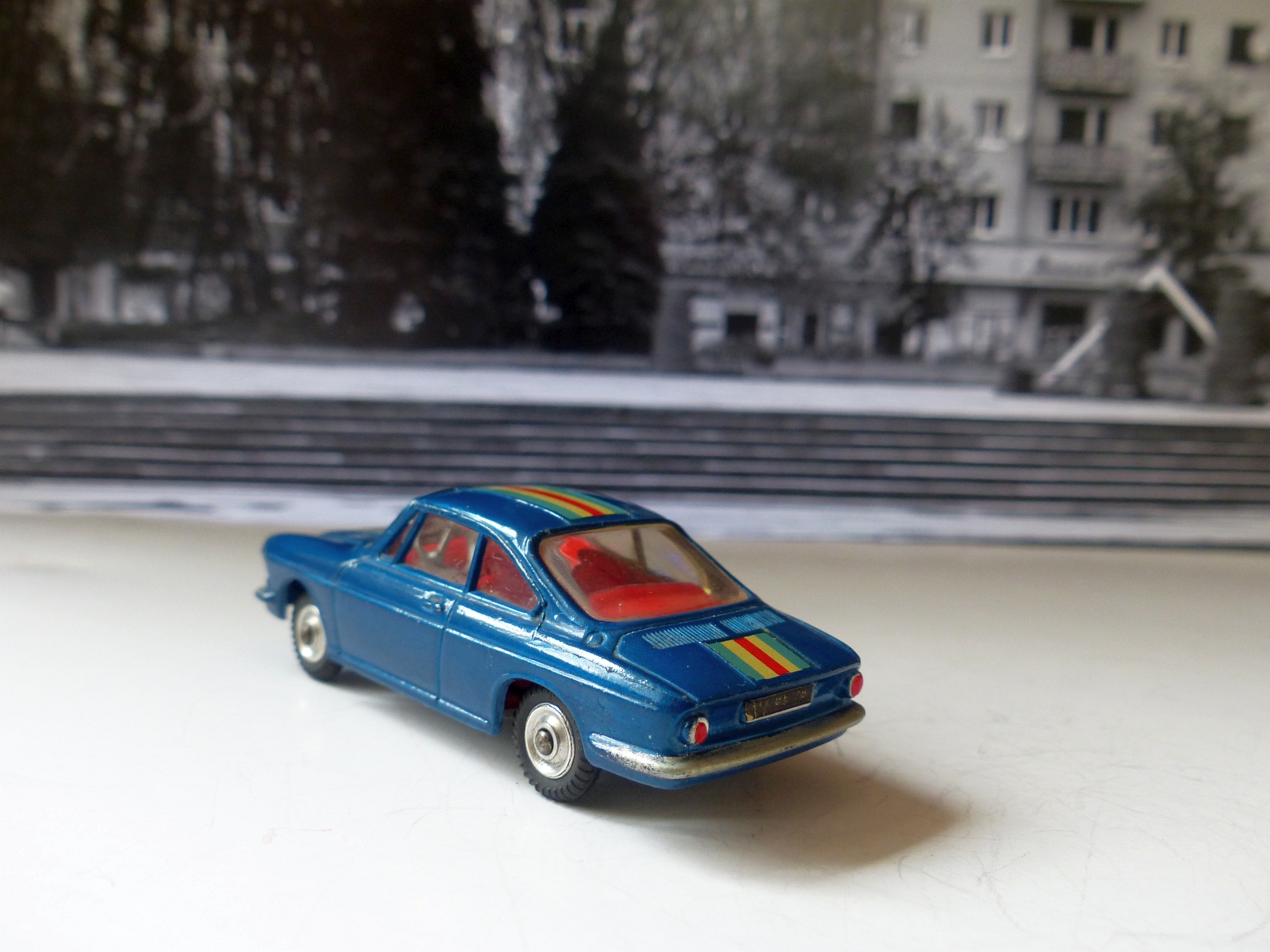
It's an ugly little car, in a fairly boring solid blue with Whizzwheels. But this is worth several hundred pounds. It's the scarcest Corgi from the era I collect which one could have bought in a local toy store. 


This one is nearly complete and all original. I say 'nearly', because the passenger seat is missing. That, however, is a simple fix and the interior is identical to the white issue so I just need to find a cheap one of those and swap the seat to this one.


This blue edition of the 305 Mini Marco GT850 was only issued with the Gift Set 20 Transporter Set and that had a very limited production run in 1972 with several changes in the components. I have no clue as to the number produced but after seven or eight years of fairly constant observation of what has appeared on Ebay this is only the second that I have seen that is definitely the real thing. The other I also own and wrote about in June last year - a bit of a wreck but a real one at least!


I had a pristine-looking example some years ago which looked very good but the shade wasn't quite right, there was no transfer on the sill and the rivet, while very well-made indeed, was a slightly different style to those shown on the few illustrations I was able to use to compare. It was a superb copy and someone in Japan liked it enough to pay £515 for, aware of my full description too. So I shudder to think what I might have to pay for anything like one in excellent condition and original.


This model would have been sold with the 1146 Scammel Tri-deck Transporter in late 1972. I have seen just one set sold and that was this one in less than perfect condition, costing over £1500 in 2014. Now I think the set would make over £2000 and the car on its own £1000 if not more.

Over the period since, only the 351S RAF Land Rover has been anything like as rare to see. Yes, there are models with even lower production numbers, like the special editions made for a particular firm's promotion and there will always be the minute numbers of models with errors and, of course, production samples. I suspect that models like the two-tone re-issues of the original range with shaped wheels (and some later models where just a few were issued with cast wheels, like the Rover 2000 and Hillman Imp) may prove to be at the very top of the Scarce Tree but this one is definitely up there and not far from the top. The other special issues, variations and errors are great and may be super scarce and much sought-after but I am referring here to models that you or I could have bought for simple pocket money at the time.


I shall list these models in my store but I would very much prefer to keep them in my own collection so the cost of persuading me to part company with either will not be cheap!


And yes, these really were most unattractive in 1:1 scale too!


Thursday, 24 June 2021

A real 305 Mini Marcos GT850 in blue.


I definitely have plenty to keep me occupied during quarantine after my return from Ukraine! This is the extremely rare Mini Marcos GT850 in blue. It was issued only in a few of the Gift Set 20 Transporter Sets and is just so hard to find.

Some years ago I did come across a seemingly immaculate model but it lacked the sill transfers and there was just something about the finish that made me suspicious. Now, for the first time, I am satisfied that I have an original 305 model in my hands. Indeed, it is the first I have encountered in any media, let along touching one! Someone contacted me about a very rough one some years ago but that was the closest I got until this week when this one arrived.


You'll see that this is not in great condition! But it could be worse and, posed at the right angle, it might not be immediately obvious that it has no windows, a missing door and one that doesn't close properly and a damaged bonnet! Oh, and missing headlamp covers.


It's real, though, and I am delighted to have this on my desk. Now I have to work out how to improve its appearance without taking it apart or causing more damage. The headlamp covers will be easy. I just need to buy any old wreck and swap them over. The windows I think I can repair, thanks to the missing door. Whilst I still cannot get the whole unit in as one piece, I can cut it and attach it to the roof inside so that the front is retained and also the rear and two side windows. That will make a big difference.

The existing door has a twisted hinge so it moves up as you close it. I shall try to straighten this but may leave that to last as it looks fine when left open as shown above. I have replacements for both doors and will see how I might be able to attach one on the other side. I doubt I will be able to make a permanent fix that still opens and closes but a door that fills the gap (and painted in the correct colour) will be a good thing to have.

The bonnet I have a replacement for as well. Again, I may not be able to fit a new one that still opens and closes easily. The existing one has a tear in the metal near one of the hinges at the front but it is, of course, painted the right colour and original and I am tempted just to keep it as it is as it does close almost in line satisfactorily.

First I shall attend to the windows and headlamps and then see how it looks with a silver door lodged in position. I may decide to leave it at that.

As for its value, that's a tough question and it really has to be very much down to what someone might pay once I have made it a little more presentable. As with several of the particularly scarce models that I have in my collection, I am in no hurry to sell this, nor will any price I do decide to quote be particularly attractive! This is something special, even in this state!


Thursday, 30 May 2019

Unusual arrivals this month Part 2!

May has certainly been a fascinating month for the items coming into the village. Today three more arrived and each is a little special! 

I'll start with the Riley Pathfinder. These are always wonderful models and this is the very rare 205M mechanical edition in red. 


I have had one for a while but it has lost a lot of its paint. This one is in very good condition but there is just one insurmountable problem! It didn't come with a rear axle! For the photos I dropped one in. Actually, I am somewhat heartened to find that the motor inside and the mechanism and base generally are pristine and barely used at all. I suspect the rear axle will have come off early in its life. If I can find another gear housing and axle (with crown gear affixed) then I think I should be able to make a decent repair of this. Normally the housing is attached by two long posts, sealed inside, but I am sure I can do something that will not look markedly different.

This will then, even as a repaired item, be worth a substantial sum.


The second item is this lovely little maroon 226 Morris Mini-Minor. Well, just as its maroon colleague, the Rover 2000, featured cast wheels yesterday this model reverses all that and, instead of what I thought all of them had, cast wheels, we have the earlier type.

I am really surprised to find this. I am not 100% convinced of its authenticity and that isn't just because it has come from Russia! Three wheels are marked - the rims dented or scratched in a way that you don't normally see on even much played-with models. One wheel also seems fixed to the axle too but I have not yet been able to ascertain whether it is some sort of glue or just corrosion.

The front axle seems fine, though and, unless it has been joined by a sleeve in the middle, I can't see how anyone could have simply replaced the wheels or, for that matter, why. I mean, I may find it intriguing but the seller did not receive any more for this than he would have done for a 'normal' maroon 226 with cast wheels.

So, I shall investigate this one a bit more closely. If it is original then it's the first one I have seen and won't be at all easy to find.


Lastly, my bank balance will be pleasantly enhanced should I ever find a buyer for this beautiful Simca 1000 in blue.


It is in A+ condition with no faults other than a small mark on the front bumper. Otherwise the paintwork is immaculate and the racing decals perfect. The windows are crystal clear and undamaged and this lacks only a box really. Serious collectors often have a space where this one should be and I sold a quite worn example with a cracked rear screen some time ago for about £150.

Although a blue 205M (not sure which blue) and a red and black 216M are on their way I think these will be in too good a condition for me to extract the bits I need. So I shall be looking around for a wrecked M model going cheap and, ideally, one with the right length back axle as well as a 315 box.


Wednesday, 29 May 2019

Unusual arrivals this month

From time to time I list some of the models that have arrived here in the village. Nowadays, having acquired most of the 'normal' models that I needed for the catalogue project, I tend only to buy items that are a little scarce and often more interesting.


The first is this lovely 252 Rover 2000 in maroon. Although I expect some reached shops in boxes, this colour was mostly only found in the Gift Set 41/48 with the 1138 edition Ford car Transporter. These were popular sets so the Rover in this colour is not particularly scarce but this is the first I have encountered with cast, spoke effect wheels.


This style of wheel was used across the range, including Land Rovers and commercial models, from around 1967 and the International Rally edition of the Rover issued in February 1967 only had the cast type of wheel. Most other models started with normal wheels and then had the cast type fitted at some later date which I've tended to regard as being around 1968 in most cases.

The make-up of the Transporter Set changed in early 1969 when a new Scammell cab was also issued. So there may have been a year when the cast wheels might have been fitted to this Rover but I suspect it will have been rather shorter a period, (simply based on my  never having seen any, which may, of course, be inaccurate!)


Next is the very scarce Citroen DS19 with fog lamps included in the casting (not jewels as in the Monte Carlo edition). This example had been sadly repainted and the base had been removed so there wasn't much I could do with it. I had intended to restore it but decided to stop at the shiny mazak stage which I feel is a nice way to display this unusual casting. 

I do have an issued and unadulterated red model with these lights too.


The Mercedes may look unexceptional at first glance but its free-spinning wheels caught my attention and it did, indeed, turn out to be one of the very first 303S models issued with suspension. The interior is the same as the 303 model - white with a black steering wheel. It was not long before this was replaced by a white model or silver plated with interiors in a different style.

This model fetches high prices when it does appear but mine is not in great condition, some corrosion having affected the top surfaces.


Here is something I had been looking for for years - a blue 300 Austin Healey. I had doubts about its existence for quite a while but eventually found evidence that it really had been made, with red seat inserts. This example had had a lot of extra paint applied by one of its past owners, presumably in an attempt to cover up chips and scratches. The colour used was not far off the original but it did look, on first glance, like someone might have started with a cream or red one and painted it blue. Looking underneath it is clear that it was originally blue and the base has never been removed so all is well. There is still work to do to remove some recent paint but that's a slow task.


The Bedford CA Van in Ambulance guise as 412 was a common little item with the split screen but this Mk II version was not referred to in the Great Book of Corgi or accompanying lists and so tends to be missed by people making lists based on that source. It is certainly not a common item and would not have had a long life. Indeed, it is likely that the 414 Military Ambulance would have been the intended 'replacement' and I don't think we'll find that many of these single screen 412s will be around.


It's not very scarce but I find it hard to resist nice examples of the 216 Austin A40 with shaped wheels. Such a pretty model.


This is scarce - the 324 Marcos 1800 with blue stripes is, I'm told the edition for export to Canada. We got green stripes. This is only the third I have encountered in many years. The first was, strangely, at a talk I gave to a Welsh Society meeting when someone in the audience who had worked with Messrs Marsh and Costin on the real cars took one out of his pocket, totally unaware of its value!


Lastly for now, it has taken a while to find this uncommon edition of a 214 Ford Thunderbird with shaped wheels. In reasonable condition, too, and this can only have been one of a very few late models made when this style of wheel was fitted just before the 214S replaced it.
 I am still looking for a decent 215 with shaped wheels. I have concluded that there will be none of the M models with them, but there is a slim chance of the two-tone issues of the Ford, Austin, Morris, Vauxhall, Rover and Hillman having them. I have the Standard and both Rileys with shaped wheels (the Standard, interestingly, also having a different red paint area!) and by the time the Jaguar was in production they were fairly common.

So it has been quite a month for the unusual!