Showing posts with label Rover 90. Show all posts

Wednesday, 11 January 2023

Rover 90. Surprisingly interesting.


My eleventh Rover 90 arrived today. I cannot resist these old models. They seem to be the least loved of the first 1956 launch group and the casting often seems flawed and was regarded as the worst of the group by Marcel Van Cleemput himself by all accounts. Nevertheless, I like this old thing. It may be because I had a Rover 100 myself many years ago when I was at St. Andrews University and regularly drove to Edinburgh and back, stopping to get out and knock the fuel pump with a screwdriver whenever it ceased working!


The 204 model seemed very uninteresting at first when I started this catalogue project and I really didn't pay much attention to it. I thought there was a lightish colour normal model, a green M edition and the two-tone one and that was it.

The story is, however, rather more fun. First the 204 comes in two main flavours: light grey and ivory. 


The two-tone is a quite stunning pale pink over metallic crimson.
The 204M models appear at first to have two finishes: a metallic bluish green and a solid dark green.


Then along comes a distinctly different solid bright green!


These two shades of green remind me of the two shades that seem to exist for the 301 Triumph TR2 and 405 Bedford CA Fire Tender. I am beginning to wonder, too, whether I need to take another look at my 406 Land Rovers from Gift Set 2 now!

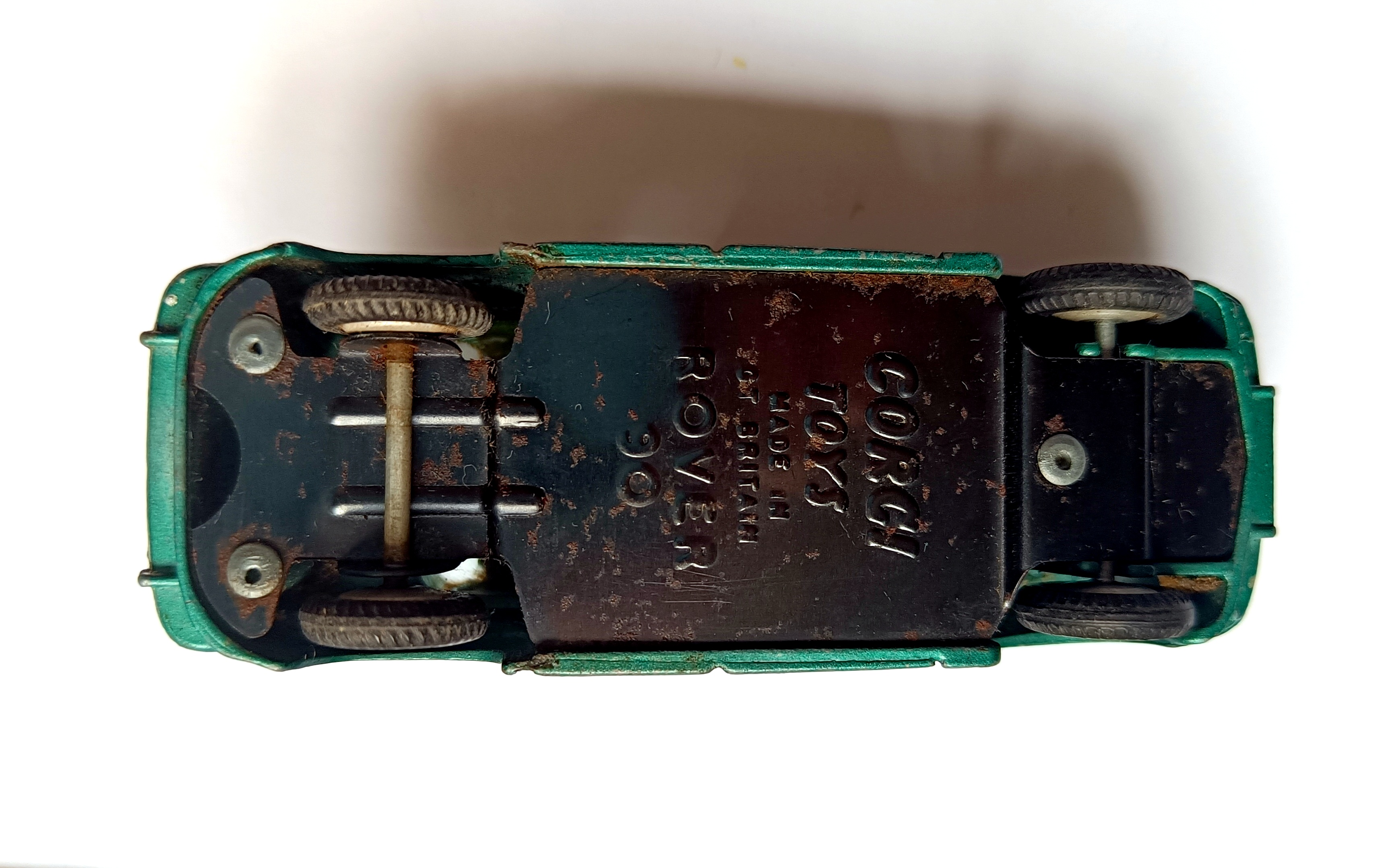
Actually, now I look again at this photo from above that I took this morning, I can see three shades of the solid green. I had placed the one with worn paint next to what I'd thought was a dark one, thinking it was the same shade but it is neither the same as the 'dark green' nor the 'bright green'! I guess I shall have to call it 'rich bright green' and add this to the catalogue. From what I can tell (apart from the new discovery) the colours are fairly evenly distributed with, in my experience, none seeming significantly scarcer than the other.


What is decidedly scarce is this one shown below. It is a non-mechanical 204 but finished in the 204M metallic bluish green. These - and you'll find similar delights across the early range - resulted from one of two things: either by simple mistake, attaching a 204 base to a 204M body or as a way to use up 204M bodies that had been painted shortly prior to the production of friction motor models being abandoned.
Finally, for now, there is yet another variation to look out for and that is on the base. There are two types. One, which I call Type A as I think it is the earliest, has British and Made placed either side of Corgi Toys. The other, Type B, has Patent and Pending in those positions and a revised text on the front axle. As what I call Type B has blanking plates it would appear that that is the one that has been revised and hence would be the later but I am only taking a guess.
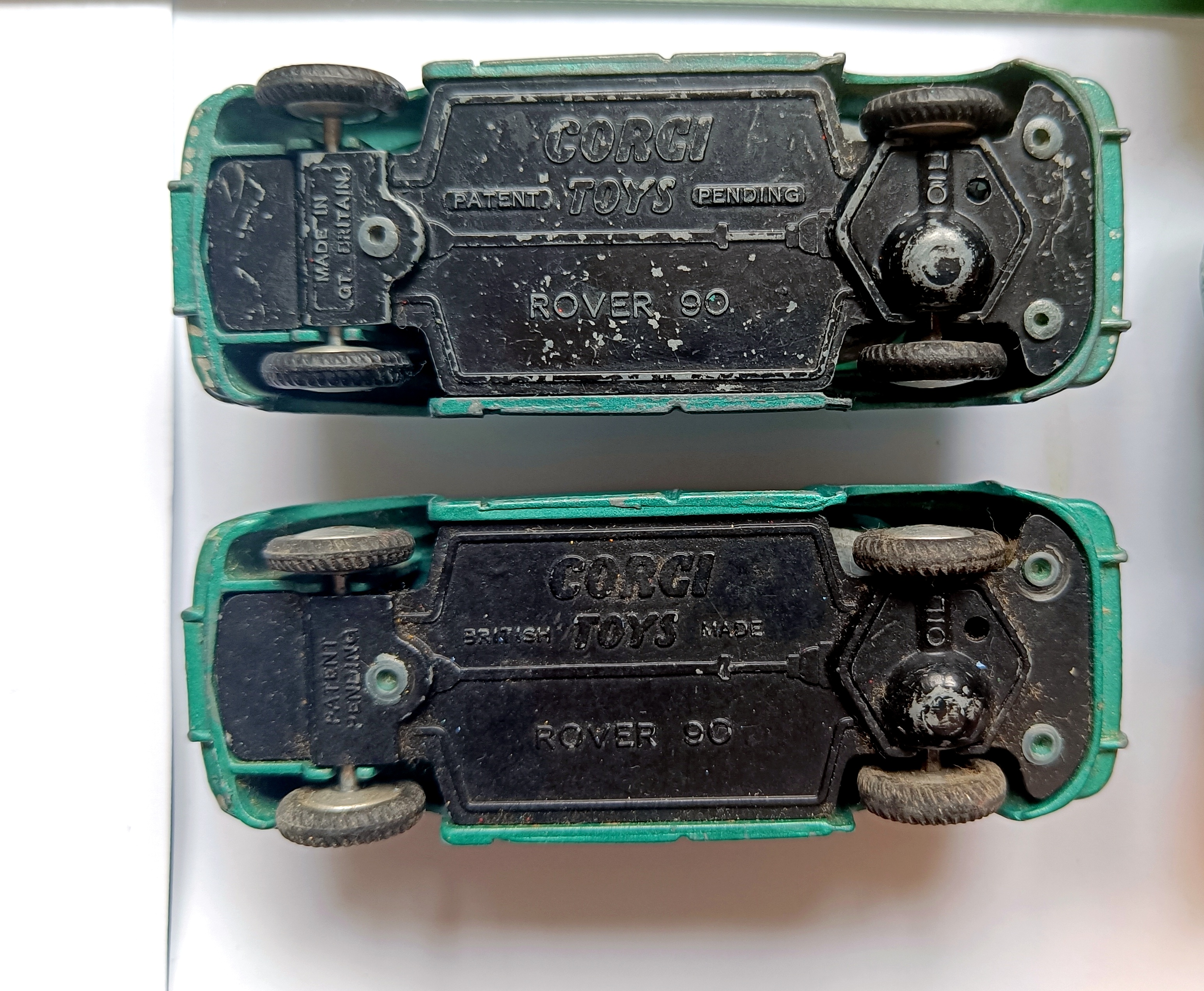

Other early issues have a similar set of Type A/B bases, complicated by some with a grey base too! I will take a look at these as my next job but I don't have that many examples to work with so any help would be appreciated if you could have a look at yours.


Thursday, 7 February 2019

Corgi Toys @ 60: Two tone and Bloodhound missiles

It would be the case that early 1959 issues were destined to have short lives. All those issued in January and these, issued in February, were withdrawn in less than two years. 

Firstly, the Powers That Be decided that interest in their original launch models could be revived and sales extended a little further if they were given a new 'two-tone' look. Whereas the original issues can be found in a range of colours, these six appeared in just these colours. 

You'll see that some of the paint schemes are more accurate than others!


February 1959 also saw changes to the Bedford CA model, the later single screen casting being used now with its revised front end and minor changes elsewhere, as well as a ribbed roof. The first issued model to get this mark II treatment was the 404 Dormobile. It can be found with a 50-50 scheme as well as a blue body and yellow roof. Each of those variations is scarce and good examples usually cost a fortune.


The Riley is conspicuous by its absence and would have been a lovely model in two-tone. I guess that the red 205, which lasted longer than most of these original issues, was selling well enough. The Standard Vanguard III had, of course, already got the two-tone treatment.

The other issue this month is a reappearance of the splendidly detailed and quite impressive Bloodhound missile, mounted on a khaki trolley. Some nice engineering clasps the missile nose and can be used to raise it whilst maintaining its horizontal aspect. Both items were included in Gift Set 4 and will be in Gift Set 6 later in the year, as well as being issued individually some time later.


It is an odd combination when towed by the RAF Land Rover, with which it is coupled in each Gift Set. The missile seems always to be white and the detachable side elements yellow. I have seen the rocket ends in red or just silver and the vanes or wings can be white but seems usually to be yellow.


Thursday, 24 July 2014

M for Mechanical


I don't think the Rover 90 was the most popular of the 1956 range of first Corgi Toys and this example in utilitarian green with a 'Mechanical' motor was even less so. It was not something I remember anyone having or remarking that they really must get one.


Whilst the side profile looks right the front certainly isn't! That may have had something to do with the poor sales too. I had a very similar Rover 100 in 1972 that was a 1958 model - the side lights are in a different position and mine didn't have the 'Cyclops' lamp in the grill but the model still has something wrong about it.


These very early Corgis look a bit boring with their dull colours and lack of features. A Ford Consul,  Vauxhall Velox, Austin Cambridge and Standard Vanguard weren't the most desirable of motors either but the Riley Pathfinder was super and made up for the common others.


The Vauxhall is a lot brighter in a brave red colour. All these models illustrated are the rare 'Mechanical' versions and the motors still just work if you're careful. At not far off 60 years old now they have survived well and it would be a sin to do anything other than keep them clean from here on. There are one or two nice looking versions available but most are fetching terribly high prices. I am happy to get an original model with a bit of paint and with windows and wheels intact.

According to some lists I have prepared, the Austin Cambridge with a Mechanical motor has one of the lowest sales figures of all Corgi models at a very precise 10202. That may be a misprint as the others are all in the 100000 region and I can't see any reason why that one should be so much less. The prices, while high, are not significantly different either, varying more with condition than model.


The top one is #201M and in pretty poor condition, mostly due to the windows being badly scarred. The bottom one has much better perspex and a bit more paint but is just a #201.


Here's #206M, a Hillman Husky which looks as if it ought to be a hatchback but wasn't. It's a short Hillman Minx and you do have to wonder why on Earth anyone would buy a Husky when they could have a Minx. Maybe there was a big price difference, although there wouldn't be much justification as each had the same engines and most of the insides were shared.


I have featured #208M, the Jaguar 2.4 S Type before. It is a strange-looking model in most colours but works well in blue and this one is in jolly good condition. 

There is a Ford Consul 200M, a Morris Cowley #202M, a #207M Standard Vanguard and a #216M Autin A40 needed to complete the British saloons. They are not easy to track down unless you want to pay several hundred pounds. Oddly, the pristine, shiny and carefully photographed standing on a box examples that I've seen do little for me at all and I certainly am not inclined to fork out a month's rent on any of them. They just look too bright and it's almost as if I have to have a dull, used-looking one for some reason - and not just price. Those MIB affairs are anaemic and devoid of character in a way that I don't feel applies to later models. A mint #210 Citroen DS19, for instance, from 1957 would be great to have. Perhaps it's the colours they produced the others in that look so strange when so clean. I don't know, but I am sure I'll get over it and and if a shiny new pale green and red Standard Vanguard comes along I won't turn it away!

Two American cars joined the M range for a brief period - the Studebaker Golden Hawk #211M and #214M Ford Thunderbird - and I'm searching for examples of these.

Completing the M range were three Bedford vans, a KLG Plugs advertising one, a Personnel Carrier and a Fire Department van. I have the first but the other two are on my search list. They are really not the most attractive of models but their scarcity makes them quite desirable!